I. INTRODUCTION
In recent years, there has been a growing public interest in animal welfare in Australia (De Witte, K., 2009). Consumers expect continual and comprehensive improvements in poultry production (Li, Ren, Li, & Zeng, 2020). The health and product quality of poultry also is linked to their welfare. Healthy hens with better emotions tend to lay more eggs of higher quality (Eggs, 2023). The assessment of the welfare of poultry commonly complies with the Welfare Quality Assessment Protocol, which is a standardized method based on four main principles: good feeding, good housing, good health, and appropriate behaviour. These principles are highly correlated with the daily activities exhibited by animals. Therefore, one of the central features of welfare assessment is the emphasis on behaviour-based evaluations (De Jong et al., 2016).
Precision Livestock Farming (PLF) is a method that integrates sensors, automation, and data analysis to streamline and enhance livestock management. It facilitates real-time tracking of each animal, offering insights into individual bird’s health, behaviour, and performance (Schillings, Bennett, & Rose, 2021). The goal of implementing PLF is to offer precise early warnings, enabling farmers to take timely actions during the initial stages of issues. It is necessary to monitor individual animals for PLF to provide truly effective early warning capability. Observing individual behaviours also informs management on the health, welfare, and production of each animal, which further enhances the accuracy of welfare assessments (Li et al., 2020).
Conventional individual identification and behaviour analysis typically rely on a radiofrequency identification (RFID) system. For example, to observe the range of laying hens, individual chickens are fitted with a silicone leg band, embedded with a unique ID microchip, to allow monitoring of activity patterns and duration (Larsen, H. et al., 2017). The benefit of applying RFID chips is they can provide individual animal data rather than the flock's behaviours. However, the RFID-based approach is intrusive because the attachment of RFID chips requires catching the birds and putting them on. Also, the leg band is only available for adult birds but not the very small ones, which restricts the age for monitoring. Thus, the data collected via RFID chips can only provide limited information for welfare analysis.
In this research, we introduce a novel approach based on machine learning and computer vision to automatically monitor and analyse the behaviour patterns of laying hens, focusing on eating, drinking and fast moving. In our prior work, we evaluated various trackingby-detection methods to trace the trajectories of sheep simultaneously (Xu et al., 2020). However, compared to larger farmed mammals, commercial laying hens are both smaller in size and more densely populated, which can diminish the effectiveness of tracking systems. This research aimed to build algorithms that track chickens robustly in high-density and occlusion scenarios.
II. METHOD
We designed the monitoring system by mounting several video cameras in the top-down view to observe bird activity in the shed. The system tracks all the visible birds within the covered area using the multi-object detection technique. Specifically, it automatically identifies and tracks each laying hen within a continuous video sequence, so the birds’ motions (such as wing flapping and running) and activities (such as eating and drinking) are recorded. To effectively record each bird’s motion or activity, the system needs to track the individuals in the whole visible period, i.e., arriving and leaving the observation area, based on the visual appearance. Visual tracking is a challenging problem due to several factors such as occlusion, optical deformation, and illumination changes.
Tracking-by-detection involves first detecting each bird within the video frame sequences using an object detection algorithm. Then, a tracking algorithm is used to link the individual bird detections across frames, thereby tracing each bird’s trajectory. The Simple Online and Real-time Tracking (SORT)* algorithm is a commonly used tracking algorithm that can be used with a tracking-by-detection approach. SORT uses a Kalman filter to predict the object's location in the next frame and associates the detection with the predicted location using the intersection over union (IoU) metric. SORT then updates the Kalman filter's state using the associated detection and repeats the process for the next frame.
Visual tracking based on object detection and SORT is an effective approach that can be used across a variety of applications, such as robotics and self-driving cars (Li, R. et al., 2021). However, in a crowded visual environment, it is highly reliant on an accurate detection algorithm and is vulnerable to occlusion and deformation. Without accurate detection, there can be mistracking of individuals in the fixed observation area, i.e., many birds are re-allocated as new instances. To overcome the difficulties, DeepSORT (Wojke et al., 2017), an extension of SORT, uses a pre-trained model to extract the appearance features from detections, which are then used to compute the similarity score between the detections and existing tracks. However, DeepSORT has high computational complexity, which does not suit most real-time tracking and data recording applications. Since the individual bird tracking is based on the object detection technique, the detection confidence score (i.e., the current bounding box contains an identified real object with known accuracy), plays a key role in ensuring the correct positioning of the object to be tracked. Applying the two methods, objects with low detection scores are discarded, which brings the mis-tracking and fragmented trajectories. In this work, we instead use ByteTrack (Zhang et al., 2022), which implements the tracking by associating all detection bounding boxes instead of only the high-score ones. In the shed of laying hens on commercial egg farms visibility conditions are negatively impacted by illumination and occlusion. The (low) illumination issue is mainly caused by dust, while occlusion is mostly caused by birds crowding together and being covered by other birds and other objects (e.g., feeders). Consequently, when the birds are mis-detected due to the low scores, they are very likely to be lost in tracking. For the low-score bounding boxes, ByteTrack utilizes their similarities with ‘tracklets’ to recover true objects and filter out the background detections.
We implemented the system by deploying the bird detection and tracking system in the shed on a commercial egg farm in Wilberforce, NSW. We used 4 AXIS network cameras connected by PoE ports to a laptop. The object detection model was built with human-annotated instances. For data annotation, 140 frames were densely annotated with bounding boxes and activity labels for 16,991 bird instances engaged in eating, drinking, and other activities. These activities are directly observable by human vision. For example, when a bird’s beak is touching the water tap, it is considered drinking. The detection model was trained using these annotated frames, achieving an average precision of 86.3% in identifying birds and activities. Equipped with the ByteTrack algorithm, the system has been running continuously for up to 9 weeks. Video data was exported for analysis as log files, which included the bird ID, time, location, and activity (eating, drinking and other activities).
III. RESULTS
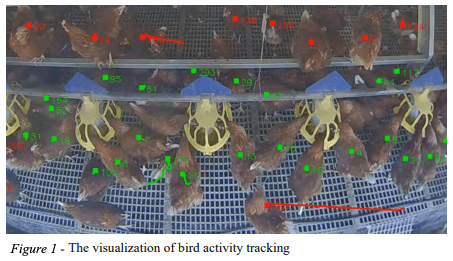
Based on the detection and tracking model, we conducted a case study for bird activity recording and pattern analysis. The tracking visualization is illustrated in Figure 1, where we use a number to uniquely identify a laying hen, and the trajectories represent their movements. Each green or red dot indicates that the bird is eating or not eating at the time. Performance evaluation involved deploying the tracking model on pre-recorded videos and onsite cameras. Under such settings, the miss-tracking rate is 0.0127/second, i.e., within every second, about 1.27% of instances are lost by the trackers due to illumination, crowdedness, occlusion, and other factors. This means there are sufficient birds suitable tracked and monitored for any correlated association with welfare issues to be identified, such as illumination and humidity. The system demonstrated satisfactory robustness and stability, with visualizations depicting detected bird instances and their activities.
IV. DISCUSSION AND CONCLUSION
We have demonstrated a practical application of advanced computer vision and video techniques for bird tracking. Our system monitors individual bird movements and activities on commercial egg farms using a low-cost and robust setup because the cost of video cameras and a desktop is far less expensive than hiring an expert for continuous monitoring. The system is suited to the automated monitoring of laying hens, which has applications for identifying a wide range of health, welfare and production risks using digital signals, statistical methods and correlation analysis. This data is available for further analysis, such as examining animal welfare status and impacts. The potential welfare issues reflected in bird tracking may be management (e.g., shed inspections) or environmental factors (e.g., humidity and temperature). This demonstrates that bird tracking using automated video camera monitoring has great potential to help improve animal welfare on large-scale commercial egg farms. Based on the feasibility of the current tracking method, the system considers temporal and spatial dependency, e.g., what activities are happening where and when — and what environmental, management or climatic changes are related to these changes, to motivate the research of animal science and contribute to welfare improvement.
ACKNOWLEDGEMENT: The authors are grateful to Australian Eggs for their financial support of this study.
Presented at the 35th Annual Australian Poultry Science Symposium 2024. For information on the latest and future editions, click here.