I. INTRODUCTION
The prices of pullets in Germany have risen significantly compared to previous years, largely due to the ban on killing male chicks and the associated more cost-intensive alternatives of rearing male chicks or sexing the egg. High feed prices, as well as significantly higher labour and energy costs, are factored into this. Other European Union countries will probably follow the same approach in the near future. Therefore, it is increasingly in the interest of laying hen farmers to extend the laying period, or to be able to use the hens in a second laying period through an induced moult. Since an extended laying period is also accompanied by a decrease in performance and fitness and thus may seem less economically attractive to the farmer, hens are even more dependent on optimal flock and feeding management at the end of the laying period than before.
OEO is known for its strong antimicrobial, antiparasitic, anti-inflammatory and antioxidant properties (LEYVA-LÓPEZ et al. 2017), and thus can contribute greatly to increasing gut health, immune function and performance of laying hens. The aim of this study was to investigate the influence of OEO on the biological performance and productivity of laying hens at the end of the laying period.
II. METHOD
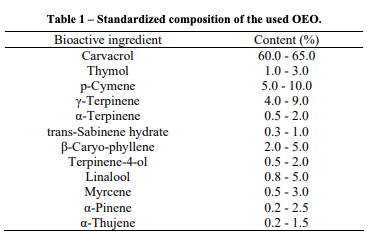
The influence of 22.5 g OEO per tonne of feed (DOSTO® Powder, Dostofarm GmbH, Germany) on biological performance, egg quality and productivity of laying hens was investigated at a federal Experimental and Educational Center for Poultry in Germany. For the feeding trial, 392 hybrid hens (Lohmann Brown-Classic) were divided into two experimental groups at 21 weeks of life. The laying hens were kept in floor housing (8 hens per m²) in a total of 14 pens with 28 birds each. From 57 to 72 weeks of life, the two groups were fed a laying hen complete feed (17% CP, 11.4 MJ/kg ME and 3.8% calcium) with or without OEO supplementation. The standardized composition of the OEO is shown in Table 1. The number of produced eggs was recorded daily, average egg weights were determined weekly from the two-day production of individual pens. Those eggs were sorted according to weight classes (S, M, L, XL) for marketable eggs and separated from dirty eggs and cracked eggs. The feed consumption of the hens of each group was determined every 28 days by weighing of added feed and feed residuals. Deaths were documented daily per feeding variant. After the feeding period, the income over feed cost (IOFC) was calculated as follows: Egg revenue - feed cost (number of eggs of the respective weight class x price of the weight class - feed price (€/kg) x feed consumption per housed hen (kg)).
For data collection and preparation, Microsoft Excel® (version 2011, Microsoft Corporation, Redmond/USA) was used. The collected performance parameters were analyzed by one-factorial variance analysis with the fixed effect feeding variant by using the statistical program SAS. The statistical significance level was set at P ≤ 0.05.
III. RESULTS
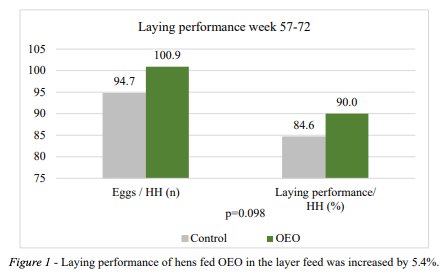
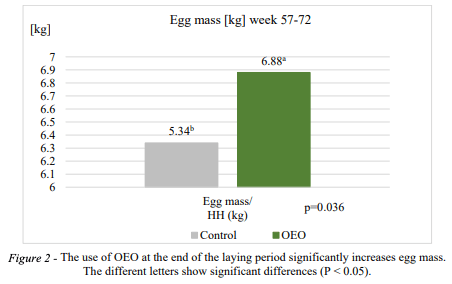
The addition of OEO to the feed of laying hens during the last 16 weeks of the laying period increased the number of eggs per housed hen (HH) and thus overall laying performance with a trend towards significance (P = 0.098). While in the control group the laying rate per HH averaged 84.6% from 57 to 72 weeks of life, the OEO inclusion resulted in an average laying rate of 90% (Fig. 1). Moreover, a significant increase in egg mass (P < 0.05) was observed by the addition of OEO in laying hen feed (Fig. 2).
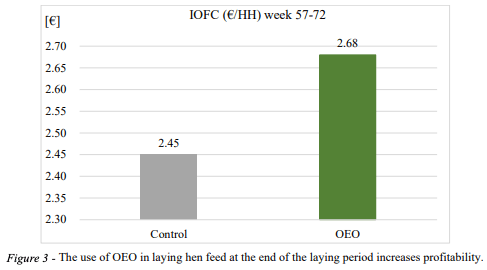
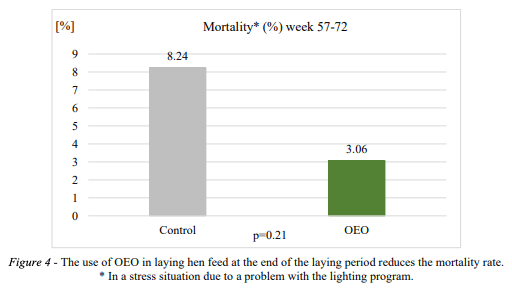
The present study showed that supplementation with OEO increases the performance and egg mass of laying hens, which is associated with economic benefits. The calculation of the "income over feed costs" (IOFC) included feed costs, egg class distribution and their individual producer prices, and feed intake data. The addition of OEO resulted in a 0.23 EURO higher income per HH after deduction of feed costs (Fig. 3). In addition, there was a numerical decrease in the mortality rate from 8.24% in the control to 3.06% in the OEO supplemented group during the period from 57 to 72 weeks of life (Fig. 4); however without statistical significance below P ≤ 0.05.
IV. DISCUSSION
The findings confirm positive results from a previous study, adding the same natural OEO to laying hens diets. The trial demonstrated significant improvements in feed conversion rate and eggshell thickness when feed was supplemented with OEO from week 60 to 72 of life. These improvements could be attributed to a higher chymotrypsin and lipase activity (P < 0.05) in the ileum and consequently an improved fat and protein digestibility (Feng et al, 2021). He et al (2017) showed that laying performance, average egg weight, feed conversion and likewise amylase and trypsin activities were significantly improved (P < 0.01) by the addition of 100 g OEO/t laying hen feed (He et al., 2017). Increased enzyme activity in the gut allows fats and proteins from the feed to be used more efficiently for egg mass production, which can result in improved feed efficiency, performance and associated economic benefits for the farmer (Reshadi et al., 2020).
Presented at the 35th Annual Australian Poultry Science Symposium 2024. For information on the latest and future editions, click here.