Egg producer perception of floor egg problems: contributing factors
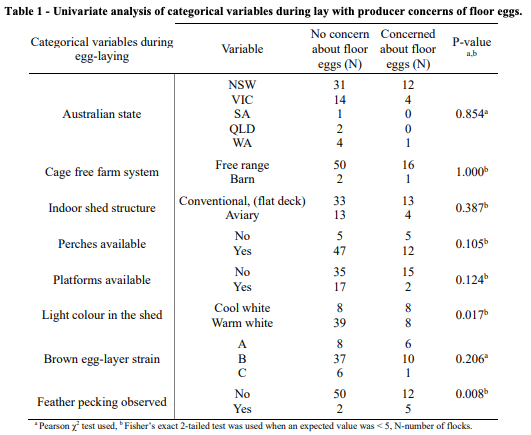
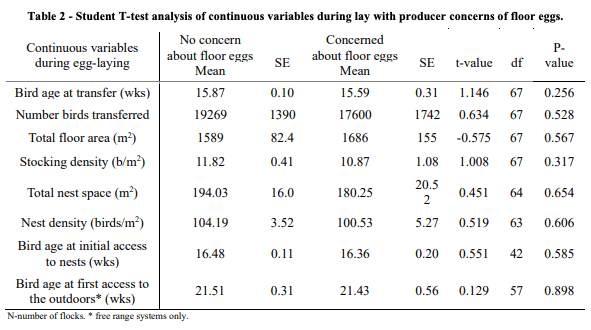
A survey was undertaken to garner some initial information about factors that may contribute to floor eggs within Australian cage-free egg production systems. For each of 69 egg-laying flocks, the percentage of floor eggs and the producer’s perspective as to whether that level of floor eggs was of concern, were recorded. Categorical and continuous variables about the farm, flock and housing environment were recorded during the laying phase of each flock. The impact of each variable in the context of the producer’s perspective of the level of floor eggs being of concern, was analysed. The percentage of floor eggs ranged from 1-28%, with levels of 1-3 % for the producers not concerned with floor eggs and 2-28% for producers concerned about floor eggs. The inclusion of 2-3% floor eggs for producers both concerned and not concerned with floor eggs illustrates the different perspective of this issue amongst producers. No continuous variables were significantly associated with producer’s concern with floor eggs; however, the categorical variables of cool white lighting and feather pecking were associated with floor eggs of concern to producers. The findings of this survey were valuable as few studies have explored these production variables with the incidence of floor eggs. They will also contribute to the development of a future survey designed to specifically identify key factors associated with floor eggs in Australian cage-free systems.
I. INTRODUCTION
II. MATERIALS AND METHODS
III. RESULTS AND DISCUSSION
Appleby, M. C. (1984). World’s Poultry Science Journal, 40, 241–249.
Australian Eggs. (2022). Australian Eggs Annual Report.
Australian Eggs. (2023). Egg types and labels. https://www.australianeggs.org.au/farming/egg-types-and-labels.
Bécot, L., Bèdèrt, N., Coton, J., Burlot, T., & Le Roy. (2023). Genetics Selection Evolution, 55, 1–10.
Campbell, D. (2023). Journal of Applied Poultry Research. (Submitted manuscript).
Department of Agriculture, Fisheries and Forestry. (2022). Australian Animal Welfare Standards and Guidelines for Poultry. https://www.agriculture.gov.au/agriculture-land/animal/welfare/standardsguidelines/poultry.
Edwards, L. E., & Hemsworth, P. H. (2021). Animal Production Science, 61, 944–967.
Gunnarsson, S., Keeling, L. J., & Svedberg, J. (1999). British Poultry Science, 40, 12–18.
Lay, D. C., Jr., Fulton, R. M., Hester, P. Y., Karcher, D. M., Kjaer, J. B., Mench, J. A., Mullens, B. A., Newberry, R. C., Nicol, C. J., O’Sullivan, N. P., & Porter, R. E. (2011). Poultry Science, 90, 278–294.
O’Flaherty, E. (2019). Contributing Factors to Floor Egg Issues in Layer Hens. Nuffield Australia. https://www.nuffieldscholar.org/sites/default/files/reports/2018_AU_EmmaOflaherty_Contributing-Factors-To-Floor-Egg-Issues.pdf.
Pillan, G., Xiccato, G., Ciarelli, C., Bordignon, F., Concollato, A., Pascual, A., Birolo, M., Pirrone, F., Sirri, F., Averós, X., Estevez, I., & Trocino, A. (2023). Poultry Science, 102, 102542.
Williams, L. (2021). Understanding nesting behavior: Managing for fewer floor eggs in layers. The Poultry Site. https://www.thepoultrysite.com/articles/understinding-nesting-behaviormanaging-for-fewer-floor-eggs-in-layers.




















United States