How to Plan Equipment for a Commercial Layer Poultry Farm: 7 Key Factors to Consider
Published: September 11, 2026
Source : Meng Jiang
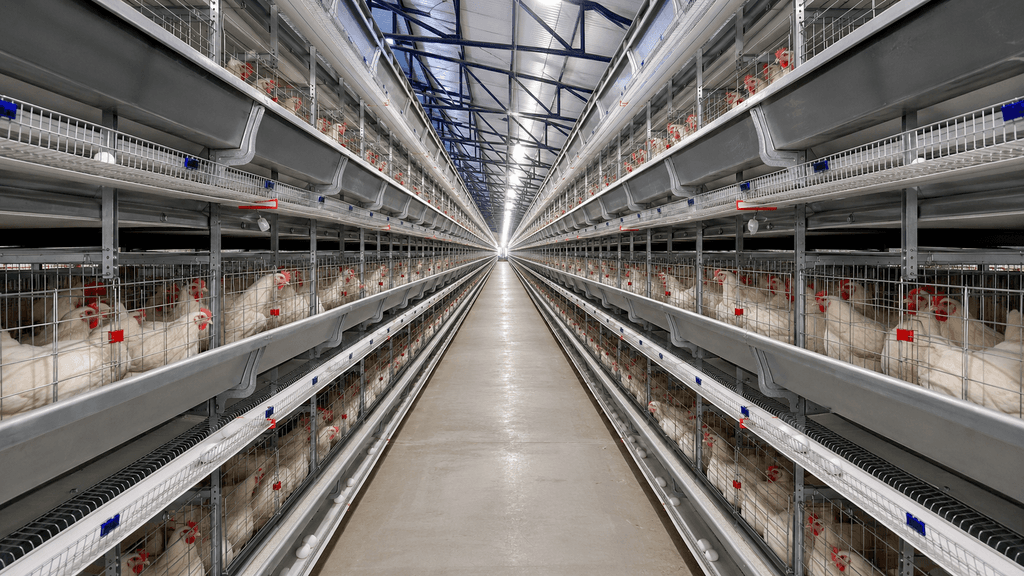
A complete layer farm may include cage systems, feeding and drinking equipment, egg collection, manure removal, feed storage, ventilation, cooling, lighting, and environmental control. These systems should be planned together because the choice or layout of one system can affect the others.
For farmers and investors preparing a new layer project, the following seven factors are especially important.
## 1. Start With the Planned Bird Capacity
The first question should be simple:
**How many laying hens will the farm accommodate?**
Bird capacity affects almost every equipment decision, including:
* Number of poultry houses
* Cage rows and tiers
* Feeding system capacity
* Drinking system layout
* Egg collection requirements
* Manure handling capacity
* Feed storage
* Ventilation requirements
However, bird capacity should not be used alone to select equipment.
For example, two farms may both plan to raise 50,000 layers, but one may use several lower-density houses while another may prefer a more compact multi-tier layout.
The required equipment can therefore be very different.
A better planning sequence is:
**Bird capacity ? House dimensions ? Cage layout ? Supporting equipment**
rather than:
**Bird capacity ? Buy cages**
This distinction can prevent many layout problems later in the project.
## 2. Confirm Poultry House Dimensions Before Finalizing Equipment
The length, width, and usable height of the poultry house directly influence the equipment layout.
Before selecting a cage model, confirm:
* House length
* House width
* Usable internal height
* Number and position of doors
* Service areas
* Equipment rooms
* Feed storage location
* Egg collection route
* Manure discharge direction
* Ventilation arrangement
Why does this matter?
Because cage rows do not operate independently.
A wider house may allow additional cage rows, but adequate service aisles still need to be maintained. A taller house may provide more options for multi-tier cage configurations, but equipment access and environmental control also need to be considered.
The cage layout can also affect the position of feeding equipment, egg collection lines, manure belts, lighting, and airflow.
For this reason, **poultry house design and equipment planning should ideally be developed together**.
For an existing poultry house, accurate dimensions should be provided before an equipment layout is prepared.
For a new project, it may be more practical to coordinate the house design with the proposed equipment arrangement before construction is finalized.
## 3. Choose the Layer Housing System According to the Farm
For cage-based commercial layer farming, **A Type and H Type layer cage systems** are two common configurations.
They should not be treated simply as “basic” and “advanced” versions of the same product. Their structures can lead to different farm layouts and management approaches.
### A Type Layer Cage System
An A Type cage uses an A-shaped arrangement of cage tiers.
Depending on the project, it may be considered where farmers prefer a relatively straightforward cage arrangement, flexible farm layout, or a different balance between investment and automation.
### H Type Layer Cage System
An H Type cage uses a vertically stacked multi-tier structure.
It is commonly considered for commercial farms where higher space utilization and integration with automated feeding, egg collection, and manure removal are important project requirements.
### So which one is better?
There is no universal answer.
The decision should consider:
| Factor | Questions to Ask |
| ----------------- | ----------------------------------------------- |
| Farm capacity | How many layers are planned? |
| House dimensions | How much usable width and height are available? |
| Automation | Which operations need to be automated? |
| Labor | How much routine manual work is practical? |
| Manure management | How will manure be removed and handled? |
| Expansion | Will additional capacity be added later? |
The right cage system is the one that fits the **farm layout and operating plan**, not simply the one with the largest capacity or highest level of automation.
## 4. Plan Feeding and Drinking as Part of the Cage System
Feeding and drinking equipment should be planned together with the cage layout.
### Feeding System
A commercial layer feeding system may involve:
**Feed storage ? Feed silo ? Conveying system ? House feeding equipment ? Cage feeding troughs**
When planning the feeding system, consider:
* Number of birds
* Number and length of cage rows
* Daily feeding schedule
* Feed storage requirements
* Conveying distance
* Access for inspection and maintenance
For larger farms, feed storage and conveying should be considered from the beginning rather than added after the cage layout is complete.
### Drinking System
Commercial cage systems commonly use nipple drinking equipment.
A drinking system can include:
* Main water supply
* Filtration
* Pressure regulation
* Water pipes
* Nipple drinkers
* Flushing or maintenance components, depending on the system
Water pressure, water quality, pipe layout, and maintenance access all matter.
A good drinking system is not simply a line of nipples installed inside cages. It starts with a reliable water source and ends with water being delivered appropriately throughout the poultry house.
## 5. Plan Egg Collection and Manure Removal Early
Two systems become increasingly important as commercial layer farms grow: **egg collection and manure removal**.
### Egg Collection
Automatic egg collection equipment can move eggs from cage rows toward a collection point.
Before choosing the system, consider:
* Cage row length
* Number of cage rows
* Collection direction
* Central collection location
* Worker access
* Egg handling after collection
The location of the egg collection area should therefore be considered when planning the poultry house—not after all cage rows have already been installed.
### Manure Removal
Manure management should also be included in the original layout.
Many H Type layer cage configurations use manure belts beneath cage tiers. The manure is transported toward the end of the cage rows and then transferred out of the house according to the farm's manure handling plan.
The important planning questions include:
* Where will manure leave the poultry house?
* How frequently will the system operate?
* Where will manure be stored or handled after removal?
* Is there enough space for the required equipment?
* Can workers access the system for inspection and maintenance?
This illustrates an important principle:
**Equipment planning should continue beyond the cage itself to consider what happens to feed, water, eggs, and manure throughout the farm.**
## 6. Match Ventilation and Environmental Control to the House and Climate
A poultry equipment layout cannot be separated from the poultry house environment.
Local climate conditions can influence the required ventilation, cooling, heating, and environmental control strategy.
Important factors include:
* Outdoor temperature
* Humidity
* Seasonal climate changes
* Poultry house dimensions
* Bird population
* Cage arrangement
* Air inlet design
* Fan arrangement
* Cooling requirements
A farm operating in a hot climate may require a different environmental control configuration from one operating in a cooler region.
This is one reason why copying another farm's equipment list is not necessarily a good planning method.
Even if two farms have the same bird capacity, differences in **climate, building design, cage arrangement, and management practices** can lead to different equipment requirements.
Ventilation planning should therefore be coordinated with the poultry house and cage layout.
## 7. Choose the Right Level of Automation—Not Simply the Highest Level
Automation can reduce repetitive manual work and help coordinate farm operations, but not every project requires the same level of automation.
A commercial layer farm may automate:
* Feed distribution
* Water delivery
* Egg collection
* Manure removal
* Ventilation
* Cooling
* Lighting
* Environmental monitoring and control
The appropriate level should be based on:
**Farm scale + labor availability + management capability + project budget + local operating conditions**
For example, a large commercial farm with limited labor may place greater importance on integrated automation.
Another farm may prefer to automate the most labor-intensive processes first and expand the system later.
The objective should not be:
**“How can I automate everything?”**
A better question is:
**“Which level of automation makes sense for this farm?”**
That leads to more practical equipment decisions.
# Why Two 50,000-Layer Farms May Need Different Equipment
Consider two farms that both plan to raise **50,000 laying hens**.
### Farm A
The farmer has sufficient land, several poultry houses, relatively easy access to labor, and prefers a moderate level of automation.
### Farm B
The available building area is more limited. The owner wants higher space utilization and intends to integrate feeding, egg collection, manure removal, and environmental management.
Both projects have exactly the same bird capacity.
But their suitable:
* Cage structure
* Number of rows
* Number of tiers
* House dimensions
* Automation level
* Egg collection arrangement
* Manure handling
* Ventilation design
may be different.
This leads to one of the most important lessons in commercial poultry equipment planning:
> **Bird capacity tells us how many birds the farm needs to accommodate. It does not tell us, by itself, how the farm should be designed.**
A useful equipment proposal therefore requires more than a bird number.
# How the Main Layer Farm Systems Work Together
Instead of looking at each machine separately, it is useful to think of a commercial layer farm as an integrated system:
**Feed Storage**
?
**Automatic Feeding**
?
**Layer Housing System**
?
**Nipple Drinking**
?
**Egg Collection**
?
**Manure Removal**
?
**Ventilation & Environmental Control**
Each system has its own function, but its layout can affect other parts of the farm.
For example:
* Cage rows influence feeding and egg collection routes.
* Cage tiers influence manure removal and lighting arrangements.
* House dimensions influence cage layout and ventilation.
* Bird capacity affects feed storage and equipment capacity.
* Local climate influences environmental control requirements.
This is why equipment planning should be approached as **system integration rather than individual product selection**.
# Information to Prepare Before Requesting a Poultry Equipment Proposal
Before contacting an equipment supplier or requesting a farm layout, farmers and investors can save considerable time by preparing the following information:
### 1. Project Location
Country and region.
### 2. Bird Type
Layers, pullets, broilers, or another poultry category.
### 3. Planned Capacity
Total number of birds.
### 4. Number of Poultry Houses
Existing or planned.
### 5. House Dimensions
Length × width × height for each house.
### 6. Required Automation
Feeding, drinking, egg collection, manure removal, environmental control, or other systems.
### 7. Project Status
Existing farm, new construction, expansion, or equipment upgrade.
### 8. Future Expansion
Whether additional houses or bird capacity may be added later.
With this information, an equipment supplier can evaluate the project much more effectively than with a request based only on the number of birds.
# Frequently Asked Questions
## What equipment is needed for a commercial layer poultry farm?
A commercial layer farm typically requires a housing or cage system, feeding equipment, drinking equipment, egg collection, manure management, feed storage, ventilation, lighting, and environmental control. The exact configuration depends on farm capacity, poultry house dimensions, climate, labor, and automation requirements.
## Should I choose the cage system before designing the poultry house?
For a new project, it is usually better to coordinate the poultry house and equipment layout before finalizing construction. House dimensions influence cage rows, tiers, aisles, feeding equipment, egg collection, manure removal, and ventilation.
## Is an H Type cage always better than an A Type cage?
No. H Type and A Type systems have different structures and can suit different project requirements. Farm capacity, house dimensions, automation level, labor, manure management, budget, and future expansion should all be considered.
## Does a larger poultry farm always need full automation?
Not necessarily. Automation should be selected according to farm scale, available labor, management capability, operating conditions, and investment priorities. The most automated configuration is not automatically the most suitable one.
## What information should I provide to a poultry equipment supplier?
At minimum, provide the project location, bird type, planned capacity, number of houses, poultry house dimensions, required automation level, and whether the project is new, existing, or planned for future expansion.
# Final Thoughts
Planning equipment for a commercial layer farm is not simply a matter of choosing cages and adding machines around them.
A more practical sequence is:
**Bird Capacity ? Poultry House ? Cage Layout ? Feeding & Drinking ? Egg Collection ? Manure Removal ? Ventilation & Environmental Control ? Future Expansion**
When these decisions are coordinated from the beginning, farmers and investors can evaluate equipment proposals based on the needs of the complete project rather than comparing isolated products.
For anyone preparing a commercial layer project, I would start with three pieces of information:
**How many layers?**
**What are the poultry house dimensions?**
**What level of automation is actually required?**
Those answers provide a much stronger foundation for equipment planning than starting with equipment price alone.
---
### About the Author
I work with **LIVI** in the poultry equipment industry, focusing on equipment planning and solutions for commercial layer and broiler farms. My work involves layer and broiler housing systems, feeding and drinking equipment, egg collection, manure removal, environmental control, and poultry farm automation.
Authors:

Recommend
Comment
Share

Would you like to discuss another topic? Create a new post to engage with experts in the community.










Adisseo – a Bluestar Company
Adisseo is one of the world’s leading experts in feed additives, based worlwide to produce and market nutritional solutions for sustainable animal feed.

Norel Animal Nutrition
Norel is a Spanish company whose business is based on the development, manufacturing, and marketing of ingredients for animal feed.
Featured users in Poultry Industry

Dr. Algis Martínez  Cargill
DVM, Diplomado ACPV - Poultry Veterinarian North America Cargill
United States
United States