Introduction
The modern poultry meat production industry achieves high productivity indexes and it has a major importance in worlds economy. For this production to be efficient, leading edge technology is needed in terms of facilities, genetics, management, nutrition and health. Aiming to improve production efficiency, antimicrobials are used at sub-therapeutic doses to promote significant results in terms of animal performance, with improved yields and maximized production (Costa et al., 2007). Nonetheless, given the potential induction of bacterial resistance and the presence of antimicrobial residues in animal-derived foods, some countries have imposed restrictions to the use of such antimicrobials as growth promoters.
The trend to ban the use of antimicrobials in feeds, has resulted in a more intensive search of alternative products aiming to maintain high levels of animal productivity without affecting end product quality. Among these alternatives probiotics, prebiotics, symbiotics, and organic acids out stand.
The digestive tract is an open system at its ends, lined by specialized epithelial cells that are constantly exposed to microorganisms and toxic chemicals resulting from the ingestion of feed, water, and eventually litter material, that can potentially result in the loss of intestinal integrity which is of outmost importance in order to have a large surface area of contact with the feed thus guaranteeing efficient digestion. Therefore, pathological alterations in the enteric mucosa must be prevented by the use of products such as performance enhancers, that can eventually protect or stimulate the intestinal tract during critical developmental stages, thus preserving bird's performance potential (Boaro, 2009).
The purpose of this study was to evaluate the duodenal mucosa morphometry, the length and weight of the small intestine (duodenum, jejunum, ileum), of broilers supplemented with various performance enhancers, alternative to antimicrobials.
Materials and Methods
The experiment was conducted at the College of Veterinary Medicine and Animal Husbandry, UNESP, Botucatu Campus, Brazil. One thousand and eighty (1,080) one-day-old broilers were housed at a stocking density of 12 birds per square meter. The experimental design was completely at random with 6 treatments and 6 30-bird repetitions. Feeding included 4 phases i.e., 1 (1-10 days), 2 (11-21 days), 3 (22-35 days) and 4 (36-42 days). T1 (control): basal diet with no additives or antimicrobials; T2: basal diet + antimicrobial (Enradin® F80 10 ppm for phase 1; 5 ppm for all other phases); T3: basal diet + probiotic (a commercial product including anaerobic bacteria, 107 colony-forming units (CFU)/g, lactose-fermenting enterobacteria, 105 CFU/g, Enterococcus spp. 106 CFU/g and Lactobacillus acidophilus 107 CFU/g at the dose rates of 150 g/Ton for phase 1 and 100 g/Ton for all other phases); T4: basal diet + prebiotic (mannan oligosaccharides 1 kg/Ton for phase 1 and 500 g/Ton for all other phases); T5: basal diet + symbiotic (T3 + T4); T6: basal diet + organic acids, (a commercial product including the following microencapsulated fumaric (64.1%), calcium propionate (10.3%), calcium formiate (20.5%), and potassium sorbate (5.1%) at the dose of 600 g/ton for all phases). The birds were vaccinated for coccidiosis on day 2 of age, since no feed anticoccidials were given. In order to magnify the challenge, the chickens were grown on reused, wood ss litter.
At 42 days of age, 72 birds, (2 per repetition in each treatment) were weighed individually and euthanized. The entire GI tract was then harvested, content was emptied, and the materials from both the small and large intestines were separately labeled. The small intestine segments (duodenum, from pylorus to distal duodenal loop; jejunum, from distal duodenal loop to Meckel's diverticulum; and ileum, from Meckel's diverticulum to the cecal opening) were weighed using a semi-analytical balance and measured using a measuring tape. For duodenal mucosa morphometric analysis, samples from 2 birds per repetition were taken, for a total of 12 samples per treatment. Samples were washed with distilled water then fixed in 10% buffered formalin for 24 hours. Duodenal segments were then subjected to routine histological preparation, colored using Masson's Trichrome Stain as per the methodology recommended by Behmer et al. (2003).
The duodenal mucosal morphometry was studied by analyzing the histological preparations under an optic microscope coupled to an image-capture computerized system (Leica Qwin 3.0). Ten measurements were performed in each micro-slide preparation. Data was subjected to variance analysis using the SAS (Statistical Analysis System, 2004) software. The differences among the means were subjected to Tukey´s test using the GLM (General Linear Models) procedure, at a significance level of 5%.
Results and Discussion
No influence was observed of the treatments on the relative weight of duodenal and ileal segments. Regarding the jejunum, the highest relative weight was obtained with the prebiotic treatment, as compared with the antimicrobial, while none of the additives showed a difference as compared to the controls. The relative weight of the small intestine as a whole, showed the highest values (P<0.05) in both the prebiotic and the probiotic treatments, as compared with the antimicrobial, but none of the additives was different from the control (Table 1).
Table 1. Relative weight of the small intestine of broilers at 42 days of age fed various performance-enhancing additives
Means followed by different in the same column are statistically different as per Tukey´s test (P<0.05). CV (%): coefficient of variation; P: probability; Small intestine %: Relative weight of the small intestine.
Regarding the other variable evaluated (small intestine length) no difference (P<0.05) was seen among the treatments (Table 2).
Table 2. Length of the small intestine of broilers at 42 days of age fed various performance-enhancing additives
CV (%): coefficient of variation; P: probability.
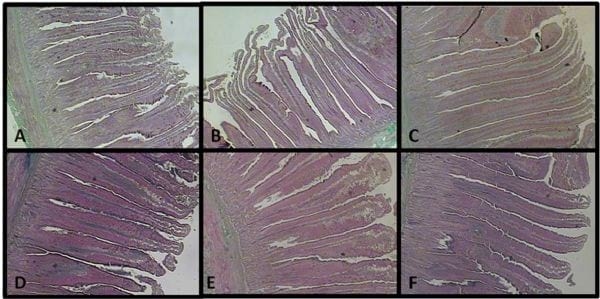
AS far as the morphometry of the duodenal mucosa is concerned, no influence (P<0.05) of the treatments was observed (Table 3 and Figure 1). Other authors agree with our results. In other words, they found no positive results when using performance-enhancing additives on the intestinal morphology. Among them, Pelicano (2006), tested a Bacillus subtilis + bacterial pool-based feed additive + mannan oligosaccharides (MOS) in broilers at 43 days of age, and Yang et al. (2007) investigated the effects of MOS in this type of birds.
Table 3. Length (µm) of the duodenal mucosa of broilers at 42 days of age in the various treatments
CV (%): coefficient of variation; P: probability; Org. ac.: Organic acids.
Figure 1. Photo micrographof the duodenal mucosa of the 42-day-old broilers
A: Controls; B: Treatment with antimicrobial; C: Treatment with probiotic; D: Treatment with prebiotic; E: Treatment with symbiotic Treatment with organic acid. Masson´s trichrome stain, 5x.
Conclusion
No beneficial effect was obtained with any of the performance-enhancing feed additives used in this study on the morphometry of the duodenal mucosa of broilers at 42 days of age.
Bibliography
Behmer OA et al. 2003. Manual de Técnicas para Histologia Normal e Patológica. 2ª ed. Editora Manole, Barueri. 331p.
Boaro M. 2009. Morfofisiologia do trato intestinal. In: Conferência APINCO 2009. Facta: Porto Alegre. Pp. 262-274.
Costa LB et al. 2007. Extratos vegetais como alternativas aos antimicrobianos promotores de crescimento para leitões recém-desmamados. Revista Brasileira de Zootecnia, Viçosa. 36(3):589-595.
Pelicano ERL. 2006. Desempenho, qualidade de carne e desenvolvimento da mucosa intestinal de frangos produzidos com probiótico e prebiótico. 117 f. Tese (Doutorado em Zootecnia) - Faculdade de Ciências Agrárias e Veterinárias, Universidade Estadual Paulista "Júlio de Mesquita Filho", Jaboticabal.
SAS (Statistical Analysis System). 2004. SAS user's guide: Statistic. SAS Institute Inc., Cary, NC, USA.
Yang Y et al. 2007. Effects of mannanoligosaccharide on growth performance, the development of gut microflora, and gut function of broiler chickens raised on new litter. Journal Applied Poultry Research 16:280-288.