Explore

Advertise on Engormix

Dietary selenium and zinc supplementation alters growth and immunity of broiler chicken
Published: September 4, 2026
Source : MEESAM RAZA 1, 2; CHANDRA DEO 1; NASIR AKBAR MIR 1*; AVISHEK BISWAS 1; DIVYA SHARMA 1 and J J ROKADE 1 / 1 ICAR-Central Avian Research Institute, Izatnagar, Uttar Pradesh 243 122 India; 2 DGCN College of Veterinary and Animal Sciences, CSKHPKV, Palampur, Himachal Pradesh.
Interactions among nutrients such as vitamins and minerals are of great importance in poultry nutrition and can negatively affect the performance of birds if not considered (Mir et al. 2021). Providing protection to the cells against the oxidative damage by free radicals and lipo-peroxides, selenium (Se) is an integral part of Se-dependent antioxidant enzymes, and thus involved in the antioxidant defense system of the body (Finkel and Holbrook 1991). Traditionally, in poultry diets, Se supplementation, in inorganic forms, are recommended at 0.15 mg/kg diet level (NRC 1994, BIS 2007). However, basal diet containing 0.24-0.25 mg Se/kg diet was found optimum under normal conditions or under heat stress for broiler chicken (Ghazi et al. 2012). Furthermore, Se supplementation increased relative weights of immune organs of chicken under heat stress condition (Mahmoud et al. 2016) and improved cellular and humoral immunity was reported in layer chicken fed ration containing 0.3 mg Se/kg diet (Mohapatra et al. 2014) with higher IgG and IgM levels in broiler chicken (Cai et al. 2012) compared to control diets.
Similarly, in mammals, the second most abundant trace mineral is zinc (Zn) which has structural and/or functional importance in more than 300 enzymes involved in antioxidant defense mechanisms (Mir et al. 2013). In poultry nutrition, the role of dietary Zn has been established in the growth, bone development, feather development, enzyme structure and function, immunomodulation, and appetite regulation. Though NRC has recommended 40 mg Zn/kg diet as optimum for growth performance of broiler chickens, there is no concurrence among the poultry nutrition researchers whose recommendations vary from 40 to 120 mg/kg diet (Burrell et al. 2004, Zhang et al. 2006). BIS has recommended 80 mg Zn/kg diet for optimum growth and immunity of broiler chicken (BIS 2007, Ghazi et al. 2012). Furthermore, Zhang et al. (2006) reported that in broiler chicken Zn supplementation should be 80-120 mg/kg diet to get better growth performance, immune competence, and other physiological indexes. Therefore, the deficiency of one or both micronutrients may reasonably affect the health and production of the broiler chicken. Since, the optimization of dietary requirement of nutrients in broiler chicken is a continuous process because of the continuous genetic improvement of birds and at the same time BIS (2007) recommendation is now 16 years old. Thus, the present study was undertaken to optimize requirement of dietary levels of Se and Zn in broiler chicken diet.
MATERIALS AND METHODS
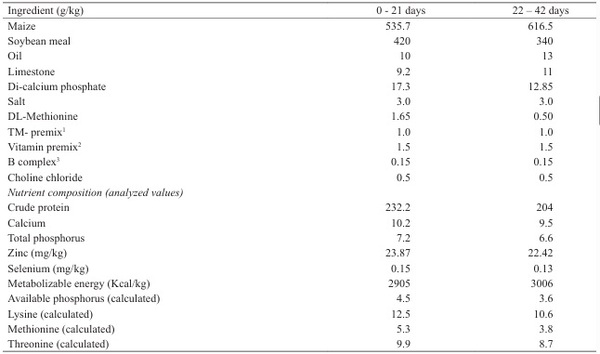
The ethical approval for this study was provided by Animal Ethics Committee of IVRI, Izatnagar, India (Approval number 491/01/ab/CPCSEA). This study was carried out on straight run CARIBRO Vishal broiler chicken (n=432), which were distributed at random into 54 groups based on their initial body weight having 8 birds in each group. The basal diets of similar energy and protein levels were formulated as starter and finisher with ingredients and nutrient composition given in Table 1. A 3×3 factorial experimental design was followed by employing three levels of each Se (0.15, 0.30, and 0.45 mg/kg) and Zn (40, 80, and 120 mg/kg) which resulted in nine experimental diets. Each treatment was assigned six groups of birds at random (48 birds/treatment). Selenium (Se) and zinc (Zn) levels in the diets were analyzed and the supplementation was done accordingly to achieve the desired levels of Se and Zn in the respective diets. The source of Se and Zn supplementation was in the form of Sodium selenite and Zinc sulphate, respectively. The respective diets were offered to birds ad lib. in mash form with uniform managemental conditions.
The feed intake (FI) of birds was recorded group-wise and daily feed intake per bird was calculated. The body weight of birds was recorded on weekly basis followed by body weight gain (BWG) and feed conversion ratio (FCR) calculation for each treatment group wise separately. The effects of Se and Zn supplementation on the growth efficiency of broiler chicken were assessed by calculating production efficiency factor (PEF), protein efficiency ratio (PER), and energy efficiency ratio (EER) as follows (Kumar et al. 2021):
PEF = [Final body weight (kg) × Livability (%) × 100]/ Age in days × FCR
PER = Weight gain/Protein intake
EER = [Weight gain (g)/Total energy intake (ME kcal)]/ × 100
For the study of carcass characteristics, 12 birds (2 birds per group) per treatment were selected at random, feed was withdrawn 12 h before sacrificing, but drinking water was provided ad lib. at the end of 42 d experimental trial. However, male and female were selected in equal number to avoid the influence of sex on the results of slaughter traits of birds.
The immunity of birds in response to Se and Zn supplementation was assessed in terms of cell mediated immunity (CMI) against the mitogen {Phyto haemagglutinin-P (PHA-P)}, humoral immunity (HI) against sheep red blood corpuscles (SRBC), and the development of lymphoid organs. The relative weight of lymphoid organs (thymus, spleen, and bursa) was measured at the time of bird sacrifice. The foot web index (mm)
Table 1. Ingredients and nutrient composition of basal diets for broiler chicken
Dietary selenium and zinc supplementation alters growth and immunity of broiler chicken - Image 1
1 Trace mineral mixture (100 g): FeSO4 .7H2 O-8 g, ZnSO4 .7H2 O-10 g, MnSO4 . H2 O- 10 g, CUSO4 .5H2 O-1 g, KI- 30 g. 2 Vitamin premix (1 g): Vitamin A-82.5 IU, Vitamin E 50% -160 mg, Vitamin D3-12000 unit, Vitamin K-10 mg. 3 Vitamin B complex (1 g): Vitamin B1-8 mg, Vitamin B6-16 mg, Vitamin B12-80 mcg, Niacin-120 mg, Calcium panthotheonate-80 mg , Vitamin B2-50 mg, L-lysine-10 mg and DL- Methionine- 10 mg.
measurement was done in 12 birds (2 birds per group) from each dietary treatment at 22nd day to assess CMI. 0.2 ml of PHAP-P mitogen (1 mg/ml PBS) was injected in left foot web of birds and 0.2 ml PBS was injected in right foot web to serve as positive control. The thickness of foot webs for each bird was measured prior to injection and 24 h post injection in both legs and difference between the two legs was calculated as a response to PHA-P injection Bera et al. (2019).
The HI was measured in terms of HA titre against SRBC in 12 birds (not used for CMI assay) from each treatment (2 birds per group). About 1 ml of 1% suspension of SRBC was injected via wing vein of birds. Blood samples were collected at 6th day post injection for harvesting of serum followed by storage at -20°C until further use. The HA antibody titre estimation was done in fresh U-bottom micro titre plates by making two-fold serial dilution of sera and reciprocal of the highest dilution showing clear agglutination was taken as end point of titre and the values were expressed as log2 .
A completely randomized design was followed for the data analysis via two-way ANOVA by adopting General Linear Model procedure of IBM SPSS software-20. For the data pertaining to feed intake, FCR, and efficiency parameters each group was designated as an experimental unit and for the data pertaining to weight gain, carcass characteristics, and immune response experimental unit was sampled bird.
RESULTS AND DISCUSSION
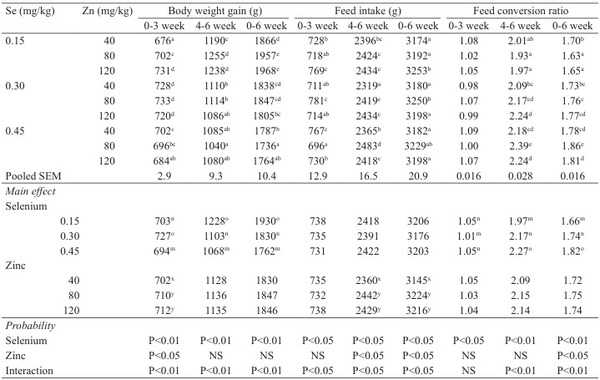
Growth performance: The BWG during 0-3 weeks of age was higher (P< 0.01) in birds fed 0.15 mg Se/kg diet along with 120 mg Zn/kg diet and 0.30 mg Se/kg diet along with either of 40 mg, 80 mg, or 120 mg Zn/kg diet. Whereas, lower BWG was observed in birds fed 0.15 mg Se/kg diet along with 40 mg Zn/kg diet (Table 2). The other dietary combinations of Se and Zn yielded intermediate values. However, during 4-6 weeks and 0-6 weeks of age, higher BWG was observed in birds fed 0.15 mg Se/kg diet along with 80 mg or 120 mg Zn/kg diet while lower BWG was observed upon supplementation of 0.45 mg Se/kg diet along with 80 mg Zn/kg diet. The other combinations of Se and Zn resulted in intermediate values of BWG. The 0-3 week FI of birds was (P< 0.05) higher at 0.15 mg Se/kg with 120 mg Zn/kg diet, 0.30 mg Se/kg with 80 mg Zn/kg, and 0.45 mg Se/kg with 0.40 mg Zn/kg diet compared to 0.45 mg Se/kg with 80 mg Zn/kg diet and other combinations resulted in intermediate values. During 4-6 weeks of age, higher (P< 0.05) FI was observed in birds fed 0.45 mg Se/kg with 80 mg Zn/kg diet compared to birds fed 0.30 mg Se/kg with 40 mg Zn/kg diet whereas, other combinations resulted in intermediate FI of birds. During 0-6 weeks age, higher (P< 0.05) FI was observed at 0.30 mg Se/kg with 80 mg Zn/kg diet followed by 0.45 mg Se/kg with 80 mg Zn/kg diet compared to other combinations which did not differ significantly from each other. The FCR during 4-6 weeks and 0-6 weeks of age
Table 2. Effect of different levels of selenium (Se) and zinc (Zn) on growth performance of broiler chicken
Dietary selenium and zinc supplementation alters growth and immunity of broiler chicken - Image 2
Value bearing different superscripts within a column differ significantly, NS-Non-significant.
was better (P< 0.01) in birds fed 0.15 mg Se/kg with 80 mg and 120 mg Zn/kg diet compared to 0.45 mg Se/kg with 80 mg Zn/kg diet and the other combinations resulted in intermediate FCR values in birds. The main effect of Se at 0-3 weeks of age resulted in better BWG (P< 0.01) and FCR (P< 0.05) at 0.30 mg Se/kg diet followed by 0.45 mg Se/kg diet compared to 0.15 mg Se/kg diet. However, at 4-6 weeks and 0-6 weeks of age, better (P< 0.01) BWG and FCR of birds was observed at 0.15 mg Se/kg diet followed by 0.30 mg Se/kg diet compared to 0.45 mg Se/kg diet. No significant effect of Se supplementation was observed on the FI of birds. The main effect of Zn supplementation revealed lower (P< 0.05) 0-3 week BWG and 4-6 week and 0-6-week FI at 40 mg/kg diet compared to other two higher levels which did not differ significantly from each other.
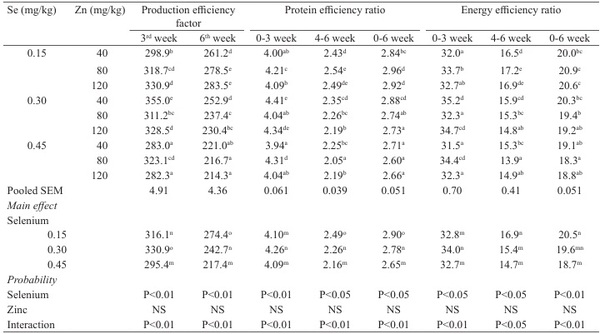
The growth efficiency parameters have shown significant interaction effects and main effects of Se supplementation only (Table 3). The PEF at 3rd week of age was higher (P< 0.01) in birds fed 0.30 mg Se/kg with 40 mg Zn/kg diet followed by 0.15 mg and 0.30 Se/kg with 120 mg Zn/ kg diet compared to birds fed 0.45 mg Se/kg with 40 or 120 mg Zn/kg diet. At 6th week of age, higher (P< 0.01) PEF was observed in birds fed 0.15 mg Se/kg with 80 or 120 mg Zn/kg diet compared to birds fed 0.45 mg Se/kg with 80 or 120 mg Zn/kg diet. Higher (P< 0.01) PER and EER during 0-3 weeks of age were observed in birds at 0.30 mg Se/kg with 40 or 120 mg Zn/kg diet compared to birds fed 0.45 mg Se/kg with 40 or 120 mg Zn/kg diet and 0.15 mg Se/kg with 40 mg Zn/kg diet. During 4-6 weeks of age, higher (P< 0.01) PER and EER were observed in birds fed 0.15 mg Se/kg with 80 or 120 mg Zn/ kg diet compared to birds fed 0.45 mg Se/kg with 80 mg Zn/kg diet. Similarly, during 0-6 weeks of age, birds fed 0.15 mg Se/kg with 80 or 120 mg Zn/kg diet resulted in higher (P< 0.01) PER and EER compared to birds fed 0.30 mg Se/kg with 120 mg Zn/kg diet and 0.45 mg Se/kg with 40, 80, or 120 mg Se/kg diet. Other combinations yielded intermediate PEF, PER, and EER values of birds. The main effects of Se supplementation resulted in higher (P< 0.01) 3rd week PEF in birds at 0.30 mg Se/kg diet followed by 0.15 mg Se/kg level compared to 0.45 mg Se/kg diet. But higher PEF at 6th week (P< 0.01), 4-6 week and 0-6 week PER (P< 0.05) were observed at 0.15 mg Se/kg diet followed by 0.30 mg Se/kg diet compared to 0.45 mg Se/kg diet. During 0-3 weeks of age, higher PER (P< 0.01) and EER (P< 0.05) were observed in birds fed 0.30 mg Se/ kg diet compared to other two levels, whereas, higher EER during 4-6 weeks (P< 0.05) and 0-6 weeks (P< 0.01) of age were observed at 0.15 mg Se/kg diet compared to other levels.
Therefore, during 0-3 weeks of age, optimum growth performance and growth efficiency of chicken were observed at 0.30 mg Se/kg diet. However, during 4-6 weeks of age and overall growth phase (0-6 week), 0.15 mg Se/kg diet turned out to be optimum level which shows the age dependency of Se requirement of broiler chicken. Similarly, the BWG was higher in birds fed at least 80 mg Zn/kg diet. According to this study, for optimum growth performance and efficiency of broiler chicken, 0.30 mg Se/kg diet must be supplied in the ration along with 80 mg Zn/kg diet. On similar lines, better growth of broiler chicken was reported at a level of 0.25 mg Se/kg
Table 3. Effect of different levels of selenium (Se) and zinc (Zn) on growth efficiency parameters of broiler chicken
Dietary selenium and zinc supplementation alters growth and immunity of broiler chicken - Image 3
Value bearing different superscripts within a column differ significantly, NS-Non-significant.
diet (Sagar et al. 2020). However, the results of this study do not concur with the recommendation of 0.15 mg Se/kg diet by NRC (1994) and BIS (2007) in all phases of chicken growth. There are the reports of non-significant effects on the BWG and FCR of chicken (Payne et al. 2005, Li et al. 2018) which can be associated with the different genetic makeup of birds, Se status of hatching eggs, and the managemental conditions (Attia et al. 2010). Similar to the results of present study, 80 mg Zn/kg diet resulted in improved growth performance and growth efficiency of broiler chicken (Burrell et al. 2004, Mohammadi et al. 2015). Improved feed efficiency has been reported in broiler chicken fed 60-90 mg Zn/kg diet (Ahmadi et al. 2013, Zhao et al. 2014). Even an earlier study reported 80-120 mg Zn/kg diet to be optimum for better growth performance and other physiological indices (Zhang et al. 2006). The results of this study contradicted the recommendation of 40 mg Zn/ kg diet by NRC (1994) but supported the recommendation of 80 mg Zn/kg diet by BIS (2007). Contrary to the results of the present study, 40 mg Zn/kg diet was found optimum for broiler chicken (Mir et al. 2013).
Carcass characteristics: None of the carcass characteristics were influenced by Se or Zn supplementation or by their interaction (Supplementary Table 1). This study did not reveal any significant effect of Se and Zn supplementation on carcass characteristics of broiler chicken. On the similar lines, supplementation of Zn (Collins and Moran 1999, Kumar 2007, Kumar et al. 2009) and Se (Khajali et al. 2010, Rajashree et al. 2014) beyond NRC recommendations do not affect the carcass characteristics of chicken. The absolute weight of different internal organs was also not influenced by Se (Sevcikova et al. 2006, Haug et al. 2007) or Zn (Mir et al. 2013) supplementation in broiler chicken diet.
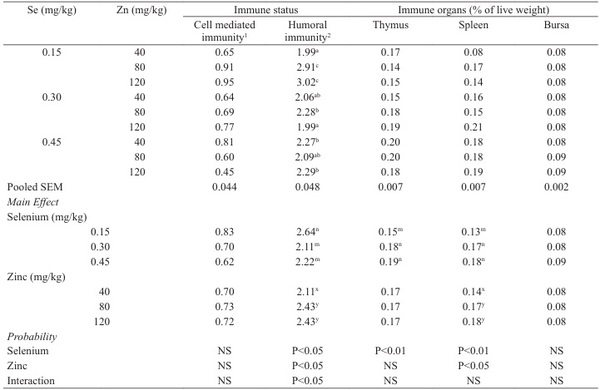
Immunity of birds: No effect was observed on the CMI and bursa weight of birds (Table 4). However, higher (P< 0.05) antibody titre was observed in birds fed 0.15 mg Se/kg with 80 or 120 mg Zn/kg diet compared to birds fed 0.15 mg Se/kg with 40 mg Zn/kg diet and 0.30 mg Se/kg with 120 mg Se/kg diet, whereas, other combinations resulted in intermediate values. The main effect of the Se revealed higher (P< 0.05) antibody titre at 0.15 mg level compared to other two levels. But, the main effect of Zn revealed lower (P< 0.05) antibody titre at 40 mg Zn/kg diet as compared to other two levels which did not differ significantly from each other. The relative weights of thymus and spleen were lower at 0.15 mg Se/kg diet compared to other two higher levels and Zn supplementation revealed lower spleen weight at 40 mg Zn/kg diet as compared to other two higher levels which were statistically similar to each other.
Table 4. Effect of different levels of selenium (Se) and zinc (Zn) on cellular and humoral immune response and immune organs of broiler chicken
Dietary selenium and zinc supplementation alters growth and immunity of broiler chicken - Image 4
Value bearing different superscripts within a column differ significantly, NS-Non-significant.1 Measured as foot-web index (mm). 2 Measured as antibody titre expressed in Log2 values.
Adaptive immunity, composed of humoral and cell mediate immunity, is determined by the activity of B- and T- lymphocytes by producing antibodies against the pathogens or by directly attacking them, respectively. In this study, no significant dietary effects were observed on the CMI of broiler chicken. However, higher humoral immunity was observed in birds supplemented with NRC recommended Se level in diet, but the NRC recommendation of 40 mg Zn/kg diet was inadequate for better humoral immune response compared to 80 or 120 mg Zn/kg diet. Further, higher spleen and thymus weight was observed at 0.3 mg Se/kg diet and higher spleen weight at 80 mg Zn/kg diet. However, earlier studies have reported that Se supplementation at levels higher than the recommended dose significantly increased the antibody titre against SRBC antigen (Nageswara et al. 2003, Yamuna et al. 2011). Further, the supplementation of chicken diets with 0.3 ppm Se improved the cellular as well as humoral immunity (Mohapatra et al. 2014). Dietary Zn is essential for normal immune functioning of the body (Dardenne et al. 1993) as evident from the present study. Better immune response was observed in chicken supplemented with 80-120 mg Zn/kg diet (Zhang et al. 2006) or 60-80 mg Zn/kg diet (Kumar 2007, Kumar et al. 2009) with respect to control diet. The increase of dietary Zn supplementation from 40 to 80 mg Zn/kg diet significantly increased the HA titre against SRBC in Aseel chicken (Deo et al. 2009).
Similarly, the Se supplementation in broiler chicken diets increased the relative weight of immune organs of birds (Hegazy et al. 2000, Mahmoud et al. 2016) which was observed in case of spleen and thymus weights only in this study. In line with the results of this study, Zn supplementation of 60 or 120 mg Zn/kg diet was reported to have no significant effects on the relative weights of thymus and bursa at 42 days of age in broiler chicken (Kulkarni et al. 2017). Contrary to the results of this study, the weight of immune organs, cellular and humoral immunity increased by supplementation of 40 ppm Zn in broiler chicken (Bartlett et al. 2003, Sunder et al. 2008).
In conclusion, Se supplementation of 0.30 mg /kg diet and Zn supplementation of 80 mg/kg diet resulted in optimum growth performance and growth efficiency of broiler chicken. No significant effect was observed on the carcass characteristics. Better humoral immunity was observed at 0.15 mg Se and 80 mg Zn/kg diet. However, 0.3 mg Se/kg diet resulted in higher spleen and thymus weights and 80 mg Zn/kg diet resulted in higher spleen weights.
   
This article was originally published in Indian Journal of Animal Sciences 93(5): 487–493, May 2023/Articlehttps://doi.org/10.56093/ijans.v93i5.123262. This is an Open Access article licensed under a Creative Commons Attribution-NonCommercial-ShareAlike 4.0 International License.

Ahmadi F, Ebrahimnezhad Y, Sis N M and Ghiasi J. 2013. The effects of zinc oxide nanoparticles on performance, digestive organs and serum lipid concentrations in broiler chickens during starter period. International Journal of Bioscience 3: 23–29.

Attia Y, Al-Hamid A E, Ibrahim M, Al-Harthi, Mohammed, Bovera F and Elnaggar A S. 2010. Productive performance, biochemical and hematological traits of broiler chickens supplemented with propolis, bee pollen, and mannan oligosaccharides continuously or intermittently. Livestock Science 164: 87–95.

Bartlett J R and Smith MO. 2003. Effects of different levels of zinc on the performance and immunocompetence of broilers under heat stress. Poultry Science 82: 1580–88.

Bera I, Tyagi P K, Mir N A, Begum J, Dev K, Tyagi P K, Biswas A, Sharma D and Mandal A B. 2019. Effect of dietary saponin rich soapnut (Sapindus mukorossi) shell powder on growth performance, immunity, serum biochemistry and gut health of broiler chickens. Journal of Animal Physiology and Animal Nutrition 103(6): 1800–09.

BIS. 2007. Nutrient Requirements for Poultry. 7176-26: Bureau of Indian Standards, New Delhi

Burrell A L, Dozier W A, Davis A J, Compton M M, Freeman M E, Vendrell P F and Ward T L. 2004. Responses of broilers to dietary zinc concentrations and sources in relation to environmental implications. British Poultry Science 45: 255 63.

Cai SJ, Wu CX, Gong LM, Song T, Wu H and Zhang L Y. 2012. Effects of nano-selenium on performance, meat quality, immune function, oxidation resistance, and tissue selenium content in broilers. Poultry Science 91: 2532–39.

Collins N E and Moran E T J. 1999. Influence of supplemental manganese and zinc on live performance and carcass quality of broilers. Journal of Applied Poultry Research 8: 222–27.

Dardenne M and Bach J M. 1993. Rationale for the mechanism of zinc interaction in the immune system. (Ed) Cunningham Rundles S. Nutrient modulation of Immune Response, New York, Mareel Dekker, pp. 501-509.

Deo C, Shrivastava H P, Mandal A B and Tyagi P K. 2009. Response of CARI Devendra dual-purpose chicks to supplemental zinc levels. Indian Journal of Animal Sciences 79: 921–24.

Finkel T and Holbrook N J. 1991. Oxidants, oxidative stress and the biology of ageing. Nature 408: 239–47.

Ghazi H S, Habibiyan M and Moeini M M. 2012. Effects of dietary selenium, vitamin E, and their combination on growth, serum metabolites, and antioxidant defense system in skeletal muscle of broilers under heat stress. Biological Trace Element Research 148: 322–31.

Haug A, Eich G S, Bernhoft A, Wold J P, Hetlandh C O A and Sogn T. 2007. Effect of dietary selenium and omega-3 fat acids on muscle composition and quality in broilers. Lipids in Health and Disease 6: 121–27.

Hegazy S M and Adachi Y. 2000. Comparison of the effects of dietary selenium and zinc supplementation on growth and immune response between chick groups that were inoculated with Salmonella and aflatoxin or Salmonella. Poultry Science 78: 331–35.

Khajali F, Raei A, Aghaei A and Qujeq D. 2010. Evaluation of a dietary organic selenium supplement at different dietary protein concentrations on growth performance, body composition, and antioxidative status of broilers reared under heat stress. Asian Australasian Journal of Animal Science 23: 501–07

Kulkarni R C, Mandal A B, Bhanja S K, Akshat G and Manish M. 2017. Dietary zinc supplementation on immune response of coloured broilers during hot-humid summer. Journal of Poultry Science and Technology 5: 18–21.

Kumar F, Tyagi P K, Mir N A, Dev K, Begum J, Tyagi P K, Biswas A, Sahu B, Dinani O P and Sharma D. 2021. Growth pattern, lipid composition, oxidation status, and serum biochemical profile of broiler chicken fed flaxseed meal for different durations. Letters in Animal Biology 01(1): 08–18.

Kumar Y. 2007. ῾Response of broiler chickens to dietary supplemental Zn levels and sources.᾿ M.V.Sc. (Poultry Science) Thesis, IVRI Deemed University, Izatnagar, 243122 UP.

Kumar Y, Deo C, Shrivastava H P, Madal A B and Mishra S K. 2009. Response of feeding different sources and concentrations of zinc on growth, immune response and carcass yield of broiler chicks. Proceedings of Animal Nutrition Association World Conference, 14-17 Feb 2, New Delhi, India.

Li J L, Zhang L, Yang Z Y, Zhang Z Y, Jiang Y, Gao F and Zhou G H. 2018. Effects of different selenium sources on growth performance, antioxidant capacity and meat quality of local Chinese Subei chickens. Biological Trace Element Research 181: 340–46.

Mahmoud H, Deep El , Daichi I, Tarek A E and Akira O. 2016. Effects of dietary nano-selenium supplementation on growth performance, antioxidative status, and immunity in broiler chickens under thermoneutral and high ambient temperature conditions. Poultry Science 53(4): 274–83.

Mir N A, Deo Chandra, Mandal A B, Tyagi Praveen, Rashid Azhar and Sharma Divya. 2013. Response of dietary zinc and vitamin A levels on growth, immune response, and carcass yield of broiler chickens. Indian Journal of Poultry Science 48: 291–96.

Mir N A, Tyagi P K, Begum J, Dev Kapil, Biswas A, Gupta S L, Tyagi P K, Sharma D, Deo C, and Mandal A B. 2021. Growth performance, tissue lipid composition and metabolism, health indices, and serum lipid chemistry of broiler chicken in response to dietary flaxseed and chromium. Letters in Animal Biology 01(1): 33–45.

Mohammadi V, Ghazanfari S, Mohammadi S A and Nazaran M H. 2015. Comparative effects of zinc-nano complexes, zinc-sulphate and zinc-methionine on performance in broiler chickens. British Poultry Science 56: 486–93.

Mohapatra P, Swain R K, Mishra S K, Behera T, Swain P, Mishra S S, Behura N C, Sabat S C, Sethy K, Dhama K and Jayasankar P. 2014. Effects of dietary nano-selenium on tissue selenium deposition, antioxidant status and immune functions in layer chicks. International Journal of Pharmacology 10: 160–67.

Nageswara A R, Ramasubba V, Reddy M and Ramakota R. 2003.

Effect of E- care -Se - herbal on the performance on immune response in broilers. Indian Journal of Poultry Science 38: 115–20.

NRC. 1994. Nutrient Requirements of Poultry, National Research Council, National Academy Press, Washington, DC 9th rev. edn, 20418

Payne R L and Southern L L. 2005. Changes in glutathione peroxidase and tissue selenium concentrations of broilers after consuming a diet adequate in selenium. Poultry Science 84: 1268–76.

Rajashree K, Muthukumar T and Karthikeyan N. 2014. Influence of inorganic and organic selenium sources on broiler performance and meat quality. Iranian Journal of Applied Animal Science 4(1): 151–57

Sagar D, Mir N A, Mandal A B, Dev K, Begum J, Tyagi P K, Rokade J J, Biswas A, Tyagi P K and Bhanja S K. 2020. Comparative study on the responses of broiler chicken to hot and humid environment supplemented with different dietary levels and sources of selenium. Journal of Thermal Biology 88: 102515.

Sevcikova S, Skrivan M, Dlouha G and Koucky M. 2006. The effect of selenium source on the performance and meat quality of broiler chickens. Czech Journal of Animal Science 51: 449–57.

Sunder G, Panda A K, Gopinath N C S, Ramarao S V, Raju M V L N, Reddy M R and Vijay K. 2008. Effects of higher levels of zinc supplementation on performance, mineral availability, and immune competence in broiler chicks. Journal of Applied Poultry Research 17: 79–86.

Yamuna K and Thangavel A. 2011. Effect of selenium and vitamin e supplementation on immune status in broiler chickens. Tamil Nadu Journal of Veterinary and Animal Science 7: 303–06.

Zhang C, Zhn W, Guan X and Song J. 2006. Effect of interaction between dietary zinc and vitamin A in broilers on performance, immunity, ALPW and Cu Zn-SOI activity and serum Insulin Concentration. World Journal of Zoology 1: 17–23.

Zhao C Y, Tan S X, Xiao X Y, Qiu X S, Pan J Q and Tang Z X. 2014. Effects of dietary zinc oxide nanoparticles on growth performance and antioxidative status in broilers. Biological Trace Element Research 160: 361–67

Related topics:
Authors:
Dr. Meesam Raza
Avishek Biswas
Recommend
Comment
Share
Profile picture
Would you like to discuss another topic? Create a new post to engage with experts in the community.
Featured users in Poultry Industry
Dr. Algis Martínez
Dr. Algis Martínez
DVM, Diplomado ACPV - Poultry Veterinarian North America Cargill
United States
Ana Maria Villegas-Gamble
DVM, MS, Ph.D. / Directora de Nutrición
United States
Carolina Hall
Carolina Hall
United States