1. Introduction
Although the global production of duck meat reached 6.07 million tonnes in 2022 [1], an increase of 111.5% since 2000, there is limited information available on different areas of commercial duck production compared to broiler chickens, laying hens, or even turkey. Along with the increase in meat production due to more ducks being raised annually, there has been a significant improvement in genetic selection to increase the growth rate. Particularly, Pekin ducks have been selected for high meat yield, reaching weights above 3.2 kg by 6 weeks of age [2]. The improvement in growth efficiency should be accompanied by adequate diet formulation to provide all the required nutrients. Considering that 70–80% of the total production costs come from the diet, it is imperative that nutrient bioavailability is optimized.
Available information on duck nutrition related to the incorporation of multi-carbohydrase exogenous enzymes in commercial duck diets is scarce [3]; therefore, there is a need to better understand the potential of dietary enzymes to improve duck performance.
Early research on ducks and dietary carbohydrase enzymes was performed by Farrell and Martin [4], evaluating an enzyme mix of xylanase, α-amylase, β-glucanase, and protease in diets with different inclusion levels of rice bran. The authors concluded that the enzyme mix had no effect on improving the nutritional value of rice bran as no response was observed in the evaluated variables. More recent research conducted in ducks has observed beneficial effects on performance. Kang et al. [5] evaluated the effects of supplementing xylanase, cellulase, and β-glucanase to meat-type duck diets. The authors reported that the addition of exogenous carbohydrases improved weight gain and FCR. Additionally, they observed improvements in nutrient digestibility when compared to diets with no enzyme supplementation. Moreover, Zeng et al. [6] evaluated the supplementation of xylanase, β-glucanase, and phytase on meat-type duck diets with nutrient reduction of energy and amino acids and phosphorous. They observed positive recovery of performance when the enzyme mix was supplemented to the nutrient-reduced diet as well as increased crude protein, apparent metabolizable energy, and calcium and phosphorus digestibility. In general, exogenous enzymes are known to increase nutrient digestibility, reduce intestinal viscosity and wet litter, as well as interact with the intestinal microbiota in swine and poultry [7]. Carbohydrase enzymes such as xylanase, cellulase, β-glucanase, or β-mannanase are a group of enzymes that will hydrolyze complex carbohydrates known as non-starch polysaccharides (NSPs). These NSPs can be grouped into three main groups: cellulose, non-cellulosic polymers (e.g., arabinoxylans, mannans, galactans, and β-glucans), and pectic polysaccharides [8]. The lack of endogenous enzymes to break down complex polysaccharides in poultry limits their ability to digest NSPs found in plant feedstuffs [9]. Traditionally, ingredients such as barley, wheat, and rye have been considered to have a high concentration of soluble NSPs associated with increased digesta viscosity [10,11]. This is why corn and soybean meal (SBM) are preferred as base ingredients in commercial poultry diets, due to their relatively low NSP content. The NSPs found in corn are mainly insoluble, including arabinoxylans, cellulose, and β-glucans [10]. In soybean meal the NSPs are mainly rhamnogalacturonans, arabinogalactan I, and xylogalacturonan. Additionally, 8% of the NSPs will be associated with cellulose [11]. Due to their high inclusion in the diet, which could represent more than 80% of the total formulation, the anti-nutritive effects of NSPs found in corn and soy remain a concern for poultry nutritionists [12]. Approximately 400 to 450 kcal/kg of digestible energy is not utilized because of the presence of NSPs in corn–SBM based diets [13]. The use of multi-carbohydrase enzyme (MCE) products with multiple enzyme activities working together to increase the release of entrapped nutrients within the plant cell wall [14] and, therefore, increase the nutritional value of feedstuffs could represent significant cost savings for the commercial meat-duck industry by ameliorating the harmful effects of NSPs. Hence, the present study was conducted to evaluate dietary supplementation of an MCE complex consisting of xylanase (5700 U/g), β-glucanase (750 U/g), cellulase (1600 U/g), and α-galactosidase (4 U/g), designed for corn–SBM-based diets, on growth performance and carcass traits of Pekin ducks.
2. Materials and Methods
All experimental procedures involving live birds followed the Guide for the Care and Use of Agricultural Animals in Research and Teaching [15] and were approved by the Institutional Animal Care and Use Committee (IACUC) of Texas A&M University.
2.1. Birds and General Management
Newly hatched straight-run Pekin ducklings were obtained from a commercial hatchery. An average body weight (BW) of the ducklings was determined to group them in 50 groups of 25 ducks (n = 1250) with similar starting BWs and variance. The ducks were then randomly allocated to 50-floor pens inside a tunnel-ventilated poultry house using a completely randomized block design. Each treatment consisted of 10 replicate pens with 25 birds each. Pen location was used as the blocking factor. All pens had new wood shavings as bedding material at the start of the trial. All pens (1.8 m × 1.8 m) were equipped with 6 nipple drinkers and 2 cylindrical feeders that were adjusted in height to accommodate bird growth. The temperature in the house was set for 30–31 ◦C and then gradually reduced as the birds advanced in age by 1 ◦C every other day, starting at day 3 of age until the temperature reached 20 ◦C, to ensure the birds’ comfort. For the first 14 days of the study the lights were set to provide 22 h of light and 2 h of dark. The lights were adjusted to provide 18 h of light and 6 h of darkness after 14 days until the end of the trial. Treatment diets were offered ad libitum except for an 8 h fasting period in preparation for bird processing. Water was offered ad libitum. Temperature in the room, lights, and access to feed and water were monitored throughout the experimental period to ensure birds’ welfare.
2.2. Dietary Treatments
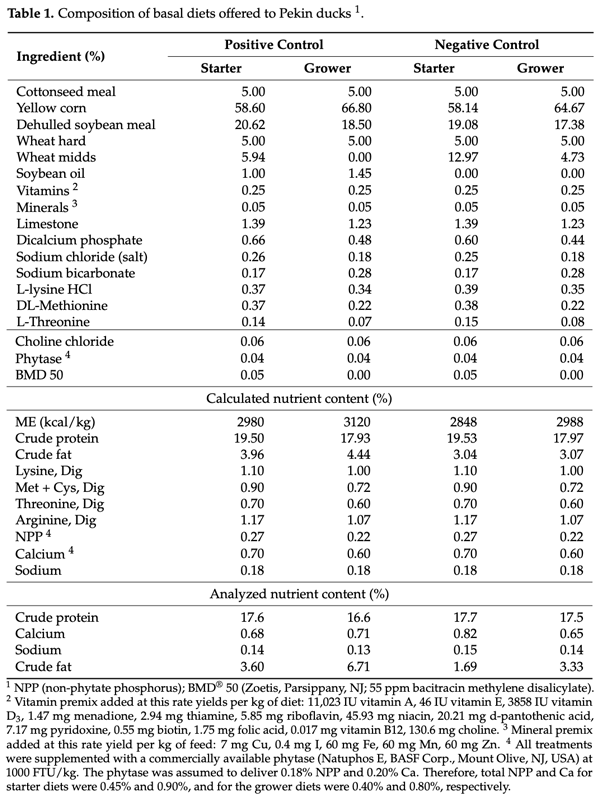
This study consisted of 5 dietary treatments. A positive control (PC; no ME reduction), negative control (NC; −132 kcal/kg of ME compared with the PC throughout the trial), and the NC supplemented with an MCE complex (Enspira® +; United Animal Health, Sheridan, IN, USA) at 75 (E75), 100 (E100), and 125 (E125) ppm. The energy reduction of 132 kcal/kg was fixed based on the potential energy release of the MCE at 125 ppm, allowing enough energy difference between the PC and NC to observe an energy response. The diets were formulated following Fouad et al. [2] and the NRC [16] nutrient recommendations for commercial ducks. All diets were based on corn and soybean meal as main ingredients and the energy reduction was mainly achieved by the removal of the fat source and addition of wheat middlings as filler. The MCE employed in this trial was derived from Aspergillus niger and Trichoderma reesei, an intrinsically thermostable enzyme complex consisting of xylanase (5700 U/g), β-glucanase (750 U/g), cellulase (1600 U/g), and α-galactosidase (4 U/g) activities. Weighed amounts of the MCE were mixed with 3 kg of the basal diet before they were incorporated into the mixer to create each experimental treatment. A commercial 6-phytase was employed to supplement all experimental diets (Natuphos® E, BASF Corp., Mount Olive, NJ, USA) at 1000 FTU/kg. Formulation matrix values target 0.18% non-phytate P and 0.20% Ca release (Table 1). The feeding program consisted of 2 dietary phases (starter 1–14 days and grower 15–35 days). All diets were pelleted (85 ◦C and 20 s conditioning time) and offered as crumbles for the starter phase and as pellets for the grower phase.
2.3. Enzyme Activity
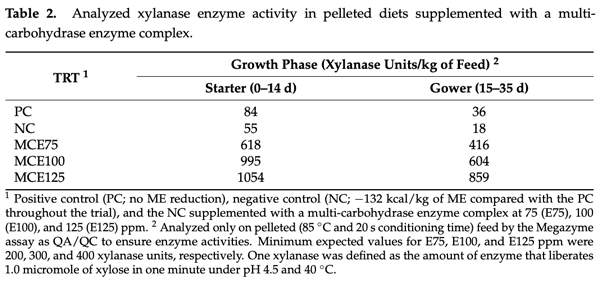
Xylanase enzymatic activity of the MCE was performed to verify adequate enzyme levels were within an acceptable range in the final pelleted feeds, as described by LeyvaJimenez et al. [17]. One xylanase unit was defined as the amount of enzyme that liberates 1.0 micromole of xylose in one minute under pH 4.5 and 40 ◦C. The other enzyme activities (β-glucanase, cellulase, and α-galactosidase) in the MCE complex were not evaluated but adequate levels were expected based on the xylanase activity (Table 2). Phytase activity was not evaluated for this trial.
2.4. Performance Evaluation
The BW at age 14 and 35 were recorded, and the average daily feed intake (ADFI) and body weight gain (BWG) during days 1–14, 15–35, and 1–35 were calculated. The BW of dead birds was recorded daily and used to adjust the feed conversion (FCR). Additionally, FCR at 35 d was adjusted to a common (3.485 kg) BW (C-FCR). The common BW was selected considering the final average BW of the PC.
2.5. Bird Processing
On day 35 of age, five birds/pen were selected based on their BW ± 1 SD (pen weight distribution) and then color-marked for quick identification. After an 8-h fasting (36 days of age), the selected birds were loaded in cages and identified by pen number. The cages were transported to the processing plant located at Texas A&M University. Upon arrival at the processing facility, the birds were individually weighed. After stunning and bleeding, birds were placed in a scalding tank with an average temperature of 60 ◦C and then defeathered using an automatic turning de-feathering machine. An additional scalding was performed using hot paraffin wax and then transferred to cold-iced water before the birds were detailed by hand for final de-feathering. The carcasses were manually eviscerated and rinsed with water.
The carcasses without giblets (WOG) were chilled in large plastic tubs with ice for 1 h. After this period, carcasses were weighed to obtain the chilled carcass weight (CCW) and cut up into commercial parts as follows: breast (with skin), and leg quarter (thigh and drumstick). Individual parts were weighed to determine the % yield relative to the processing BW.
Calculations for the variables measured used the following formulas:
% C-WOG = [CCW (kg)/processing BW (kg)] ∗ 100
% Yield (parts) = [Weight of cut-up carcass part (kg)/processing BW (kg)] ∗ 100
where
% C-WOG is the chilled carcass yield;
% Yield of the different carcass parts (breast, leg quarter).
2.6. Statistical Analysis
Statistical analysis was performed using the JMP software (Version 17.1, SAS Institute, Cary, NC, USA). Data were subjected to one-way ANOVA after assumptions were evaluated using Levene’s (homogeneity of variance) and the Shapiro–Wilk (normality of the data) tests using the same statistical software package. If significance was observed (p ≤ 0.05 for significant effects and p > 0.05–p ≤ 0.10 for statistical trends), the LS means were compared using the Student’s t-test. Mortality data were analyzed using the Kruskal–Wallis test. Linear and quadratic effects of increasing inclusion levels of MCE (NC, E75, E100, E125) were evaluated through linear regression. The pen was the experimental unit for all variables.
3. Results
3.1. Performance
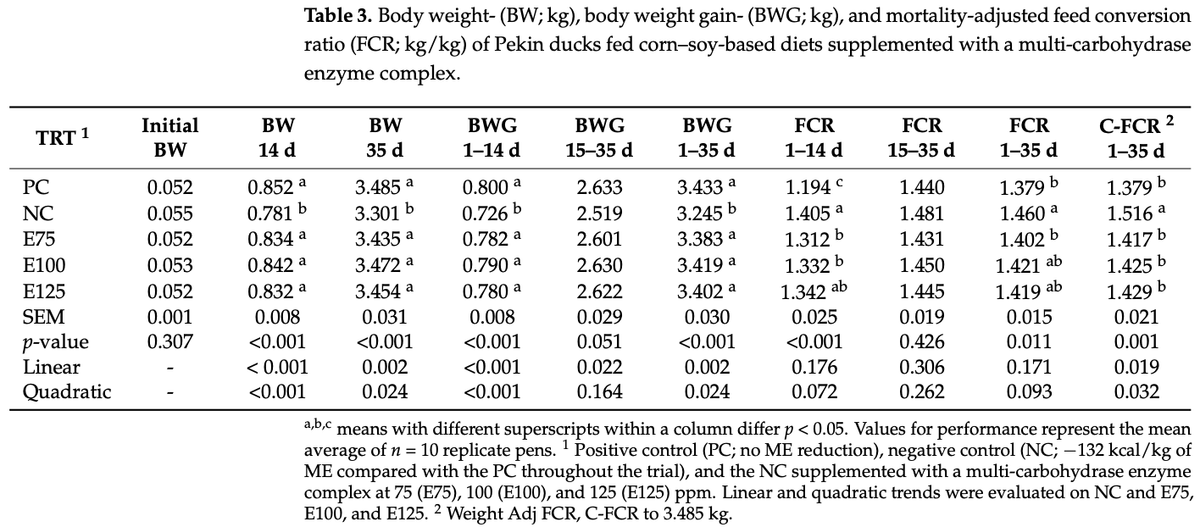
The performance results are presented in Tables 3 and 4. At the age of 14 days, the BW mean of the ducks in the NC group was decreased (p < 0.001) by 8.3% when compared to the PC group. The BW of ducks on day 14 in all MCE-supplemented treatments were higher (p < 0.001) compared to the NC and were not different (p > 0.05) from the PC. Both linear and quadratic increasing trends (p < 0.001) were observed for the inclusion level of the MCE at 14 days of the trial. At 35 days, a similar effect was observed for the NC diet, decreasing (p < 0.001) BW by 5.3% when compared to the PC. The BW of the treatments supplemented with the MCE complex at 75, 100, and 125 ppm were higher (p < 0.001) than the NC. No difference (p > 0.05) was observed in the BW on day 35 between the MCE-supplemented treatments and the PC. Cumulatively at 35 days, the MCE supplementation at 75, 100, and 125 ppm to the NC diet recovered 72.8%, 92.9%, and 83.2% of the lost BW, respectively, compared to the PC. Both linear (p = 0.002) and quadratic increasing (p = 0.024) trends were observed for 35 d BW. During day 1–14 the FCR increased (p < 0.001) by 17.7% in the NC compared to the PC. The supplementation of MCE at 75 and 100 ppm resulted in an intermediate FCR response between the PC and NC. MCE supplementation at 125 ppm numerically improved FCR compared to the NC but was not statistically significant. A quadratic 14-day FCR (p = 0.072) trend was observed. No statistical differences were observed in FCR during the day 15–35 growth phase. Cumulatively (1–35 d), the energy reduction in the NC resulted in a C-FCR (adjusted to a common BW of 3.485 kg) increase (p = 0.001) of 13.7 points (9.9%) compared to the PC, and the E75, E100, and E125 addition were able to recover 72.3%, 66.4%, and 63.5%, respectively, of the increase in the FCR in the NC when compared to the PC group. Both linear (p = 0.019) and quadratic (p = 0.032) trends were observed for 35-day C-FCR.
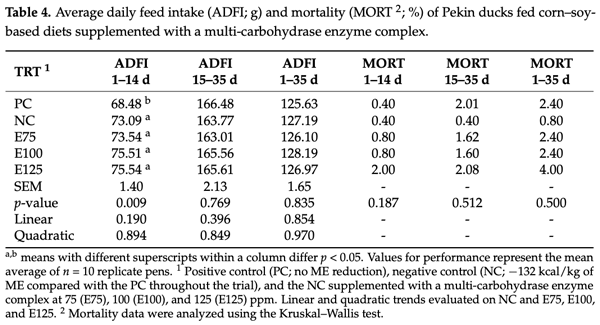
After 14 d on trial, the birds on the PC resulted in the lowest (p = 0.009) ADFI compared to all other treatments. No differences (p > 0.05) were observed between the NC and the MCE-supplemented treatments in ADFI. No statistical differences (p > 0.05) were observed on ADFI on 15–35 d or cumulatively 1–35 d of the trial.
No differences in mortality (p > 0.05) were observed between treatments throughout the trial period.
3.2. Processing
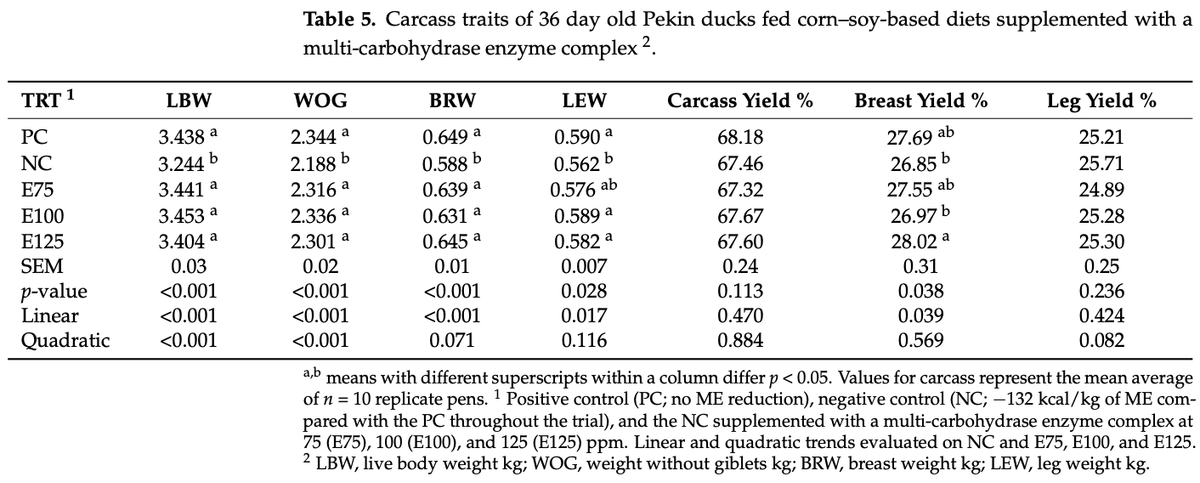
Processing results are presented in Table 5. Live weight at processing (LBW) was lower (p < 0.001) for the NC compared to all other treatments. LBW was not different (p > 0.05) between the PC and the MCE-supplemented treatments. These results are in agreement with the BW evaluated for performance which suggests that the selection of the birds for processing was successful to represent the pen average BW ± SD. The WOG and breast weight (BRW) were reduced (p < 0.001) for the NC compared to all other treatments. No difference (p > 0.05) was detected in BRW between the PC and MCE-supplemented treatments. Leg weight (LEW) had a similar response (p = 0.028); however, E75 had an intermediate response not statistically different from the NC. Breast yield was increased (p = 0.038) for E125 compared to NC and E100. No differences (p > 0.05) were observed for carcass yield or leg yield between experimental treatments. Linear trends (p < 0.05) were observed for LBW, WOG, BRW, LEW, and breast yield. Quadratic trends (p < 0.10) were observed for LBW, WOG, BRW, and leg yield.
4. Discussion
The objective of the present study was to evaluate the effect of supplementing an MCE complex to corn–SBM-based diets for Pekin ducks. This was achieved by formulating energy-reduced starter and grower diets that would cause the birds to have a nutrient deficit. The supplementation of the MCE would then help to overcome the nutritional deficiency by NSPs hydrolysis. The data collected in this trial suggest that we achieved this objective from the response in performance observed between the PC and NC throughout the trial. Cumulatively (1–35 d), the reduction of 132 kcal/kg to the PC diet reduced the BW of Pekin ducks by 5.3% and increased the C-FCR by 9.9%. It is worth noting that the NC diets incorporated the use of wheat middlings as filler when the energy was reduced. Wheat and by-products are known ingredients with high content of NSPs. It is possible that the NSPs in wheat middlings exacerbated the observed response between the PC and NC. Moreover, the response of the MCE when supplemented to the NC diets could have been influenced as well by the wheat middlings in the diet providing additional substrate for the carbohydrase enzymes, ultimately allowing the release of energy and entrapped nutrients.
Energy-reduced or nutrient-reduced models have been broadly employed in broiler chickens [13,17–19] to estimate potential ME release from basal diets when supplemented with exogenous enzymes. The intensive genetic selection of commercial broilers towards feed efficiency and rapid growth has led to changes in voluntary feed intake regulation and behavior. Broiler chickens seem to have lost the ability to regulate feed intake to meet their energy requirements [20]. In comparison, commercial meat-type ducks, not as intensively selected as commercial broiler chickens, conserve their foraging behavior, which confers ducks a better ability to respond to dietary fiber and to regulate their feed intake based on the caloric content of the diet [21–23]. Therefore, our recommendation to test enzyme response under a nutrient-deficient model would be to target a minimum of 100 kcal/kg reduction. By targeting a high energy reduction, we can overcome a possible intake response of the ducks to low energy diets. Feed intake in this trial was increased in the starter phase (1–14 d) for the NC and the MCE-supplemented treatments when compared to the PC. This response was not observed in the grower phase; we speculate that intake capacity of the birds as they age plays a role in the response observed to nutrients in the diet. Our observations agree with Zeng et al. [6] who evaluated the supplementation of an MCE complex (xylanase, β-glucanase, and phytase) on meat-type ducks fed diets with two energy reductions (70 and 100 kcal/kg). They concluded that the higher reduction of 100 kcal/kg resulted in the lowest performance and utilization of nutrients. Feed intake was also reported to increase in a similar fashion when compared to the results of the present trial. In contrast, previous literature reports investigating the effect of exogenous enzymes in ducks typically add them “on top” of basal diets with no nutrient reduction [24–27], and no consistent trend on feed intake response was observed. Independently of the model used, the supplementation of exogenous carbohydrase enzymes to duck diets has been shown to improve performance, nutrient digestibility and utilization, and bone mineralization [3]. Thus, the incorporation of exogenous carbohydrase enzymes into duck diets is recommended.
The supplementation of the MCE complex to corn–SBM-based diets (in conjunction with the 6-phytase) was effective in maintaining performance in the Pekin ducks in the present study. Cumulatively (1–35 d), the energy reduction in the NC resulted in a weightadjusted FCR increase (p = 0.001) of 13.7 points (9.9%) compared to the PC, and the E75, E100, and E125 were able to recover 72.3%, 66.4%, and 63.5%, respectively, of the FCR increase, compared to the PC. In agreement with these results, Kang et al. [5] conducted two trials to evaluate the effects of supplementing an MCE (xylanase, cellulase, β-glucanase) to meat-type duck diets on performance and nutrient digestibility. The authors reported that the addition of the MCE resulted in a significant increase in average daily gain and improved FCR. Additionally, crude protein, NDF, and AME digestibility were improved when compared to the basal diet without enzyme supplementation.
Breast weights and breast yield % were linearly improved with increasing concentrations of the MCE in this trial. It is important to evaluate processing yields when evaluating the supplementation of enzymes to ensure the improvements in BW observed are not due to increased fat deposition rather than muscle. Very limited information is available on processing metrics for meat-type ducks. However, in agreement with our results, DebickiGarnier et al. [28] evaluated the effect of an MCE (amylase, protease, xylanase) on the performance and processing yields of mule ducks. The researchers reported that the supplementation of a diet with the MCE increased BW and flock uniformity. Moreover, breast yield was numerically improved by 2% compared to the diet with no enzyme supplementation. When analyzed by weight, the boneless breast, thighs, and wings were numerically heavier by 3%, 2%, and 4%, respectively.
An important factor to consider in the results of this study is the presence of the 6-phytase. The beneficial effects of phytase supplementation in poultry are well documented [29–31]. In this regard, the inclusion of phytase at a super dose (1000 ≥ FTU/kg) in this trial could have interacted with the MCE to further improve the performance of the Pekin ducks. This interaction was evaluated in broiler chickens by Ennis et al. [32] who used an enzyme complex consisting of xylanase, β-mannanase, and their combination with two phytase inclusion levels (250 FTU/kg and 1500 FTU/kg) in corn–SBM diets. Ennis and their group observed that phytase inclusion at 1500 FTU/kg in conjunction with xylanase improved FCR and overcame a 100 kcal/kg ME reduction. Also, phytase supplementation at 1500 FTU/kg and xylanase improved cumulative BW at 44 and 55 d of age. Interestingly, a potential interaction between phytase, xylanase, and β-mannanase was observed during the starter phase (0–14 d). Higher concentration of β-mannans due to the higher inclusion of SBM was hypothesized to be the reason for the observed interaction. In meat-type ducks, phytase supplementation is supported by multiple trials showing improvements in tibia ash, P retention, performance, and nutrient digestibility [33–35]. At super dose levels, Liu et al. [36] evaluated inclusions from 1000–3000 FYT/kg of a commercially available 6-phytase in Cherry Valley ducks. Phytase supplementation linearly increased weight gain, feed intake, and body weight. Furthermore, tibia ash (linear and quadratic), and P digestibility (linear) were also improved. No bone measurements were evaluated in this trial; further research should explore this area to better understand possible interactions between dietary enzymes when phytase is present.
There is a big opportunity for nutritionists and researchers to increase their knowledge in commercial duck production and incorporating dietary exogenous enzymes. The effects of the MCE complex extend beyond nutrient digestibility, so future research should focus on bird health, gut microbiota, and the incorporation of alternative ingredients to corn and soybean meal which increases the complexity of the NSP profile.
5. Conclusions
Cumulatively (1–35 d), the reduction of 132 kcal/kg to the PC diet was successful at creating a nutritional energetic deficit in the Pekin ducks observed by the 5.3% reduction in BW and an increase of 9.9% in C-FCR.
The supplementation of the multi-carbohydrase enzyme complex to corn–SBM-based diets (in conjunction with the 6-phytase) effectively maintained performance in the Pekin ducks. The increasing supplementation of the enzyme complex recovered BW and improved FCR at comparable levels to the PC (E75, 72.3%; E100, 66.4%; and E125, 63.5%). The quadratic trend observed in C-FCR suggests that 75 ppm MCE supplementation maximized performance recovery.
Additionally, breast carcass traits were also improved with the supplementation of the enzyme complex compared to the energy-reduced diet treatment group. The % breast yield was linearly improved with increasing MCE levels in the feed, suggesting a higher inclusion (125 ppm) was required to achieve the highest response on breast yield.
Further research is needed to investigate exogenous enzymes, substrates, and host interaction due to the physiology of the duck to better understand the strategic application of exogenous enzymes in commercial production.
This article was originally published in Poultry 2024, 3, 307–317. https://doi.org/10.3390/poultry3030023. This is an Open Access article distributed under the terms and conditions of the Creative Commons Attribution (CC BY) license (https://creativecommons.org/licenses/by/4.0/).