I. INTRODUCTION
Spotty Liver Disease (SLD) is a major problem in free-range layer farming (Courtice et al., 2018). The causative agent of SLD has been identified as Campylobacter hepaticus (Van et al., 2017). The epidemiology of SLD in cage-free layers is poorly understood. Three analytical epidemiological studies have been conducted in this series. The studies surveyed cage-free layer houses across Australia, searching for statistical associations between facility and management practices with the occurrence of SLD. Factors included house design and furniture, ventilation systems, floor space, feeder and drinker space and types, nest type and space allowance, slat design, range size, and many bird performance parameters. Cage-free housing varies within Australia, with older houses converted to free-range designs (“conventional free-range”), barn style, aviary system without ranging or aviary system with free-ranging. Ventilation systems varied between natural ventilation (open sided houses) or various mechanically ventilated houses (roof extraction or tunnel ventilation designs). Cagefree houses may have the entire floor area covered by slats or may have an exposed floor area (scratch area) to allow dust bathing inside the house.
II. METHOD
Several formal epidemiological surveys were conducted in Australia over 2019 to 2022 from flocks up to 40 weeks of age. These involved extensive housing and management questionnaires and collection of cloacal swabs, faeces and/or dust for detection of C. hepaticus by PCR from each flock. Recorded findings were cross-tabulated against occurrence of SLD, or its severity. Initial comparisons used Pearson’s Chi-square analysis for categorical factors and Student’s t-tests for continuous data. Any factor showing an initial statistical association with SLD with a scanning P value of < 0.20 (Hosmer et al., 2013) were then considered using multivariate technique (multiple logistic regression) where confounding could be reduced, and the most important putative factors studied in closer detail, while controlling for the effects of other factors.
III. RESULTS AND DISCUSSION
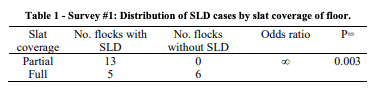
Survey 1 identified the presence of a scratch area as a major risk factor for SLD (Table 1), with every such house being a clinical SLD case (Gao et al., 2023a). Transmission route for C. hepaticus is regarded as fecal-oral (Phung et al., 2022) and hence the greater exposure to faeces afforded by a scratch area explains this finding, while full slat coverage of the floor provides separation from much fecal material inside the house and thus can be somewhat protective against SLD. Of the fully slatted houses, 45% had clinical SLD, but the remaining sample size for the latter restricted further findings. Hence, surveys 2 and 3 were conducted to evaluate other factors in either fully slatted houses or houses with a scratch area.
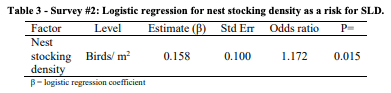
Survey 2 (Gao et al., 2023b) examined only flocks in houses that had full slat cover of the floor areas. Several factors were found to be significantly associated with the occurrence of clinical SLD in this housing mode. Houses with full slat coverage and with tunnel ventilation capacity appeared to be protected against SLD, compared with open-sided naturally ventilated houses (Table 2). This finding agrees with a field report of an ability to decrease SLD severity if house temperature can be lowered (Courtice, 2022). Within houses with natural ventilation, an association of SLD occurrence was found with bird numbers per m2 nest space area, where for every extra bird per m2 the odds of SLD increased by 17.2% (Table 3). The results suggested that maximum nest stocking densities to help avoid clinical SLD for brown egg layers in naturally ventilated houses would be 112 birds per m2 of nest space. A further finding of interest was putative associations between several factors involved with the time lag for flocks to come into early egg production. All of these factors were related to each other, and they were statistically autocorrelated. Hence, a representative factor was selected for these, being the time between transfer and the flock reaching 60% HD production, as this had the least missing data points. Flocks that had longer lag times in reaching 60% HD production were at a higher risk of SLD occurrence. It is not clear whether this putative association reflects a cause or an effect. Arguably, flocks coming into lay slightly later may be more prone to SLD outbreaks. Conversely, flocks that were sub-clinically affected by SLD early in lay may have had their onset of lay delayed by this infection. We infer that this factor may be something of a predictor for SLD, with flocks beginning lay (i.e. reaching 5% HD) at 20 weeks of age being more likely to experience later clinical SLD than those beginning lay at 19 weeks of age. Cloacal swabs from flocks during lay revealed that flocks with clinical SLD outbreaks had significantly higher numbers of birds with positive detections of C. hepaticus than did the clinically unaffected flocks. It was of high interest that C. hepaticus could be detected in flocks which never broke with clinical SLD.

Survey 3 (unpublished data) was conducted in 48 houses across Australia which had a scratch area, in either conventional free-range, barn or aviary style housing. The occurrence of SLD was high in this survey (as predicted by Survey #1), hence a severity score, based on magnitude and duration of the mortality and egg production drop and whether antibiotic treatment was necessary, was used to categorize flocks with higher or lower disease levels. Many factors were evaluated, and confounding between factors was considerable. Hence, multiple logistic regression techniques were used to distinguish the most statistically important effects. After multiple analysis controlling for the presence of all factors, the analyses reduced the statistically important factors to two – age at transfer to the layer house (later transfer compared to transfer one week earlier) and nest space allowance, where for every extra bird/ m2 of nest space, risk of more severe SLD increased by 3.4%.
Survey 3 thus confirmed the effect of higher nest density (as seen in survey 2) where a higher number of birds placed per m2 of available nest space increased risk of severe SLD. The effect of nest density may increase SLD severity risk at a lower stocking rate in houses with a scratch area than that seen in fully slatted houses.
It is concluded that greater exposure of birds to fresh faeces in a scratch area inside the house is a strong risk factor for SLD. Further, a higher number of birds per m2 of nest space increases the risk of SLD. The use of mechanical ventilation (roof extraction or tunnel ventilation systems) in houses may decrease the risk and severity of SLD occurrence. Later transfer to the layer house may also increase the risk of SLD severity.
These findings represent new information on the epidemiology of SLD and provide direction for prevention of the disease.
ACKNOWLEDGEMENTS: The studies were funded by Australian Eggs Ltd (project 1BS004US). The cooperation and support provided by all farms involved and by their consulting veterinarians is acknowledged with great gratitude.
Presented at the 35th Annual Australian Poultry Science Symposium 2024. For information on the latest and future editions, click here.