Naturally occurring influenza reassortment in pigs facilitates the emergence of intrahost virus subpopulations with distinct genotypes and replicative fitness
Pigs are recognized as amplifying hosts for influenza A virus (IAV) reassortant viruses. Understanding the extent of IAV reassortment occurring at the individual pig level in naturally infected pigs and how reassortment impacts virus diversity, persistence, and replicative fitness is essential for countering IAV threats to humans and animals. Here, 244 IAV plaques were isolated from 24 commercial pigs, resulting in 26 distinct genome segment constellations. About 33% (8/24) of pigs were infected with two or more different genotypes, with two pigs harboring two or more different subtypes. Our results indicate that few pigs in a population harbor significantly more genotypes than other pigs and generate most of the diversity, including the emergence of reassortants. However, detecting distinct genotypes during surveillance was dynamic, with most of the genotypes subsiding over time. All the IAV genotypes could replicate in various swine and human-sourced respiratory epithelial cells, and we observed that distinct reassortant genotypes recovered from a single pig could exhibit different growth abilities, especially in human cells. Overall, we demonstrated that multiple distinct IAV genotypes with distinct antigenic profiles and varying growth abilities on swine and human respiratory tracts can be shed simultaneously from a single pig, which contributes to the dynamic nature of IAV prevalence. The striking magnitude of IAV reassortment at the single pig level revealed in this study highlights the need to strengthen surveillance efforts and plans to eliminate IAV from swine farms because pigs have a high potential to produce diverse and potentially zoonotic influenza reassortant viruses.
IMPORTANCE
Pigs play a crucial role in driving influenza A virus (IAV) diversification and evolution by reassorting the viruses originating from different hosts. Despite IAV reassortment and diversity being well documented in pig populations at different scales (e.g., farm, region, country), limited field research has explored the extent of reassortment happening at the single pig level and how that contributes to the overall genetic and biological variation observed in populations. We provide initial information on levels of reassortment happening at the single pig level in naturally infected pigs, and that particular pigs can shed a plethora of distinct genotypes, with certain genotypes having distinct replicative fitness on swine and human respiratory tracts, which preserves the potential for IAV long-term evolution and facilitates the emergence of zoonotic/pandemic-capable reassortants.
KEYWORDS influenza A virus, reassortment, replicative fitness, pig, swine farm
RESULTS
Background information of field samples
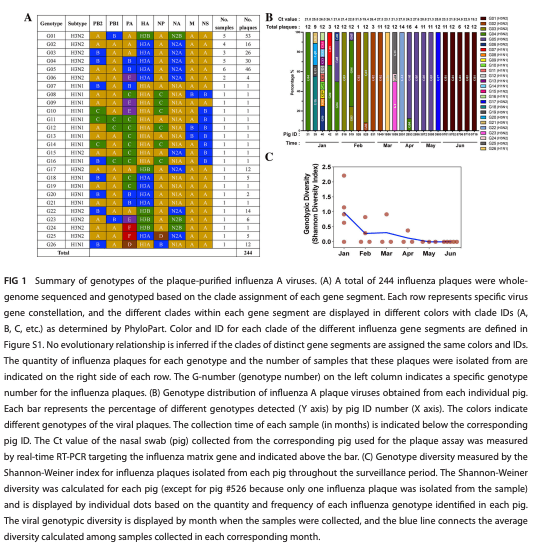
Multiple genotypes identified among viral plaques purified from single farm pigs
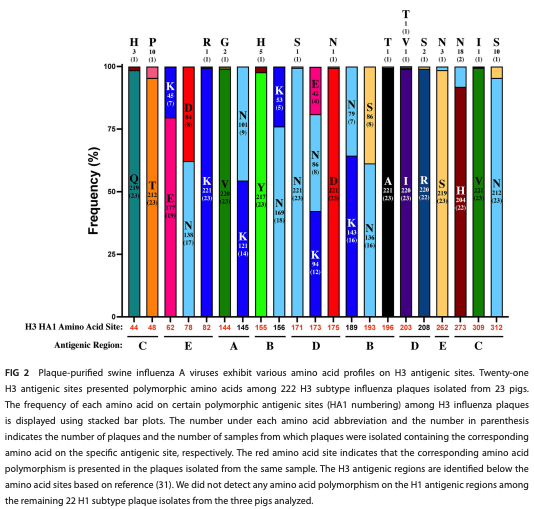
Virus subpopulations shed from single pigs exhibited high genotypic and antigenic diversity
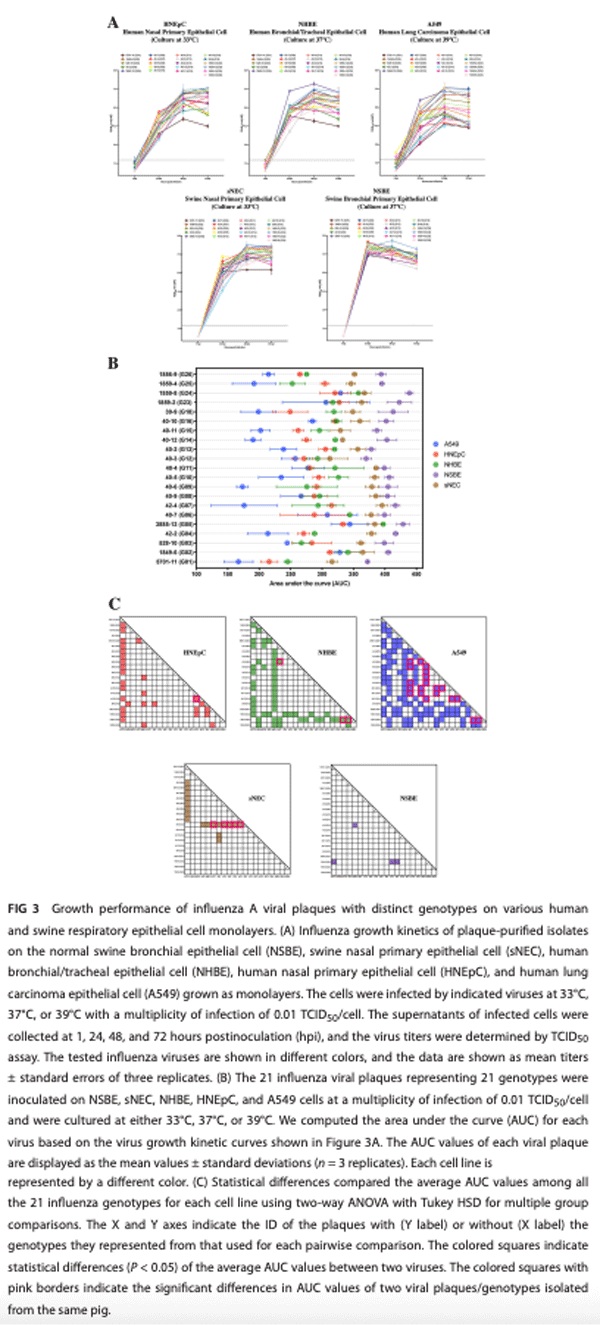
Differences in replicative fitness of distinct genotypes of influenza observed in human and swine respiratory cell monolayers
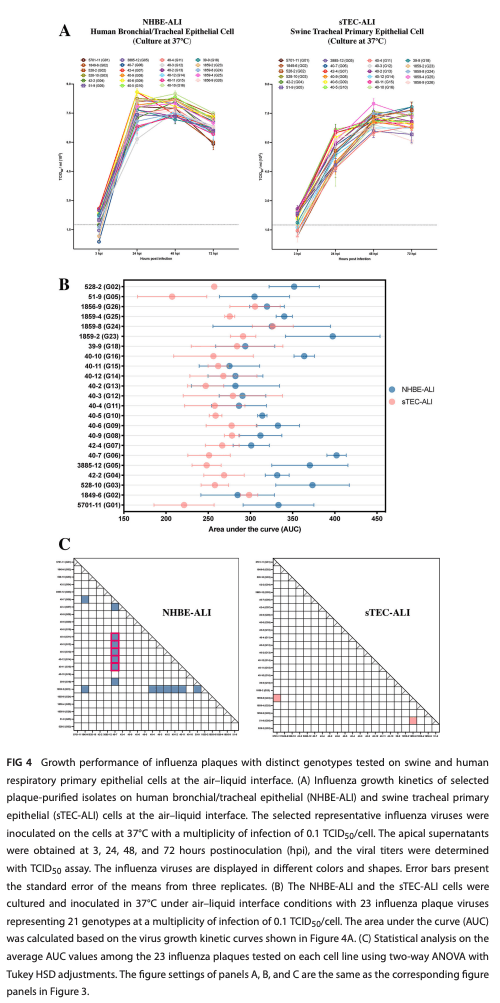
Influenza viruses with different gene combinations displayed efficient replication in swine and human respiratory cells at the air–liquid interface
DISCUSSION
MATERIALS AND METHODS
Cell lines
Swine field samples
Plaque assay for influenza purification
Whole-genome next-generation influenza sequencing
Genotype identification of influenza plaques
Differentiation of primary epithelial cells
Influenza growth kinetics on respiratory epithelial cells
Statistical analysis
1. Garten RJ, Davis CT, Russell CA, Shu B, Lindstrom S, Balish A, Sessions WM, Xu X, Skepner E, Deyde V, et al. 2009. Antigenic and genetic characteristics of swine-origin 2009 A(H1N1) influenza viruses circulating in humans. Science 325:197–201. https://doi.org/10.1126/science.1176225
2. Sun H, Xiao Y, Liu J, Wang D, Li F, Wang C, Li C, Zhu J, Song J, Sun H, Jiang Z, Liu L, Zhang X, Wei K, Hou D, Pu J, Sun Y, Tong Q, Bi Y, Chang K-C, Liu S, Gao GF, Liu J. 2020. Prevalent Eurasian avian-like H1N1 swine influenza virus with 2009 pandemic viral genes facilitating human infection. Proc Natl Acad Sci USA 117:17204–17210. https://doi.org/10.1073/pnas.1921186117
3. Pu J, Wang S, Yin Y, Zhang G, Carter RA, Wang J, Xu G, Sun H, Wang M, Wen C, et al. 2015. Evolution of the H9N2 influenza genotype that facilitated the genesis of the novel H7N9 virus. Proc Natl Acad Sci U S A 112:548–553. https://doi.org/10.1073/pnas.1422456112
4. Kim H, Webster RG, Webby RJ. 2018. Influenza virus: dealing with a drifting and shifting pathogen. Viral Immunol 31:174–183. https://doi.org/10.1089/vim.2017.0141
5. Lowen AC. 2017. Constraints, drivers, and implications of influenza A virus reassortment. Annu Rev Virol 4:105–121. https://doi.org/10.1146/annurev-virology-101416-041726
6. Ma EJ, Hill NJ, Zabilansky J, Yuan K, Runstadler JA. 2016. Reticulate evolution is favored in influenza niche switching. Proc Natl Acad Sci U S A 113:5335–5339. https://doi.org/10.1073/pnas.1522921113
7. Zhang X-S, De Angelis D, White PJ, Charlett A, Pebody RG, McCauley J. 2013. Co-circulation of influenza A virus strains and emergence of pandemic via reassortment: the role of cross-immunity. Epidemics 5:20–33. https://doi.org/10.1016/j.epidem.2012.10.003
8. Vijaykrishna D, Mukerji R, Smith GJD. 2015. RNA virus reassortment: an evolutionary mechanism for host jumps and immune evasion. PLoS Pathog 11:e1004902. https://doi.org/10.1371/journal.ppat.1004902
9. Steel J, Lowen AC. 2014. Influenza A virus reassortment, p 377–401. In Influenza pathogenesis and control-volume I. Springer.
10. McLean RK, Graham SP. 2022. The pig as an amplifying host for new and emerging zoonotic viruses. One Health 14:100384. https://doi.org/10.1016/j.onehlt.2022.100384
11. Ma W, Kahn RE, Richt JA. 2009. The pig as a mixing vessel for influenza viruses: human and veterinary implications. J Mol Genet Med 03:158. https://doi.org/10.4172/1747-0862.1000028
12. Taubenberger JK, Kash JC. 2010. Influenza virus evolution, host adaptation, and pandemic formation. Cell Host Microbe 7:440–451. https://doi.org/10.1016/j.chom.2010.05.009
13. Li C, Culhane MR, Schroeder DC, Cheeran MC-J, Galina Pantoja L, Jansen ML, Torremorell M. 2022. Vaccination decreases the risk of influenza A virus reassortment but not genetic variation in pigs. Elife 11:e78618. https://doi.org/10.7554/eLife.78618
14. Ganti K, Bagga A, Carnaccini S, Ferreri LM, Geiger G, Joaquin Caceres C, Seibert B, Li Y, Wang L, Kwon T, Li Y, Morozov I, Ma W, Richt JA, Perez DR, Koelle K, Lowen AC. 2022. Influenza A virus reassortment in mammals gives rise to genetically distinct within-host subpopulations. Nat Commun 13:6846. https://doi.org/10.1038/s41467-022-34611-z
15. Zhang X, Sun H, Cunningham FL, Li L, Hanson-Dorr K, Hopken MW, Cooley J, Long L-P, Baroch JA, Li T, Schmit BS, Lin X, Olivier AK, Jarman RG, DeLiberto TJ, Wan X-F. 2018. Tissue tropisms opt for transmissible reassortants during avian and swine influenza A virus co-infection in swine. PLoS Pathog 14:e1007417. https://doi.org/10.1371/journal.ppat.1007417
16. Chamba Pardo FO, Schelkopf A, Allerson M, Morrison R, Culhane M, Perez A, Torremorell M. 2018. Breed-to-wean farm factors associated with influenza A virus infection in piglets at weaning. Prev Vet Med 161:33–40. https://doi.org/10.1016/j.prevetmed.2018.10.008
17. Nirmala J, Perez A, Culhane MR, Allerson MW, Sreevatsan S, Torremorell M. 2021. Genetic variability of influenza A virus in pigs at weaning in Midwestern United States swine farms. Transbound Emerg Dis 68:62–75. https://doi.org/10.1111/tbed.13529
18. Diaz A, Marthaler D, Culhane M, Sreevatsan S, Alkhamis M, Torremorell M. 2017. Complete genome sequencing of influenza A viruses within swine farrow-to-wean farms reveals the emergence, persistence, and subsidence of diverse viral genotypes. J Virol 91:e00745-17. https://doi.org/10.1128/JVI.00745-17
19. Walia RR, Anderson TK, Vincent AL. 2019. Regional patterns of genetic diversity in swine influenza A viruses in the United States from 2010 to 2016. Influenza Resp Viruses 13:262–273. https://doi.org/10.1111/irv.12559
20. Lewis NS, Russell CA, Langat P, Anderson TK, Berger K, Bielejec F, Burke DF, Dudas G, Fonville JM, Fouchier RA, et al. 2016. The global antigenic diversity of swine influenza A viruses. Elife 5:e12217. https://doi.org/10.7554/eLife.12217
21. Vincent AL, Lager KM, Anderson TK. 2014. A brief introduction to influenza A virus in swine. Anim Influ Virus:243–258. https://doi.org/10.1007/978-1-4939-0758-8_20
22. Gao S, Anderson TK, Walia RR, Dorman KS, Janas-Martindale A, Vincent AL. 2017. The genomic evolution of H1 influenza A viruses from swine detected in the United States between 2009 and 2016. J Gen Virol 98:2001–2010. https://doi.org/10.1099/jgv.0.000885
23. Kitikoon P, Nelson MI, Killian ML, Anderson TK, Koster L, Culhane MR, Vincent AL. 2013. Genotype patterns of contemporary reassorted H3N2 virus in US swine. J Gen Virol 94:1236–1241. https://doi.org/10.1099/vir.0.51839-0
24. Rajão DS, Walia RR, Campbell B, Gauger PC, Janas-Martindale A, Killian ML, Vincent AL. 2017. Reassortment between swine H3N2 and 2009 pandemic H1N1 in the United States resulted in influenza A viruses with diverse genetic constellations with variable virulence in pigs. J Virol 91:e01763-16. https://doi.org/10.1128/JVI.01763-16
25. Ryt-Hansen P, Krog JS, Breum SØ, Hjulsager CK, Pedersen AG, Trebbien R, Larsen LE. 2021. Co-circulation of multiple influenza A reassortants in swine harboring genes from seasonal human and swine influenza viruses. Elife 10:e60940. https://doi.org/10.7554/eLife.60940
26. Richard M, Herfst S, Tao H, Jacobs NT, Lowen AC. 2018. Influenza A virus reassortment is limited by anatomical compartmentalization following coinfection via distinct routes. J Virol 92:e02063-17. https://doi.org/10.1128/JVI.02063-17
27. van Riel D, den Bakker MA, Leijten LME, Chutinimitkul S, Munster VJ, de Wit E, Rimmelzwaan GF, Fouchier RAM, Osterhaus ADME, Kuiken T. 2010. Seasonal and pandemic human influenza viruses attach better to human upper respiratory tract epithelium than avian influenza viruses. Am J Pathol 176:1614–1618. https://doi.org/10.2353/ajpath.2010.090949
28. Richard M, van den Brand JMA, Bestebroer TM, Lexmond P, de Meulder D, Fouchier RAM, Lowen AC, Herfst S. 2020. Influenza A viruses are transmitted via the air from the nasal respiratory epithelium of ferrets. Nat Commun 11:766. https://doi.org/10.1038/s41467-020-14626-0
29. Zhang X, Cunningham FL, Li L, Hanson-Dorr K, Liu L, Waters K, Guan M, Olivier AK, Schmit BS, Nolting JM, Bowman AS, Torchetti MK, DeLiberto TJ, Wan X-F. 2020. Tissue tropisms of avian influenza A viruses affect their spillovers from wild birds to pigs. J Virol 94:10–1128. https://doi.org/10.1128/JVI.00847-20
30. Chan RWY, Kang SSR, Yen H-L, Li ACL, Tang LLS, Yu WCL, Yuen KM, Chan IWW, Wong DDY, Lai WW, Kwong DLW, Sihoe ADL, Poon LLM, Guan Y, Nicholls JM, Peiris JSM, Chan MCW. 2011. Tissue tropism of swine influenza viruses and reassortants in ex vivo cultures of the human respiratory tract and conjunctiva. J Virol 85:11581–11587. https://doi.org/10.1128/JVI.05662-11
31. Lee M-S, Chen J-E. 2004. Predicting antigenic variants of influenza A/H3N2 viruses. Emerg Infect Dis 10:1385–1390. https://doi.org/10.3201/eid1008.040107
32. Lacroix G, Koch W, Ritter D, Gutleb AC, Larsen ST, Loret T, Zanetti F, Constant S, Chortarea S, Rothen-Rutishauser B, Hiemstra PS, Frejafon E, Hubert P, Gribaldo L, Kearns P, Aublant J-M, Diabaté S, Weiss C, de Groot A, Kooter I. 2018. Air–liquid interface in vitro models for respiratory toxicology research: consensus workshop and recommendations. Appl In Vitro Toxicol 4:91–106. https://doi.org/10.1089/aivt.2017.0034
33. Runstadler JA, Lowen AC, Kayali G, Tompkins SM, Albrecht RA, Fouchier RAM, Stallknecht DE, Lakdawala SS, Goodrum FD, Casadevall A, Enquist LW, Alwine JC, Imperiale MJ, Schultz-Cherry S, Webby RJ. 2023. Field research is essential to counter virological threats. J Virol 97:e0054423. https://doi.org/10.1128/jvi.00544-23
34. Laver WG, Air GM. 1985. Antigenic structure of influenza viruses.
35. Thomas DB, Patera AC, Graham CM, Smith CA. 1998. Antibody-mediated immunity, p 267–277. Textb Influ. Oxford: Blackwell Sci Ltd.
36. Bush RM, Bender CA, Subbarao K, Cox NJ, Fitch WM. 1999. Predicting the evolution of human influenza A. Science 286:1921–1925. https://doi.org/10.1126/science.286.5446.1921
37. Anderson TK, Chang J, Arendsee ZW, Venkatesh D, Souza CK, Kimble JB, Lewis NS, Davis CT, Vincent AL. 2021. Swine influenza A viruses and the tangled relationship with humans. Cold Spring Harb Perspect Med 11:a038737. https://doi.org/10.1101/cshperspect.a038737
38. Trovão NS, Nelson MI. 2020. When Pigs Fly: pandemic influenza enters the 21st century. PLoS Pathog 16:e1008259. https://doi.org/10.1371/journal.ppat.1008259
39. Wang D-Y, Qi S-X, Li X-Y, Guo J-F, Tan M-J, Han G-Y, Liu Y-F, Lan Y, Yang L, Huang W-J, Cheng Y-H, Zhao X, Bai T, Wang Z, Wei H-J, Xiao N, Shu Y-L. 2013. Human infection with Eurasian avian-like influenza A(H1N1) virus, China. Emerg Infect Dis 19:1709–1711. https://doi.org/10.3201/eid1910.130420
40. Parys A, Vandoorn E, King J, Graaf A, Pohlmann A, Beer M, Harder T, Van Reeth K. 2021. Human infection with Eurasian avian-like swine influenza A(H1N1) virus, the Netherlands, September 2019. Emerg Infect Dis 27:939–943. https://doi.org/10.3201/eid2703.201863
41. Xie J-F, Zhang Y-H, Zhao L, Xiu W-Q, Chen H-B, Lin Q, Weng Y-W, Zheng K-C. 2018. Emergence of Eurasian avian-like swine influenza A (H1N1) virus from an adult case in Fujian Province, China. Virol Sin 33:282–286. https://doi.org/10.1007/s12250-018-0034-1
42. Lopez-Moreno G, Davies P, Yang M, Culhane MR, Corzo CA, Li C, Rendahl A, Torremorell M. 2022. Evidence of influenza A infection and risk of transmission between pigs and farmworkers. Zoonoses Public Health 69:560–571. https://doi.org/10.1111/zph.12948
43. Rajão DS, Gauger PC, Anderson TK, Lewis NS, Abente EJ, Killian ML, Perez DR, Sutton TC, Zhang J, Vincent AL. 2015. Novel reassortant human-like H3N2 and H3N1 influenza A viruses detected in pigs are virulent and antigenically distinct from swine viruses endemic to the United States. J Virol 89:11213–11222. https://doi.org/10.1128/JVI.01675-15
44. Nelson MI, Vincent AL, Kitikoon P, Holmes EC, Gramer MR. 2012. Evolution of novel reassortant A/H3N2 influenza viruses in North American swine and humans, 2009–2011. J Virol 86:8872–8878. https://doi.org/10.1128/JVI.00259-12
45. Martin BE, Brooke CB. 2019. Flu shows the power of diversity. Cell 176:9–10. https://doi.org/10.1016/j.cell.2018.12.017
46. USDA. 2022. United States hog inventory down 2%.
47. Villa M, Lässig M. 2017. Fitness cost of reassortment in human influenza. PLoS Pathog 13:e1006685. https://doi.org/10.1371/journal.ppat.1006685
48. Meliopoulos V, Cherry S, Wohlgemuth N, Honce R, Barnard K, Gauger P, Davis T, Shult P, Parrish C, Schultz-Cherry S. 2020. Primary swine respiratory epithelial cell lines for the efficient isolation and propagation of influenza A viruses. J Virol 94:e01091-20. https://doi.org/10.1128/JVI.01091-20
49. Tobita K, Sugiura A, Enomote C, Furuyama M. 1975. Plaque assay and primary isolation of influenza A viruses in an established line of canine kidney cells (MDCK) in the presence of trypsin. Med Microbiol Immunol 162:9–14. https://doi.org/10.1007/BF02123572
50. Zhou B, Donnelly ME, Scholes DT, St George K, Hatta M, Kawaoka Y, Wentworth DE. 2009. Single-reaction genomic amplification accelerates sequencing and vaccine production for classical and swine-origin human influenza A viruses. J Virol 83:10309–10313. https://doi.org/10.1128/JVI.01109-09
51. Andrews S. 2010. FastQC: a quality control tool for high throughput sequence data. Babraham Bioinformatics, Babraham Institute, Cambridge, United Kingdom.
52. Bolger AM, Lohse M, Usadel B. 2014. Trimmomatic: a flexible trimmer for Illumina sequence data. Bioinformatics 30:2114–2120. https://doi.org/10.1093/bioinformatics/btu170
53. Seemann T. 2020. Shovill — assemble bacterial isolate genomes from Illumina paired-end reads. GitHub. San Francisco, CA, USA.
54. Chang J, Anderson TK, Zeller MA, Gauger PC, Vincent AL. 2019. octoFLU: automated classification for the evolutionary origin of influenza A virus gene sequences detected in U.S. swine. Microbiol Resour Announc 8:e00673-19. https://doi.org/10.1128/MRA.00673-19
55. Edgar RC. 2004. MUSCLE: multiple sequence alignment with high accuracy and high throughput. Nucleic Acids Res 32:1792–1797. https://doi.org/10.1093/nar/gkh340
56. Nguyen L-T, Schmidt HA, von Haeseler A, Minh BQ. 2015. IQ-TREE: a fast and effective stochastic algorithm for estimating maximum-likelihood phylogenies. Mol Biol Evol 32:268–274. https://doi.org/10.1093/molbev/msu300
57. Kalyaanamoorthy S, Minh BQ, Wong TKF, von Haeseler A, Jermiin LS. 2017. ModelFinder: fast model selection for accurate phylogenetic estimates. Nat Methods 14:587–589. https://doi.org/10.1038/nmeth.4285
58. Hoang DT, Chernomor O, von Haeseler A, Minh BQ, Vinh LS. 2018. UFBoot2: improving the ultrafast bootstrap approximation. Mol Biol Evol 35:518–522. https://doi.org/10.1093/molbev/msx281
59. Prosperi MCF, Ciccozzi M, Fanti I, Saladini F, Pecorari M, Borghi V, Di Giambenedetto S, Bruzzone B, Capetti A, Vivarelli A, Rusconi S, Re MC, Gismondo MR, Sighinolfi L, Gray RR, Salemi M, Zazzi M, De Luca A, ARCA collaborative group. 2011. A novel methodology for large-scale phylogeny partition. Nat Commun 2:321. https://doi.org/10.1038/ncomms1325
60. Spellerberg IF, Fedor PJ. 2003. A tribute to Claude Shannon (1916–2001) and a plea for more rigorous use of species richness, species diversity and the “Shannon–Wiener” Index. Glob Ecol Biogeogr 12:177–179. https://doi.org/10.1046/j.1466-822X.2003.00015.x
61. Ganti K, Bagga A, DaSilva J, Shepard SS, Barnes JR, Shriner S, Koelle K, Lowen AC. 2021. Avian influenza A viruses reassort and diversify differently in mallards and mammals. Viruses 13:509. https://doi.org/10.3390/v13030509
62. Reed LJ, Muench H. 1938. A simple method of estimating fifty per cent endpoints. Am J Epidemiol 27:493–497. https://doi.org/10.1093/oxfordjournals.aje.a118408












Hangzhou DE Mark Industrial Co Ltd

Enhancing Swine Reproduction by Improving Health and Reducing Oxidative Stress



United States