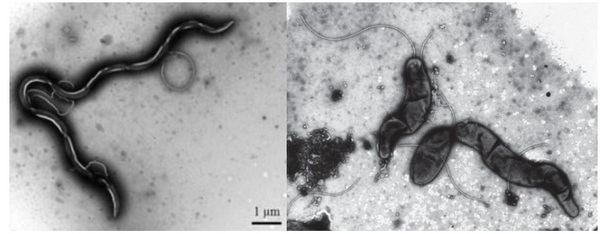
Brachyspira and Lawsonia are responsible of two major diseases at swine’s fattening stage: dysentery and ileitis. They look similar when you approach them, regardless how they are classified. We all believe it is clear when to addressone or the other, but they resemble making them extremely easy to be mixed up when we aim to diagnose.
Like if they were very close siblings we met at a party and with whom we chattered briefly, we would be doubtful time later about who was who. I like from time to time to do some catchup on any new findings or developments related to them while I take advantage of reading again on the basics. I am surprised to find how the information is outlined differently in same sources over the time, aiming to highlight the differences better than before. Devil (or disease in this case) is in the details.
LET´S GET TO THE POINT THROUGHOUT A FEW HINTS
Dysentery and ileitis are bacterial diseases caused, respectively, by Brachyspira hyodysenteriae (and, less commonly, B. hampsonii), and Lawsonia intracellularis.
I visited farms several times and when we got to the point of talking about disorders at fattening stage, I was surprised to hear too often that the farm was suffering of dysentery OR ileitis. 100%. Symptoms were very clear.
Diarrhea of a kind is never a pathognomonic symptom, and it is also quickly unveiled that tests to unmask any of the candidates have not been carried out, of course, but even if they were, we might be still unable to see the full picture. Nowadays human and veterinary medicine are stuck in testing, but the two basic principles of testing are not being carefully observed:
- Sensitivity (SN): the ability of a diagnostic test to correctly identify individuals who truly have the disease or condition. Therefore, a test with high sensitivity produces few false-negative results and it is especially useful for ruling out a disease: if the result of a highly sensitive test is negative, the individual is unlikely to have the disease.
- Specificity (SP): the ability of a diagnostic test to correctly identify individuals who truly do not have the disease or condition. Therefore, a test with high specificity produces few false-positive results and it is especially useful for confirming a disease: if the result of a highly specific test is positive, it is likely to be a true positive.
Focusing on the antemortem existing tests, Brachyspira could be diagnosed using more complex techniques like qPCR targeting, SN 87% and SP 98%, or more common ones like regular PCR, SN 73,2% and SP 96,2%. Lawsonia, in turn has available as well cutting-edge tests like a specific indirect ELISA, SN 98% and SP 99,3%, but conventional ELISAs could be extremely variable, SN 36-100% and SP 50-100% while qPCR targeting drops in this case to SN 84% and SP 93 %.
Even being lucky enough to get the right sample, the odds of ruling out involuntarily any of the pathogens must be kept in mind. Besides, finding one type does not mean the farm is clear of the other.
In fact, ileitis is an endemic disease present at almost every farm in Spain and this is the first point at which the certainty of having one or the other pathogen falls apart, while also gives a valuable lesson: farms are not sterile environments and disease does not relate to the absence or presence of a certain pathogen only. Coexistence and management of environmental and intestinal microbiota are the keys to keep not only a high amount of saprophytic bacteria but to keep out certain pathogens and keep other ones just controlled. There is no such a thing as a space empty of microorganisms. We aim to regulate the cohorts that fill it. Based on this reasoning it is not a coincidence that ileitis could be a subclinical disease showing only losses in productivity and maybe slightly higher mortality at the fattening stage while dysentery is always clinical. That is a first hint.
Dysentery is mostly represented in its pathology as a mucoid brown pastry diarrhea that turns into bloody diarrhea (with a dark-tarred look) that could entail rapid CC loss and mortality while ileitis could take forms of porcine intestinal adenopathy, necrotic enteritis and acute hemorrhagic ileitis. However, when it comes to evaluate photo stocks related to these pathogens at specialized sites, maybe all photos are not related to one but to both these pathogens as probable causing agents, which rules out symptomatology as a reliable diagnostic resource.
Age could apparently shed some light on making a difference, but 3tres3 site depicts dysentery related to 12-75kg pigs and ileitis to growing pigs and gilts without specifying weight, while Merk manual specifies for ileitis 18-36kg of live weight: two overlapped intervals. However, dysentery is the only one affecting piglets and using sows as carriers. We have a second hint.
As briefly introduced before, difference between the pathogens could be actually made based on other details and a convenient prophylaxis is also a way to rule out one or another bacteria. Dysentery is taken by the ingestion of contaminated feces, so if farm hygiene is poor, we could be pointing out dysentery. Certainly, prophylaxis always helps, but it has been assessed to not be that critical in case of ileitis as it is regarding the other pathogen, which contagion pathways are not fully understood (lack of previous exposure, no implementation of all in-all out systems or changes in feed are considered that could be targeting reasons). That would be a third hint.
It was mentioned before that Lawsonia is present almost at every farm in Spain but Brachyspira, in turn, though could be preserved up to 112 days in feces and could use fomites, mice, flies and birds for contagion, dies in 2 days if heat and dry exposure occur. Therefore, it is likely not to be a summer issue. Asking ourselves in which season we are will drive us closer to the goal, especially in dirty farm all year round. This could be a fourth hint.
AND BESIDES HANDLING?
Antibiotics and vaccines are resources available in both cases and, as it happens in the confrontation of any bacteria, preventive use of antibiotics is not allowed in the EU.
- Due to endemic nature of Lawsonia, though the uncertainty on the contagion pathways exist, makes evident that antibiotic programs and vaccination are not sufficient by themselves. Antibiotics available are tiamulin, tylosin and certain valnemulins while there is also live attenuated vaccine to be used from 3 weeks onwards and could last up to 17 weeks, which would leave some weeks empty at finishing
- Brachyspira is also treated with tiamulin and valnemulin and low sensitivity to them has been detected by certain strains. A particular feature of this microorganism is that it does not trigger adaptative immunity for long, which is observed by a quick drop of IgG and IgA in the antibiogram. Nevertheless, first authorized vaccine in the EU has shown up in the year 2025
THE OTHER RESOURCE
As depicted above, handling and prevention are the cornerstones to effectively fight Lawsonia and Brachispira while vaccines and antibiotics are supportive measures. It should be also kept in mind the role that phytobiotic, organic acids and chelates play against bacterial diseases and how combinations of these are designed not only to act nonspecifically against certain pathogens, but could be also designed to counteract specific ones. Even being presumed evident properties of individual ingredients (e.g.: a greater effectivity of essential oils against Gram+ bacteria) surprising effects could be found when specific combinations are tested in vitro and in vivo.
According to this aim, Liptosa designed and successfully sells a specific product specifically engineered to be used against Lawsonia and Brachyspira based on a phytobiotic core, together with organic acids, glycerides and chelates to be used from the feed change before the presumable outbreaks occur at affected farms, not being only an unique resource additional to antibiotics and vaccines, but also being able to protect the animals until the end of the cycle due to the absence of withdrawal period to be observed in contrast with antibiotics and the limited protection of vaccines time-wise.
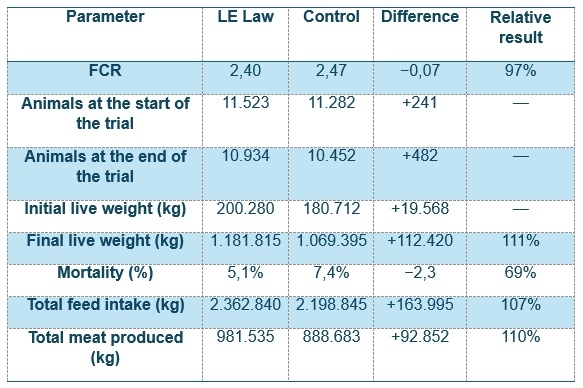
As an example of the product potential, the following field trial was conducted in Catalonia, Spain, between 2019 and 2020, with pigs during the growing and fattening phases, up to slaughter in a Lawsonia endemic farm.
At the end of the trial, 31% lower mortality, 10% more meat produced and improved FCR (from 2,47 to 2,4) were observed.