
Content sponsored by:
LIPTOSA
Essential oils as an antibiotic alternative in pigs
Published: March 9, 2026
Source : Fernando Aguado, Degree in Veterinary Sciences, Export Area Manager Western Europe
Scientific rationale and the value of synergistic blends
WHY SCIENCE MATTERS MORE THAN “NATURAL” CLAIMS?
Pig production is undergoing a structural shift driven by antimicrobial-resistance concerns and stricter stewardship expectations. In the European Union, antibiotic growth promoters have been banned for years, and therapeutic use is increasingly controlled while prophylactic is no longer allowed. Producers are therefore expected to maintain performance and welfare with fewer antimicrobial “shortcuts, ” especially after weaning, when intestinal stability is fragile and pathogen pressure can rise quickly. This reality has accelerated the search for practical, reliable alternatives that help stabilize the gut and reduce the need for medication.
The transition is not about finding a single “natural substitute” for antibiotics. The practical objective is to build a toolbox that improves resilience throughout compounds that could fight back pathogens remaining profitable without the drawbacks related to antibiotics. Several additive categories can contribute to this approach—organic acids, enzymes, probiotics and prebiotics, antimicrobial peptides, and phytogenic compounds. Among phytogenics, essential oils (EOs) stand out because they contain a major lipophilic fraction enclosing several compounds that englobe multi-target antimicrobial strategy that can act on microbes through more than one pathway.
ESSENTIAL OILS: COMPLEXITY AND VARIABILITY
Essential oils are complex mixtures of volatile compounds produced by plants and obtained through physical extraction processes only, such as steam distillation, cold pressing, and CO₂ extraction and several others. The composition of any essential oil is variable and potential is not predictable. These matters can vary with plant species, the botanical part used, agronomic and environmental conditions, geographical origin, harvest timing, and of course, the extraction method. Therefore, even in case of confronting two apparently identical essential oils, composition and concentration wise, they are likely to perform differently in vitro and in vivo.
From a chemistry standpoint, EOs contain a “cocktail” of constituents including terpenes (mono-, sesqui- and diterpenes), alcohols, acids, esters, epoxides, aldehydes, ketones, amines, and sulfides.
MECHANISMS OF ACTION IN BACTERIAL CELLS
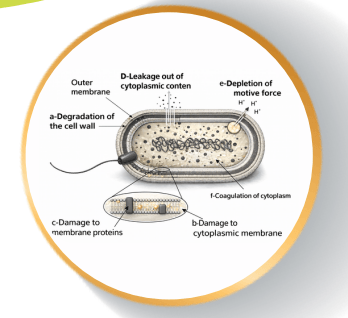
The antibacterial mode of action is not completely elucidated, yet several mechanisms are repeatedly proposed. Hydrophobicity appears central: many EO components can integrate into lipid membrane, thus altering its structure and affecting its permeability. Downstream effects may include disruption of the cell wall and membrane, leakage of intracellular contents, disturbance of cellular energy balance (ATP), and alterations in intracellular pH. Additional proposed actions include induction of stress responses, intracellular coagulation, DNA damage, and anti-quorum sensing activity—interfering with bacterial communication and coordination.
FROM IN VITRO RESULTS TO IN VIVO REALITY
A critical point is that antimicrobial potential evaluation of the EO is not straightforward. EO are volatile and poorly soluble in water, which can complicate laboratory assays and introduce variability. Moreover, the lack of fully standardized testing across studies makes direct comparisons difficult. Even when in vitro antimicrobial activity is clear, translating those findings to the pig’s gastrointestinal tract is not automatic. The feed matrix, gut pH, digestive secretions, microbial ecology, and contact time all influence whether an active compound reaches the relevant site at an effective concentration.
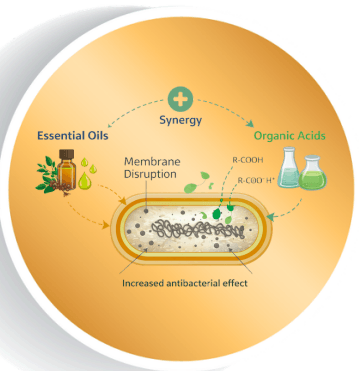
For this reason, formulation and delivery are as important as ingredient choice. Approaches that protect essential oils and improve their availability—while minimizing losses during feed processing or early digestion—can be decisive for consistent on-farm outcomes. Beyond protection, a particularly promising strategy is the rational design of combinations tailored to specific challenges. Synergy can occur among different essential oils, organic acids and antibiotics.
THE VALUE OF SYNERGY
Beyond protection, a particularly promising strategy is the rational design of combinations tailored to specific challenges. Synergy can occur among different essential oils, organic acids and antibiotics.
Digging into the synergy with the organic acids, their action is enhanced by the prior disruption of the bacterial membrane carried out by essential oils. This allows both non-dissociated and dissociated organic acid forms to enter the cell; without it, the dissociated acids would be unable to cross the membrane. As a result, organic acids can act more effectively against bacteria regardless of their pKa, improving consistency of antimicrobial performance across different pHs.
In conclusion, essential oils represent a technically grounded option within a broader, integrated health strategy for pigs. Their value is not simply that they are “natural, ” but that they provide chemical complexity, multi-mechanistic activity, and the potential for synergy when blends are designed rationally and delivered effectively. Manufacturers that seek specific solutions must work themselves on testing because of the impossibility of fully predicting the potential of any preparate documentation-wise. Conclusion is clear both for manufacturers and end users: an assessment is always necessary to truly evaluate an essential oil potential or the one of any product based on an extract of this kind.
A REAL APPROACH
Liptosa’s core business is the optimal design of phytobioticbased solutions—selecting, combining, and standardizing botanical actives to achieve reliable efficacy under real production conditions. A key part of this work is recognizing that the “potential” of essential oils cannot be assumed from tradition or isolated literature claims: it must be demonstrated and quantified through a structured pipeline of in vitro screening and in vivo validation.
A good example of why this approach matters is illustrated in the table below. Even though one would typically expect certain essential oils to show stronger activity against Gram positive bacteria, the data show that a blend of six essential oils (including Origanum vulgare and Syzygium aromaticum oils) combined with organic acids and their salts is more efficient against certain Gram negative strains.
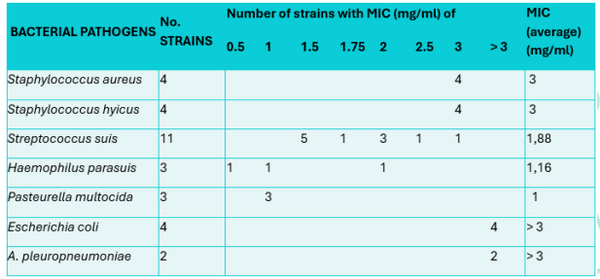
For this reason, constant experimentation is not optional but essential. Only continuous testing and iterative refinement allow us to identify the right combinations, optimize doses, and translate promising phytobiotic concepts into products that perform consistently, batch after batch, and farm after farm.

Related topics:
Authors:


Recommend
Comment
Share

Would you like to discuss another topic? Create a new post to engage with experts in the community.
Featured users