DESCRIPTION OF PROBLEM
Soybean meal is the most commonly used oilseed meal in United States poultry diets. Soybeans are primarily grown for their oil content and a by-product of the oil extraction process is defatted soybean meal. Soybean meal is often referred to as the “Gold Standard” of protein ingredients used for poultry because it contains a high amount of protein, e.g., 44 to 49 % CP, and an amino acid profile that is complementary to that of corn and other cereal grains (Cromwell, 2012). However, there are other by-products produced through the production of purified soybean oil, i.e., gums and soapstocks, of which this research investigates. These by-products will be referred to as soybean “add-backs”. Soybean add-backs are lipid-based compounds removed from crude soybean oil during the oil refinement process. They include soybean gums and soybean soap stocks. Soybean gums are removed from soybean oil through a process known as “degumming”. In this process phosphoric acid and water are added to crude soybean oil which causes the phospholipid-based gums to be precipitated (Daun, 2004). After degumming, sodium hydroxide is added to precipitate the soap stocks from the oil which are composed of free fatty acids and a mixture of mono and diglycerides (Viera et al., 2015). Because soybean gums and soap stocks are lipid based, these authors hypothesized that they could be incorporated into the soybean meal portion of the diet with no negative consequences on broiler performance, or possibly improvements due to higher dietary energy. Therefore, the objective of this research was to investigate the effects of inclusion of soybean “add-backs” ingredients in broiler diets on live performance, gut health, processing characteristics, and body composition.
MATERIALS AND METHODS
Bird husbandry
Cobb 500 chicks used in this research were vaccinated for Marek’s, infectious bursal disease, and coccidiosis, and then vent sexed. Upon arrival to the University of Arkansas Poultry Research Farm, chicks (1,200 males) were placed in floor pens measuring 1.22 m x 1.83 m at an allocation of 24 birds per pen for a total of 50 floor pens. Each pen was equipped with a hanging feeder, a section of continuous nipple drinker line (5 nipples per pen), and fresh pine shavings. Initial temperature set points were set at 32.2 C and gradually reduced to 18.3 C at the conclusion of the experiment (45 d). Water flow rates were set at 21 mL per min and increased by 7 mL per min per wk until 56 mL per min was reached at d 38. Lighting schedules from incandescent light were set for light:dark cycles of 24:0, 23:1, and 18:6 from placement to d 1, d 2 to 7, and d 8 to 45, respectively. Corresponding intensities were 54, 32, and 22 lux, respectively. Light intensities were verified at bird level using a light meter (LT300, Extech Instruments, Waltham, MA). All research herein and bird care were approved by the Division of Agriculture Institutional Animal Care and Use Committee of the University of Arkansas System.
Experimental diets
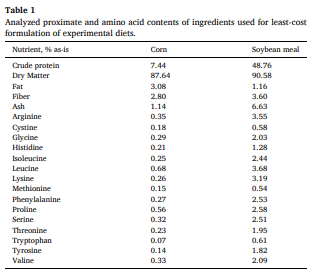
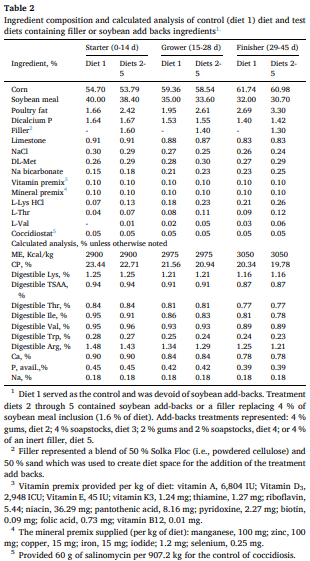
Experimental diets were fed throughout the entire duration of the growing cycle (0 to 45 d) and were broken into three feeding phases: starter (0 to 14 d), grower (15 to 28 d) and finisher (29 to 45 d). Five corn and soy-based diets (10 replicates per treatment) were formulated with soybean meal containing various levels of soybean gums and soapstock inclusions or the addition of an inert filler. The soybean gums and soapstocks were included as treatments without assigned energy values to mimic soybean crush plant additions of these add backs to soybean meal. Calculated energy values of test diets were based solely on the energy contributed from the other ingredients. Diet 1 contained soybean meal with no add-backs whereas diets 2 through 5 contained soybean meal with either 4 % gums, 4 % soapstocks, 2 % gums and 2 % soapstocks, or 4 % of an inert filler, respectively. Diet 1 was mixed independently. However, to reduce variability caused by differences in feedstuff composition, a common basal diet was formulated for diets 2 through 5 to which the add-backs ingredients were added to create the experimental treatments. When mixing diets 2 through 5, first the basal diet less the soybean meal was mixed and set aside in the starter and moved to a designated bin in the grower and finisher mixes. Subsequently, the soybean meal was added to the mixer along with the addbacks ingredients. After the add-backs ingredients were incorporated into the soybean meal, the correct amount of the basal diet was added into the mixer and the diet was mixed further prior to pelleting. Prior to formulation, samples of corn and soybean meal used in experimental diets were submitted for analysis of proximate and amino acid content (Table 1). Analysis procedures followed methods from the Association of Official Analytical Chemists (AOAC, 1990) for methods 942.05 (ash), 930.15 (dry matter), 920.39 (fat/oil), 990.03 (crude protein) 978.10 (crude fiber), 982.30 (amino acids by hydrochloric acid), 994.12 (amino acids by performic acid), and 988.15 (amino acids by sodium hydroxide). All diets were formulated to have the same energy level, except for any additional energy obtained by the addition of add-backs ingredients (Table 2). All essential amino acids were formulated to meet minimum ratios (Cobb, 2022) across the five treatments (Table 2).
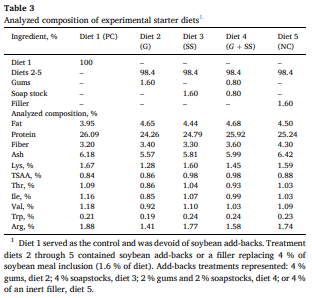
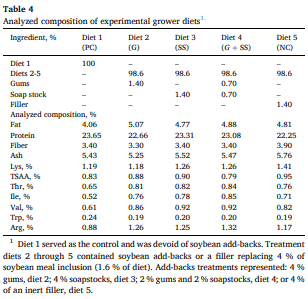
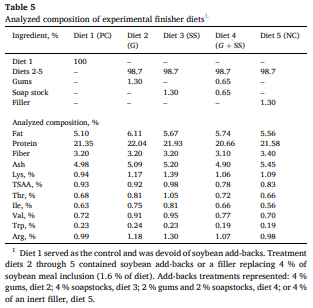
All diets were mixed in a vertical screw mixer, pelleted at 65.5◦C, and bagged. Representative composite samples were collected during bagging prior to analyses of proximate analysis and total amino acids (Tables 3, 4, 5). Analysis procedures followed Association of Official Analytical Chemists (AOAC, 1990) methods previously described.
Measurements
Pen BW were collected at the start and conclusion of each feeding phase. Feed intake was recorded for the duration of the experimental period. Prior to placing feed into feeders, the weight of the empty feeder was recorded. Weight of feed placed was recorded and any additional feed was also weighed. Mortality was collected twice daily, and BW of dead birds were recorded. Pen BW were obtained using a Mosdal Small Cart scale (Mosdal Scale Systems, Inc. Lanesboro, MN). Individual BW gain was obtained by subtracting initial from final pen BW divided by number of birds. For FCR, pen feed intake was divided by the summation of pen BW gain and corrected for mortality BW by pen. For gut integrity, two birds per pen post 45 d data collection were randomly selected for determination of intestinal integrity via fluorescein isothiocyanatedextran (FITC-D). Each bird was orally gavaged with FITC-D (8.32 mg/kg, MW 3-5 kDa, Sigma-Aldrich, St. Louis, MO) and blood was collected one hour post gavage. Serum FITC-D concentrations were determined as described in Ruff et al. (2020). Fluorescence was measured at an excitation wavelength of 428 nm and emission wavelength of 528 nm using the Synergy HT multi-mode micro plate reader (BioTek, Winooski, VT).
Following each weigh period, one bird per pen was individually weighed, tagged, euthanized via CO2 inhalation, and analyzed for body composition using dual x-ray absorptiometry (GE, Madison, WI) with small animal body software module (Lunar Prodigy from GE encore version 12.2). Prior to selecting regions of interest and scanning birds, a complete daily quality assurance procedure was performed, and birds were scanned to determine protein, fat, and mineral mass following the procedure of Caldas Cueva (2015). The complete daily quality procedure consisted of analyzing a phantom block of know composition to evaluate calibration accuracy of the dual x-ray absorptiometry equipment.
At d 45, after completion of all live production, body composition, and gut integrity data collection, birds were subjected to a 10 h feed withdrawal and six randomly selected birds per pen (300 total birds) were transported (1.5 h) to the pilot processed plant following procedures of Kidd et al. (2025). Post chill carcasses were then deboned on a single debone line to obtain carcass part weights (Mettler Toledo IND236), which included: two boneless and skinless breast fillets (Pectoralis major), two tenderloins (Pectoralis minor), wings, and legs without back (bone-in and skin-on). Carcass and part yields were calculated using the weight of various cuts divided by fasted live BW. Following deboning, breast fillets were evaluated for the incidence and severity of woody breast. One individual subjectively scored breast fillets via tactile evaluation on a scale of 0 to 2. Breast fillets with a score of 0 exhibited no hardness in the caudle region of the breast fillet, breast fillets with a score of 1 exhibited hardness in the cranial and caudle region of the breast fillet but remained flexible in the mid region of the fillet, and breast fillets with a score of 2 exhibited stiffness throughout the fillet including the mid region as previously described (Maynard et al., 2022).
Statistical analysis
Pen was considered the experimental unit and treatments were assigned to pens in a randomized complete block design with pen location serving as the blocking factor. The five treatments (10 replicate pens of 24 birds each) were analyzed using a One-way ANOVA using JMP® Pro software (JMP Statistical Discovery LLC, Cary, NC) with diet as the fixed effect and block as a random effect. Statistical significance was considered at P ≤ 0.05. Where applicable, means were separated using a Tukey’s range test.
RESULTS AND DISCUSSION
Analyzed proximate analysis and amino acid levels for the experimental diets were in close agreement with calculated total levels and remained similar in all diets (Tables 3, 4, 5). Average BW at d 45 was 3.671 kg with an average mortality of 6.67 %. Most of the mortality occurred at the near the end of the growing cycle due to heart attacks. Mortality was not influenced by dietary treatments (P > 0.05).
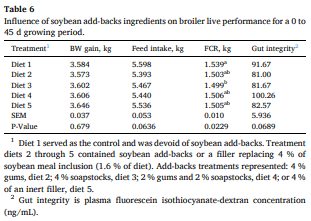
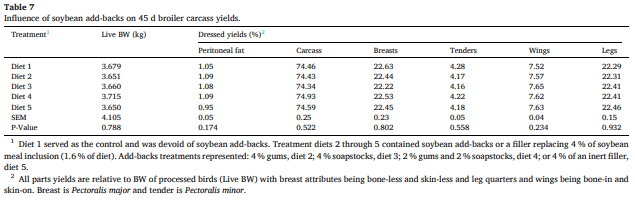
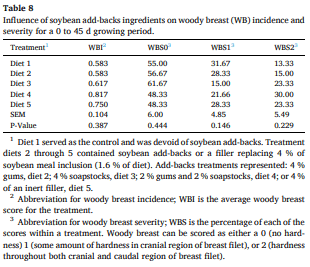
There was no significant effect of soybean add-backs ingredients on BW gain, feed intake, or plasma FITC-d concentration (Table 6). However, there was a significant effect of dietary treatment on FCR. Birds fed diet 1 had a higher FCR compared to birds fed diet 3, with birds fed diets 2, 4, and 5 being intermediate (Table 6). Diet 1 contained overall less fat inclusion compared to Diets 4-5. Dietary fat has been shown to reduce passage rate of the digesta through the gastrointestinal tract which may allow for better nutrient absorption and utilization leading to a reduced FCR (Peebles et al., 2000; Baiao ˜ and Lara, 2005; Latshaw, 2008). Regarding carcass traits, no significant responses were observed for dietary treatment on processing yields (Table 7), incidence or severity of woody breast (Table 8), or body composition (Table 9).
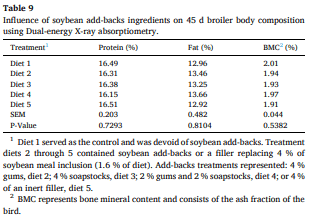
These data demonstrate that overall bird live performance and processing characteristics were not affected by inclusion of soybean addback ingredients. Soybean gum and soapstock additives were able to be incorporated into the diet at a level of 4 % of soybean meal proportion without loss in performance. It could prove beneficial for more research to be conducted under different settings, including lower diet energy levels, use of a lower quality soybean meal, and higher inclusion of the test ingredient. The characterization of ingredient quality of the add-backs is limited, when established, further research testing add backs with the incorporation of exogenous enzymes may prove industry applicable. In this experiment, the basal diet energy levels were formulated to current recommendations (Cobb, 2022). Therefore, any benefit that may have been conferred through the addition of added energy was minimized. Moving forward, it would be beneficial to observe how birds respond to soybean add-backs when fed a diet limiting in energy. Moreover, no statistical difference was detected for any parameter aside from FCR, but some parameters approached significance: feed intake, P = 0.06; plasma FITC-d concentration, P = 0.07; fat yield, P = 0.17. Perhaps with higher inclusion of the test ingredients these means could be statistically separated further. Lastly, the rational behind this experiment was that soybean gums and soapstocks, which are considered impurities in soybean oil, might be added back to soybean meal to create a value-added, higher energy soybean meal. However, the soybean meal used in this experiment had a CP level of above 48 %, resembling excellent quality soybean meal. Adding these addbacks ingredients to a lower quality soybean meal (e.g., 44 % CP) may have additional practical merit following the former rational.
CONCUSIONS AND APPLICATIONS
1. Broiler live performance and processing characteristics were not affected by dietary inclusion of soybean add-backs ingredients (e.g., gums and soapstocks from crude oil processing).
2. Soybean gum and soapstock additives were able to be incorporated into the diet at a level of 4 % of soybean meal proportion without loss in performance.
3. Soybean gums and soapstock materials have the potential to be used as a low-cost energy supplement for broiler diets.
This article was originally published in Journal of Applied Poultry Research 34 (2025) 100596. https://doi.org/10.1016/j.japr.2025.100596. This is an Open Access article under the CC BY-NC-ND license (http://creativecommons.org/licenses/by-nc-nd/4.0/).