Increasing barn wind speed is not sufficient to maintain cows in normal body temperature under summer heat stress conditions
Published: January 5, 2026
Source : Israel Flamenbaum / Cow Cooling Solutions Ltd, Israel.
Heat stress poses a significant challenge for dairy cows, particularly in warm climates, as it hampers their physiology, behavior, and milk production. A study carried out in Hungary and published recently (Journal of Thermal Biology 135, 2026) investigated the effect of increasing barn wind speed by using modern fans on cows' behavior and performance.
The research took place in a large-scale dairy farm (1000 cows), with high yielding cows (average daily milk production above 50 kg), and studied the effectiveness of using "modern fans" equipped with temperature-dependent fans in alleviating heat stress and enhancing cow welfare and productivity, as compared to old "box fans" already existing in the farm for more than 25 years.
The experiment compared two high-yielding groups of around 100 cows each. The experimental group was housed in a barn with newly installed louvered, temperature-dependent "circulation fans" (providing high airspeed), while the control group remained in a barn with "box ventilators" (low airspeed). Wind speed in the experimental barn was notably higher (1.5–2.5 m/s) than in the control barn (0.2–0.5 m/s).
Environmental conditions were monitored using data loggers that recorded temperature and humidity, enabling calculation of the temperature-humidity index (THI). Cow body temperature was measured intravaginally once every month during the summer months. Additionally, time spent lying, eating, and ruminating was also tracked. Daily milk yields were obtained from the farm’s database.
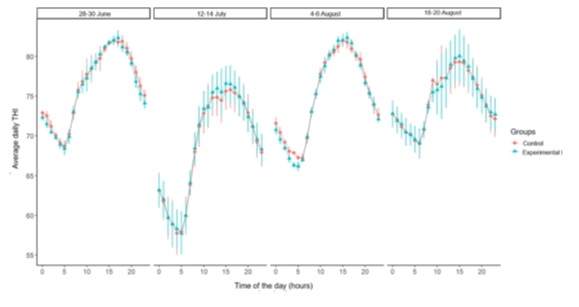
THI values in both barns surpassed the heat stress threshold (THI > 68) for most of the summer experimental period, as can be seen in Fig. 1.
Fig. 1 - The average per hour along the day of the temperature-humidity index (THI) in the barns during the experimental period
- The figure was copied from the article
Body temperature of the cows in the high and low wind speed barns is presented in Table 1.
Table 1 - Average body temperature (°C) of cows in the high and low speed barns during the summer months

Body temperature of cows in the high wind speed barn was significantly (P< 0.05) lower than that of cows in the low wind speed barn. Anyhow, body temperature was above normal (< 39.2 °C) in all measurements in both groups.
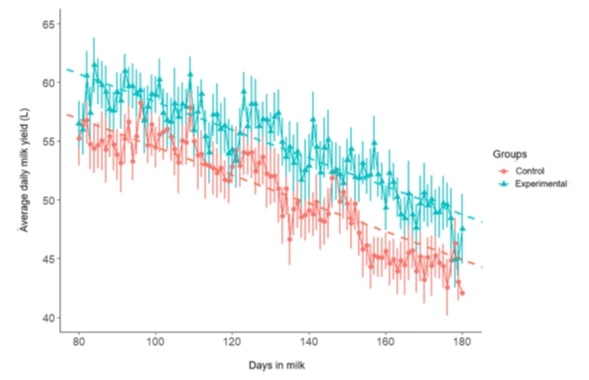
While lying time did not vary significantly, eating and ruminating time increased in the experimental group over the study period. Milk yield was approximately 3 L/day higher (p < 0.05) in the experimental group. Daily milk production during the summer months in the two experimental groups is described in Fig. 2.
Fig 2 - The average daily milk yield of the cows between days in milk (DIM) 80 and 180 in the two experimental groups
- The figure was copied from the article.
The results of this experiment give us two important insights:
- Enhancing barn wind speed by replacing old "box fans" providing wind speed of less than 0.5 m/sec with modern "circular fans" providing wind speed close to 2.5 m/sec, significantly reduces the cow's body temperature and allows them to obtain higher feed consumption and milk production in the summer.
- Enhancing barn wind speed does not prevent the increase in the cow's body temperature in periods where the average daily THI is above the threshold of 68.
From the experience already existing, we know that cooling the cows by a combination of wetting and high-speed, forced ventilation for 6 cumulative hours per day, is capable to maintain cows in normal body temperature in the entire summertime. Cooling the cows in such manner will permit even higher milk production than that obtained in this experiment, when using high-speed fans alone, without combining it with wetting the cows.
The cost of ventilation (fans purchasing and operation) is near 80% of the total cost of cooling the cows by combining it with wetting. Therefore, there is no reason to use high-speed fans only, without combining it with wetting the cows.
Related topics:
Authors:

Recommend
Comment
Share

Would you like to discuss another topic? Create a new post to engage with experts in the community.







Featured users in Dairy Cattle




José Manuel Oropeza Meza
MSD - Merck Animal Health
Gerente Nacional Cuentas Clave en MSD Salud Animal
United States
United States