Background
This brief paper is focused on the production of milk on dairy farms in North America and elsewhere, and how this is influenced by management and scale of farms and dairy enterprises. Projections of how dairy farming may change by 2050 have been forecast (Britt et al. 2018 and Britt et al. 2021). Dairy programs differ significantly between the USA and Canada, but it is not an intent of the author to say what is best, but rather to focus on systems that affect stability and have driven larger scale farms.
Numerical values referred to in this paper reflect recent data from USA or Canadian government agencies, dairy agencies, or related businesses. At the end of 2023, the USA had 9.4 million dairy cows in an estimated 27,932 herds that were producing 10,955 kg of milk annually. Canada had 9,739 herds with an average yield the same as the USA. The average dairy herd in the USA had 336 head of milking cows, slightly over 3-times the size of an average milking herd in Canada. In the USA, 52.3% of dairy cows were in five states in rank order: California, Wisconsin, Idaho, Texas, and New York. In Canada, 70% of the dairy cows were in Quebec (37.2%) and Ontario (32.6%). In 2022, consumption of all dairy products (milk, butter, yogurt, cheese, etc.) in the USA averaged 297 kg per person on a milk-equivalent basis. Over the last two decades, dairy consumption in the US has increased an average of 1.3 kg per person per year.
A significant difference between the USA and Canada is how dairy farms are established. In the USA, a dairy farm can be established by meeting the permits for producing Grade A milk, having access to a dairy processing plant, and having the land and dairy-related resources to do so without adversely affecting the environment. Dairy farms in both countries must have a demand for milk within their region and must be able to supply it to a processing facility at a reasonable cost. The USA does not have a nationwide quota system for milk production; however, some milk processing cooperatives have quotas for farms that produce their milk. Canada is different from the USA because it imposes a start-up fee per cow that will be milked on that farm. This limits milk supply in a way that makes prices paid per liter of milk typically greater in Canada than the USA.
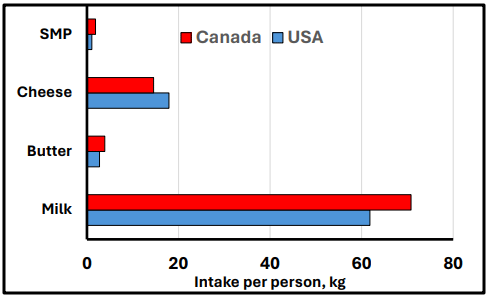
Both the USA and Canada have significant intake of dairy products per capita (Figure 1). On a total milk equivalent basis, the USA ranked second in the world in milk consumption, just behind the European Union. Canada ranked fifth after New Zealand and Australia. The values in Figure 1 may underestimate true intake because not all dairy-based products may be included.
Figure 1. Intake of dairy products, expressed on a milk-equivalent basis for 2022 (SMP is skim milk powder). Source: https://www.clal.it/en/?section=tabs_consumi_procapite
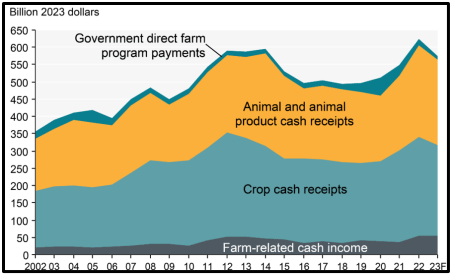
Canadians may believe that farmers in the USA receive substantial income from government subsidies, but Federal data do not support that belief. In the past two decades, the percentage of farm income from government subsidies has been negligible in the USA (Figure 2). Any farmer may receive income from the Conservation Reserve Program, which provides annual payments to farmers that maintain permanent crops on land subject to long-term significant erosion.
USA dairy farmers may participate in the Dairy Margin Coverage Program by paying premiums to receive coverage if regular payments for their milk drop below specified levels. There are restrictions on the amount of milk that can be covered by one dairy farm. The current amount for this restriction is five million pounds of milk annually (https://www.fsa.usda.gov/programs-andservices/dairy-margin-coverage-program/index). This equates to a herd of 217 cows, which is 30% smaller than the average USA dairy herd.
Figure 2. USA cash farm income from 2002 to 2022. Source:(https://www.ers.usda.gov/webdocs/charts/90818/CTEgcfidecomposedrealwithforecastN ov2023.png?v=6379)
Westward
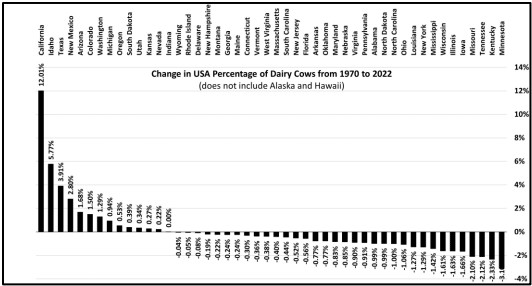
Dairy farming in both the USA and Canada grew initially in eastern states and provinces, with exceptions of certain areas on the west coast. Now, dairying has clearly moved westward in both countries, as illustrated for the USA in Figure 3. This has been driven primarily by larger tracts of available land to establish larger dairy farms, but western dairying has also been driven by increased population in western states or provinces. For example, there has been significant increase in dairying in Texas as it has grown into the USA’s second most populous state.
Figure 3. Change in percentage of dairy cows in various states in the USA from 1970 to 2022.
In both the USA and Canada, the largest dairy farm operations may keep cows and heifers in various locations, often with age-groups in different states or provinces. This is particularly true in the USA, where milking cows may be concentrated in more northern regions, and heifers raised in states farther south, where animals may be in pastures with shades without access to barns. Large dairy farm complexes in the USA may exceed 30,000 head with all-aged calves, heifers, and cows in a common location. Bull calves are most often sent to separate farm operations where bull calves are raised as steers in a feedlot-type setting. Use of sexed semen has boosted the percentage of bull calves, and it is more common to have feedlots comprised of Holstein steers.
The Most Important 100 Days for Best Fertility in Dairy Cows
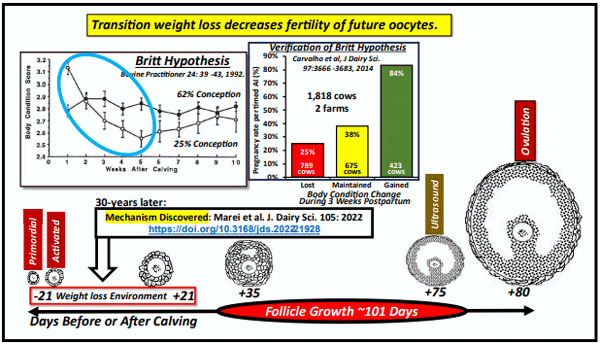
Cows are mammals and must deliver a calf to produce milk. A newborn calf’s original cells developed when its dam was a fetus within its granddam’s uterus. When the calf-to-be was developing in its dam’s uterus that was within its granddam’s uterus, its ovaries were the site where the female germ cells (oocytes) developed. Thus, a pregnant cow represents three generations: the dam, the fetus in the dam’s uterus, and the developing ovary in that fetus which is the next generation. By around the middle of the fetus’s 9-month development, her two ovaries become populated by a million or more germ cells which will eventually develop into oocytes for the next generation. Over the life of the female calf, heifer and cow, batches of germ cells develop as oocytes (eggs) and one or two will ovulate just after estrus (heat) in the heifer or cow. The important thing to remember is that the oocyte takes about one hundred days to mature to the point that it is ovulated as an “egg.” During this 100-day maturing process, the oocyte can be damaged by biological and environmental effects (Figure 4). For example, oocytes exposed to heat stress during development may be fertilized, but they rarely develop more than 10 days before dying from the effects of the former heat stress. Similarly, when eggs begin developing in the cow’s ovaries around the time that she calves, the eggs can be damaged if the cow loses significant weight around calving and during the early postpartum period. This is one of the reasons that we would rather have cows be a little thinner than has traditionally been the case, because their appetite will be greater if they are a bit thinner. We would rather have cows calving with a body condition sore of 3.0 rather than 4.0. If cows lose significant body condition around calving, it is best to delay first breeding to about one hundred days postpartum.
Figure 4. Oocyte development and impact of body weight loss on fertility.
Manure Management
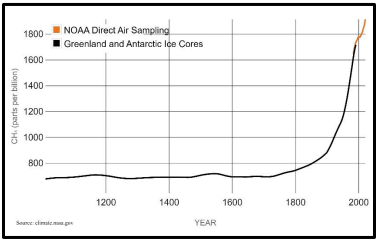
Global temperature has been increasing since 1800, primarily because of industrialization and accumulation of atmospheric gases that trap heat in the global ecosystem (Figure 5). There are concerns that temperature may increase sufficiently to have a greater impact on global warming. Agricultural practices can contribute to this problem, and one significant factor is methane gas from manure accumulating in the atmosphere.
Figure 5. Change in methane concentration in the earth’s atmosphere over 1000 years. Source: https://climate.nasa.gov/vital-signs/methane/
Manure from cattle can be a significant source of methane emissions, depending on how their manure is handled. When manure is excreted in pastures and dries, there are lower amounts of emissions. On dairy farms and beef feedlots where manure is held in a liquid form, such as in lagoons, methane emissions are quite significant. In the USA, large-scale farms or collectives of smaller farms may entrap liquid manure in covered lagoons. The entrapped gas can then be cleaned of undesirable gases, and fuel-grade methane can be exported into natural gas systems, generating income for the dairy farms. Currently, the costs of equipping farms with such systems are prohibitive, unless there are sources of government funding to pay for part of costs. It would be appropriate for state or federal agencies to subsidize programs for capturing methane from livestock lagoons, including those on dairy farms and cattle feedlots. Nevertheless, when expressed as amount of methane produced per liter of milk, North America has the lowest level in the world, according to the UN Food and Agriculture Organization.
Dairying in North America in the Future
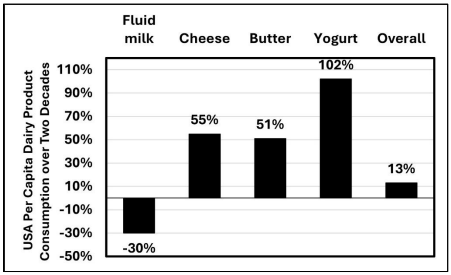
Currently, there are about ten million dairy cows in North America, and these cows are among the highest producing cows worldwide when yield is expressed as liters of milk per day. Consumption of dairy products in the USA continues to increase, and this has put a greater emphasis on milk fat and protein and less emphasis on total yield (Figure 6). Genetic selection indexes currently in place for dairy cattle emphasize increasing milk fat and protein, while putting a negative emphasis on milk volume, so the trend upward in percentage of milk protein and fat will continue.
Growth in future dairy consumption depends on trends in population. The USA Census projects that the USA population will increase to 458 million people by 2050, a 38% increase in population. The Canadian Census projects a 28% increase in population over the same period. This would create a strong future demand for dairy products in North America and likely will lead to an increase in overall dairy herd size in North America.
Figure 6. Consumption of various milk-based products over the last two decades in the USA.
Health of North American Dairy Cows
Dairy cattle in North America are healthy because of strong federal programs to limit exotic infectious diseases from other countries. Mastitis and lameness are environmental diseases and are the two primary health problems that affect dairy cows in the USA and Canada. Mastitis is a common environmental disease that is characterized by increased somatic cells in one or more quarters of a cow’s udder. Causative organisms are common, but their impact is reduced by good hygiene and management of contaminants on the udder. Typically, mastitis is the major cause of milk loss in herds, but this is reduced by excellent management. Infusion of antibiotics into each quarter of the udder at dry-off has been an historical practice for 70 years; however, there is a global effort to reduce antibiotic use in livestock. This will reduce the standard practice of treating each quarter at dry-off, but infected quarters may be treated. In the future, there will be approaches to limit mastitis, including genetic selection for cows more resistant to mastitis.
Lameness is common in dairy herds that are housed in modern free-stall barns with concrete surfaces, and the level of lameness in confined herds is significantly greater than in grazing herds. There are methods of finishing concrete surfaces that reduce lameness; however, there is not yet a standard way of documenting a surface’s impact on lameness. Covering concrete with rubber mats reduces the adverse impact of concrete on lameness; however, this may be cost prohibitive. A potential opportunity to reduce impact of lameness is to provide lame cows access to a bedding pack without a concrete surface. Lame cows could be grouped with fresh cows on surfaces that are less likely to induce lameness.
Most long-term weather forecasts predict that North America will be warmer in 50 years, and there is likely to be an increase in rain. What does this mean for dairy farming? It may have only a modest impact. Systems for keeping cows cool during hot weather are already used widely in the USA and Canada, and these systems are becoming more automated and sophisticated. For example, automated water sprinklers and fans may operate only when there is a cow or cows in specific locations in free-stall barns. Furthermore, there will be genetic changes in cattle that will reduce haircoat thickness and improve natural cooling.
One change that is occurring is to managing dry cows and springing heifers in strategic ways during 3 months before calving. Research at the University of Florida and elsewhere has shown that heat stress during the last 2-3 months of pregnancy affects pregnant heifers and cows adversely, and heifer calves produced under this heat stress conditions have reduced milk production for at least their first three lactations.
Global Perspective for Dairy Cows
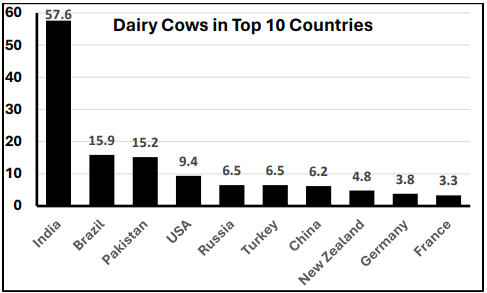
According to the Food and Agriculture Organization of the United Nations, there are an estimated 270 million “milk cows” in the world, and the top ten countries comprise 129 million cows (Figure 4). These cows provide multiple benefits to farm families, particularly in developing countries. Such cattle produce milk, provide power for hauling or plowing, and serves as the major source of the family’s financial resources. Nevertheless, these cows produce 7-times more methane per liter of milk high producing cows in developed dairy countries. There is a global effort to enhance productivity of cows in developing countries, in part to reduce their environmental impact. Crosses between Holstein and Zebu cattle in Brazil have resulted in cows with enhanced milk production while maintaining usefulness as work animals. In contrast to North America, milk in many regions of the world provide power for plowing and hauling, and provide food and wealth for the farm family. Furthermore, in one or more countries, cows are considered sacred and may be kept for years beyond their productive stage.
Figure 4. Number of dairy cows in top countries of the world. Source of data: https://ruminants.ceva.pro/dairy-industry