Introduction
Due to the international market demands that are increasingly stringent for the import of Brazilian products, and the consumer interest to have information on food products, it is necessary to meet the demands of consumer markets, ascertaining and ensuring the quality food exports. Traceability has become an important tool to ensure product quality to consumers. The use of meat and bone meal from cattle (MBM) serves as a source of protein, mainly minerals (including phosphorus) for birds. There are no restrictions in the domestic market on the use of animal byproducts in feed for laying hens, commercial production has been performed with and without the inclusion of MBM in diets.
Due to recent world events related to animal products in livestock feed, among which we can cite the dioxin crisis in Belgium (1999) and Germany (2000/2001) and several cases of bovine spongiform encephalopathy (BSE) in various European countries, Canada, USA and Japan (Fernandes Filho and Queiroz, 2001; Cerutti, 2002), its use was banned for export to European countries.
In an attempt to identify and quantify the use of animal byproducts in feed for birds, studies have been carried out with the use of the technique of stable isotopes of carbon and nitrogen. The integration of the isotopic composition of carbon-13 incorporated into the body of the animal along with the decline for the exhalation and excretion must be equal to the carbon isotopic composition of the diet (DeNiro and Epstein, 1976, 1978). With regard to nitrogen-15, enrichment occurs through 3‰ at each trophic level rise (Kock et al., 1994). The carbon isotope ratio (13C/12C) in association with the isotopic ratio of nitrogen (15N/14N) allowed tracking in the final product the MBM in broilers (Carrijo et al., 2006) . Poultry offal meal in feed for broiler chickens and quail (Oliveira et al., 2010, Móri et al., 2007), poultry offal meal with yeast and wheat bran in the diet of broilers (Gottmann et al., 2008) and MBM in the feed of layers (Denadai et al., 2009).
Therefore, the objective of this study was to evaluate whether the inclusion of other ingredients such as wheat bran, corn gluten and yeast in the diet of laying hens may interfere with the traceability of MBM in eggs by the technique of stable isotopes of carbon and nitrogen.
Material and Methods
The experiment was conducted in the Poultry Sector of the Brotas Research and Development Unit, Department of Decentralisation and Development, São Paulo Agribusiness Technology Agency, Ministry of Agriculture and Supply of São Paulo, Brazil. 256 Bovans Goldline laying hens were used randomized into 8 treatments with 4 repetitions. At 56 days, 8 eggs per treatment were taken randomized. The treatments were a control diet produced from corn, soy (soybean) cake (paste or flour) and wheat bran (MST) and other diets were added with corn gluten (G) and/or MBM (2.0%) and/or yeast (Y). The samples were analyzed at the Stable Isotope Center (CIE) of the Biosciences Institute of UNESP, Botucatu campus. Albumin was separated from the yolk by hand, dried for 24 hours in an oven with forced ventilation at 56° C and ground cryogenically to study it in the element analyzer (EA 1108 - CHN - Fisons Instruments, Rhone, Italy) coupled to a mass spectrophotometer of isotopic ratios (Delta S - Finnigan MAT, Bremen, Germany). The results of the analysis were expressed in delta per thousand (δ) of the isotopic ratio of the sample compared to international standards Peedee Belemnite (PDB) and atmospheric nitrogen (N2) for tcarbon and nitrogen, respectively, according to the expression:
δ (sample, standard) = 1000 [(R sample and R standard)/R standard]
where R represents the proportion (ratio) between the heavier and lighter isotope, in particular 13C/12C and 15N/14N.
The isotopic results of δ13C and δ15N were subjected to linear discriminant multivariate analysis with the aid of the Minitab statistical program.
Results and Discussion
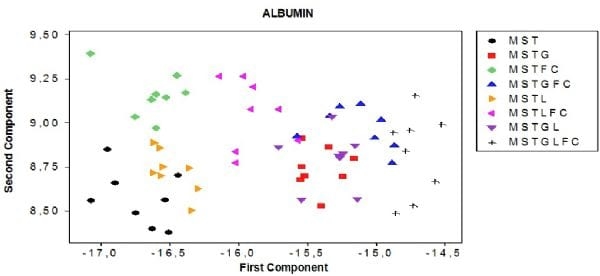
The groups formed according to the isotopic values δ13C and δ15N of the yolk and albumin samples collected at 56 days are presented in Figures 1 and 2.
Figure 1. Graph of the main components of carbon-13 and nitrogen-15 in the yolk, at 56 days.
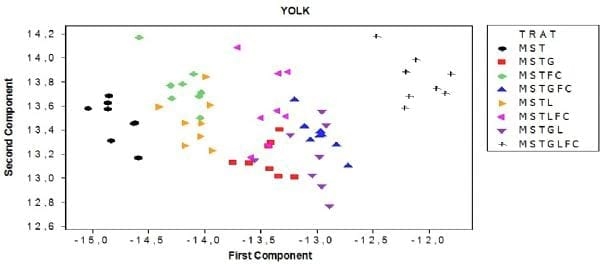
According to yolk data (Figure 1), discriminant analysis showed three different response groups, where to the left of the graph is the group of control treatments based on corn, soybeans and wheat (MST) and treatment with the addition of 2.5% of meat meal (MSTFC) and treatment with the addition of yeast (MSTL). At the center of the graph a second group was formed in which all treatments carry the addition of corn gluten (MSTG, MSTGFC and MSTGL) except for the treatment with the addition of yeast and 2.5% meat meal (MSTLFC) were also placed in the same group. On the right side of the graph is the third group, formed by the treatments containing gluten, yeast and 2.5% meat meal (MSTGLFC). Possibly, the inclusion of 3% of gluten allowed detection of 2.5% of meat meal. However, Denadai (2008) detected in the yolk inclusion from 3.0% of meat and bone meal from cattle in the feed the hens, but detected a lower albumin level (1.5% of meat and bone meal).
Figure 2. Graph of the main components of carbon-13 and nitrogen-15 in the yolk, at 56 days.
With respect to albumin (Figure 2) two distinct groups of response were observed, placed on the left side of the graph: the group without the addition of corn gluten (MST, and MSTFC and MSTL), and a second group of treatments (MSTLFC, MSTG, MSTGL and MSTGLFC), which overlap, preventing the differentiation between them, which is consistent with Denadai et al. (2009) who affirm that the addition of a C4 ingredient, corn gluten and yeast causes an increase in enrichment, further distancing the isotope values of eggs and their fractions in the control group.
It was not possible to detect gluten, possibly because of the low inclusion of meat meal (2.5%), but the level used in the industry is 4.5 to 5.0%. We can underscore the need for further testing in conjunction with dieting, because the isotopic signal of the diet is reflected in the final product, in this case the egg, confirming the general expression of DeNiro and Epstein (1978), who claim that "the animal consumes ± 1‰ for carbon-13" and ± 3‰ (2 to 5‰) for nitrogen-15, for each trophic level rise.
Conclusions
The use of 3.0% corn gluten in the diet of layers does not allow the differentiation of the isotopic values of δ13C and δ15N in the albumin and yolk of these groups that received 2.5% of meat and bone meal from cattle.
Acknowledgements
Postdoctoral National Program, PNPD of the Foundation for the Coordination and Improvement of Higher Level Personnel, CAPES for the scholarship awarded to the first author and the project financing.
To Evandro Tadeu Silva, an official of the Center for Stable Isotopes for performing the isotopic analysis.
The APTA, from the Ministry of Agriculture and Supply of São Paulo, for providing the poultry for the study.
Bibliography
Carrijo AS, Pezzato AC, Ducatti C, Sartori JR, Trinca L, Silva ET. 2006. Traceability of bovine meat and bone meal in poultry by stable isotope analysis. Revista Brasileira de Ciência Avícola 8(1):37-42.
Cerutti M. 2002. Aplicação de um programa de rastreabilidade na cadeia de frangos de corte. In: Simpósio Sobre Manejo E Nutrição De Aves E Suínos E Tecnologia Da Produção De Rações, 2002, Campinas. Anais...Campinas: Colégio Brasileiro de Nutrição Animal. p. 253-264.
Denadai JC. 2008. Rastreabilidade de farinhas de origem animal em ovos de poedeiras comerciais pela técnica dos isótopos estáveis do carbono (δ13C) e do nitrogênio (δ15N). 90f. Tese (Doutorado em Zootecnia) - Faculdade de Medicina Veterinária e Zootecnia, Universidade Estadual Paulista, Botucatu.
Denadai JC, Ducatti C, Sartori JR, Pezzato AC, Móri C, Gottmann R, Mituo MAO. 2009. Rastreabilidade da farinha de carne e ossos bovinos em ovos de poedeiras alimentadas com ingredientes alternativos. Pesquisa agropecuária brasileira 44(1):1-7.
DeNiro MJ & Epstein S. 1976. You are what you eat (plus a few ‰) the carbon isotope cycle in food chains. Geological Society of America 6:834 (Abstract).
DeNiro MJ & Epstein S. 1978. Influence of diet on the distribution of carbon isotopes in animals. Geochimica et Cosmichimica Acta 42:495-506.
Fernandes Filho & Queiroz AM. 2001; Transformações recentes na avicultura de corte brasileira: o caso do modelo de integração. In: Congresso de Ciências Humanas, letras e arte - CONIFES-UFOP, 5. Ouro Preto: CONIFES, 26P.
Gottmann R, Pezzato AC, Ducatti C, Denadai JC, Mittuo MAO, Móri C, Sartori JR. 2008. Ratreabilidade de subprodutos de origem animal em dietas com levadura e trigo para frangos. Revista Agropecuária Brasileira-PAB 43(12):1641-1647.
Kock PL, Fogel ML, Turons N. 1994. Stable in Ecology and Environmental Science. Blackwell Scientific Publication, p.63-92.
Móri C, Garcia EA, Ducatti C, Denadai JC, Pelicia K, Gottmann R, Mituo MAO, Bordinhon AM. 2007. Traceability of animal by products in quail (Coturnix coturnix japonica) tissues using carbon (13C/12C) and nitrogen (15N/14N) stable isotopes. Brazilian Journal of Poultry Science 9(4):263-269.
Oliveira RP, Ducatti C, Pezzato AC, Denadai JC, Cruz VC, Sartori JR, Carrijo AS & Caldara FR. 2010. Traceability of poultry offal meal in broiler feeding using isotopic analysis (δ13C and δ15N) of different tissues. Revista Brasileira de Ciência Avícola / Brazilian Journal of Poultry Science 12:13-20.