Content sponsored by:
Hangzhou DE Mark Industrial Co Ltd
Vitamin and Amino Acid Market
Published: May 28, 2026
Source : Ronnick Fong. Newsletter
Issue No.: 2026005 Date: May 28,2026
Veterinary APIs Price Index (VPi):
May 7th 67.27
May 13th 67.03
May 20th 66.95
May 27th 66.79
The veterinary APIs market is currently exhibiting a generally weak and stable trend, characterized by a persistent divergence in patterns—showing more declines than increases, alongside subdued trading activity primarily influenced by essential demand.
The prices of doxycycline hyclate, tylosin tartrate, tiamulin, and chlortetracycline hydrochloride are continuing to decline. Conversely, florfenicol demonstrates resilience with a slight increase in price. Recently, there have been significant price increases in upstream basic chemical raw materials for sulfonamide intermediates, such as sulfur. The transaction price range for paracetamol has experienced an upward shift, while the price rise for mequindox has moderated.
As the low-cost inventory in the market is gradually being depleted and traders' stockpiles diminish, their inclination to reduce prices to facilitate sales has weakened, which is anticipated to gradually alleviate downward pressure. In the short term, the market still lacks definitive positive catalysts, with both supply and demand remaining weak. The situation in the Middle East continues to be uncertain, while panic sentiment is slowly diminishing. It is noteworthy that beef import quotas for Australia and Brazil are nearing exhaustion, which may result in a rebound in cattle and sheep prices, thus providing some support to the demand for related veterinary drugs and feed additives.
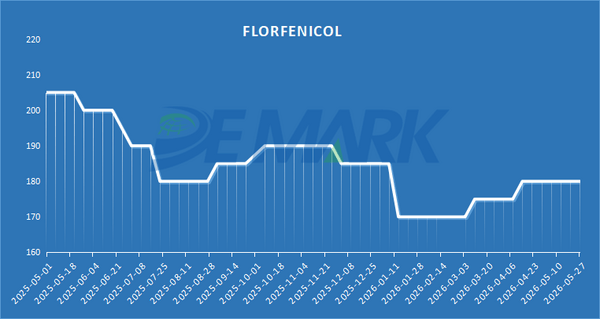
FLORFENICOL
On May 27, the market average price reached 174 RMB/kg, reflecting a month-on-month increase of 1.09%. Notably, florfenicol prices have risen contrary to the broader market trend. This rebound can be attributed to both cost and supply factors:
Persistently high international energy prices have increased the procurement costs of key intermediates, leading manufacturers to raise their prices. This excuse has been a core driver of the price rebound.However, the shift in the mainstream production process of florfenicol to biosynthesis has diminished the cost constraint from petrochemical raw materials, which has become negligible.
Additionally, leading manufacturers have further limited order acceptance, creating an illusion of supply tightness. Traders are also increasingly hesitant to sell low-priced inventory acquired earlier.
As a result, the transaction price range has moved upward, and the market is currently exhibiting a short-term firm and consolidating trend.
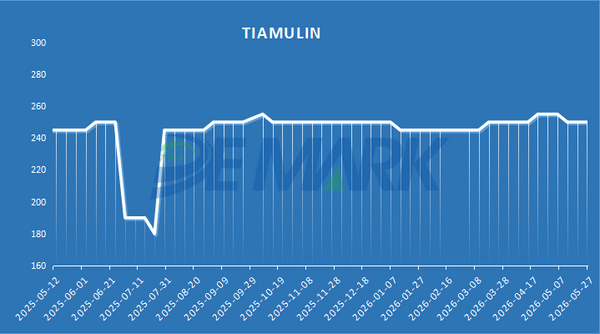
TIAMULIN
Entering May, the price of Tiamulin quickly turned into a downward channel after peaking. On the 27th, the market average price was 251 RMB/kg, down 3.13% from the year's high. In March, traders actively built up inventories, spurred by the Middle East conflict and manufacturer shutdowns.
However, after entering May, weak demand, expectations of production resumption, and easing geopolitical tensions led to a shift in market sentiment. Early stockpilers began to cut prices and offload goods, triggering a rapid price decline.
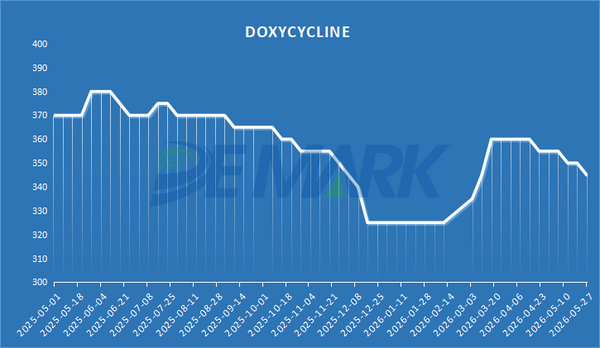
DOXYCYCLINE HCL
On the 27th, the market average price of Doxycycline was 339 RMB/kg, down 1.66% month-on-month. On the supply side, mainstream manufacturers showed strong willingness to control supply and support prices, but no significant effect has been observed.
On the demand side, downstream buyers maintained a just-in-time procurement pace, with little prospect of a surge in purchasing activity. The overall market is expected to continue its range-bound consolidation, lacking a clear unilateral driver in the short term.
TYLOSIN & TILMICOSIN
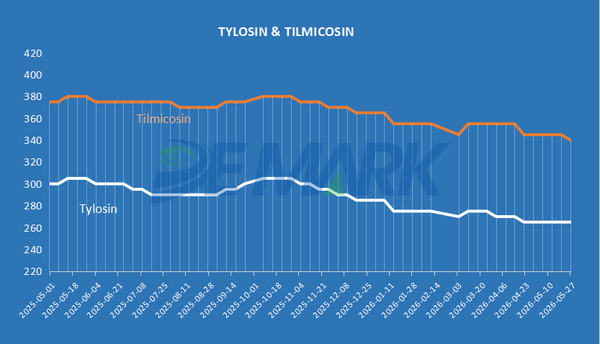
On the 27th, the market average price of Tylosin Tartrate was 264 RMB/kg, down 0.42% month-on-month. Persistent weakness on the demand side, coupled with growing expectations of production resumption by manufacturers, has led to a shift in sentiment among early stockpilers,
with a growing inclination to cut prices and offload goods. On the supply side, although leading companies maintain a price-supporting strategy, weak demand provides little support, and major manufacturers may subsequently lower their ex-factory prices. The market is expected to continue its weak and volatile pattern in the short term.
The price trends for Tilmicosin and Tylvalosin, which are related to Tylosin, are similar.
For other vet APIs market information and solid inquiries, please feel free to contact us. sales@de-mark.com
VITAMIN MARKET
The vitamin market is currently experiencing a weak and corrective adjustment. Downstream demand continues to be sluggish, and the market remains in a phase of digestion and transition, with traders maintaining a cautious approach. Prices for most vitamin varieties are on the decline, with VA, VE, calcium pantothenate, and VD3 exhibiting significant and accelerating downward trends. VC, biotin, and folic acid are also following a downward path, while VB1, VB2, VB6, VB12, and VK3 are holding steady.
The overall market has entered a correction phase following its recent peak, and this weak, range-bound pattern is anticipated to continue. The vitamin market is marked by frequent sharp increases and sudden drops, necessitating caution against the risk of ongoing price corrections.
Vitamin A (500,000IU/G)
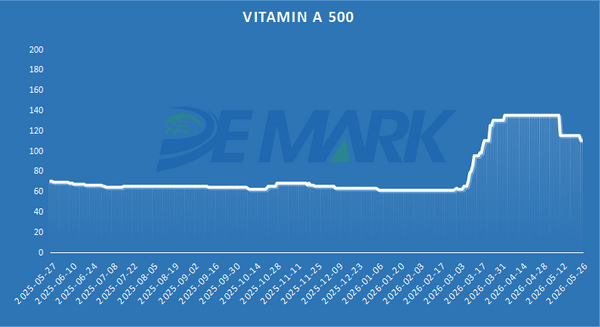
The Vitamin A market price continues to show weakness. Some mainstream manufacturers maintain suspended quotations and order-taking, indicating a strong willingness to support prices. In contrast, traders have a stronger inclination to offload goods. Downstream demand remains sluggish, and the market price index is running on the weak side.
Vitamin E 50%
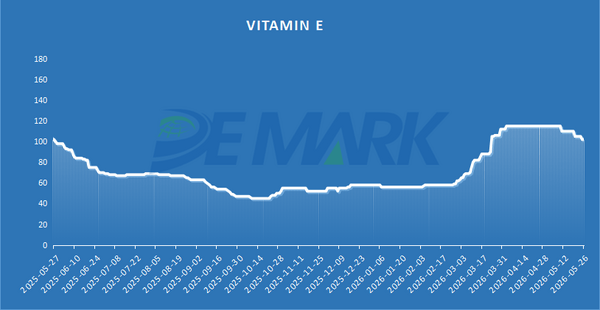
Some mainstream manufacturers have resumed price quotations, leading to increased market inquiries and trading activity. Downstream buyers are primarily digesting existing inventories, with demand mainly driven by essential needs.
The Vitamin E market price is narrowing on the weak side. Going forward, attention should be paid to the launch schedule of new production capacity.
D-Calphan
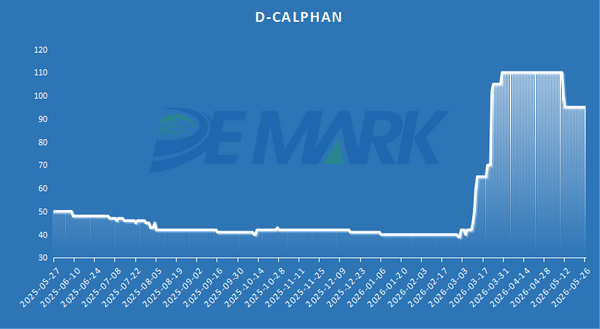
Calcium pantothenate prices continue to show weakness. The market is oversupplied. Although some manufacturers have suspended price quotations, actual transactions remain sluggish. The market price index is running on the weak side.
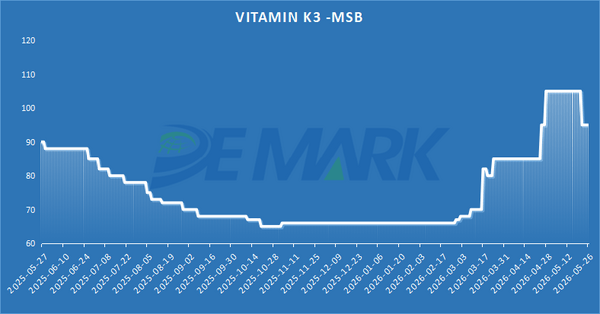
Vitamin K3 (MSB)
Vitamin K3 production costs are rising, leading manufacturers to increase their offer prices. However, terminal inventories remain ample, and the market price is experiencing narrow range-bound fluctuations.
For market information on other vitamin products and solid inquiries, please feel free to contact us. contact us
AMINO ACIDS MARKET
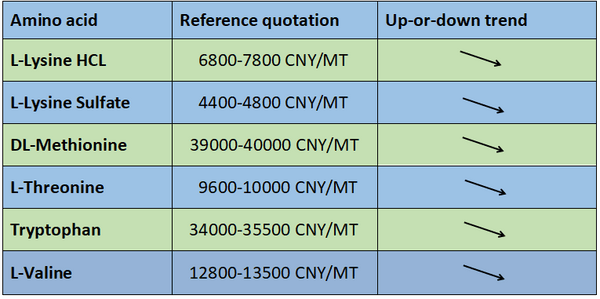
The amino acids market is currently experiencing a general weakness, characterized by notable price reductions, while end-users are increasingly adopting a cautious wait-and-see approach. The primary cause of this situation is the weak fundamentals of supply and demand.
--In the lysine sector, manufacturers continue to lower their quotations, downstream buyers are holding substantial inventories and exhibit a low willingness to replenish, overseas markets are also showing signs of weakness, and the intake of export orders is declining.
--In the methionine sector, leading manufacturers have introduced high-low bundled quotations and have subsequently halted further quotations and order-taking. Market prices are fluctuating, downstream inquiries have seen a slight increase, yet feed mills are reluctant to accept high prices and are actively exploring alternative methods and products to save on methionine.
--In the threonine market, major factories have significantly cut their quotations, reflecting the ineffectiveness of previous price-supporting strategies. Downstream buyers are making necessary replenishments, and the market continues to be driven by price.
--The valine market is experiencing an oversupply, with some manufacturers implementing bundling sales strategies.
--The tryptophan market is marked by quiet inquiries and transactions, with downstream users only making small, need-based replenishments.
Ningxia CUC is scheduled to commence its annual maintenance in mid-July, with an anticipated duration of approximately 50 days. From May to July, the amino acid industry will undergo a phase of concentrated maintenance. This resulting short-term contraction in supply is expected to offer some price support. However, it remains uncertain whether downstream users will accept this positive factor, and we will need to observe the situation closely.
Declaration:
The prices indicated in this newsletter are for your reference only and do not constitute a solid offer by our company. The transaction price shall be determined by both parties through negotiation based on the quantity and transaction conditions.
FEATURED PRODUCTS
VITAMIN C
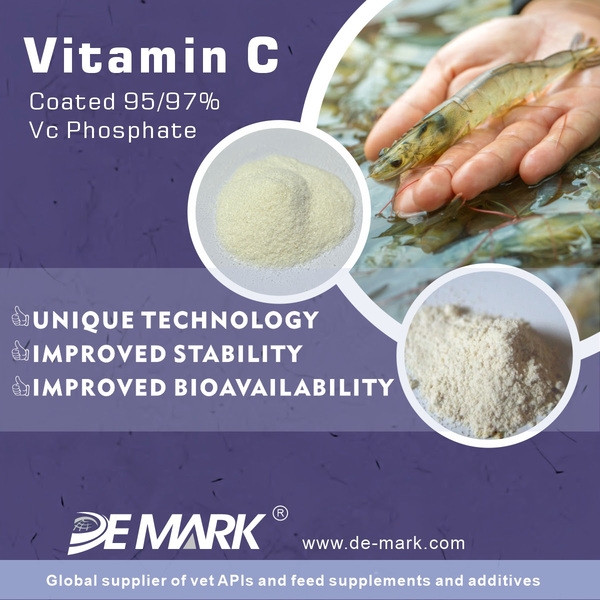
Vitamin C, as an essential nutrient for animal health and growth, faces significant challenges in conventional applications: Ordinary VC suffers up to 60% oxidation loss during feed processing (high-temperature pelleting, extrusion) and storage, severely compromising its effectiveness. Coated/phosphate ester technology effectively reduces processing losses, ensuring higher active ingredient retention.
DM-GOLD (2% Xanthophylls)
The active ingredient Xanthophylls is a type of carotenoids colorant extract from marigold flower. Here are some benefits when used in commercial animal feed:
---As colorant improving the color of chicken skin, feet, shin and egg yolk.
---As natural pigment for improving the color of salmon trout and shrimp.
---As antioxidant Improve resistance to disease in animals, Improve the egg hatching rate.
Related topics:
Authors:

Recommend
Comment
Share

31 de mayo de 2026
How about DCP and MCP price up or down trend
Recommend
Reply
Would you like to discuss another topic? Create a new post to engage with experts in the community.
TILMIPRO 200
TILMIPRO 200 is a macrolide antibiotic synthesized from tylosin recommended for control of respiratory infections in swine,poultry and cattle.
VITAMIN E 50%
VITAMIN E 50% by Hangzhou DE Mark Industrial is a Vitamin E premix for animals that protects cells and tissues and regulates blood flow in animals.
Featured users