I. INTRODUCTION
Since the ban on using antibiotics (AGP) as growth promoters in the EU in 2006, gut health has become a growing concern. As described by Conway in 1994, the gut health concept is based on three components: the diet, the microbiota, and the gut mucosa. All three components interact to maintain a dynamic equilibrium that ensures proper functioning of the digestive system without pathology. However, this equilibrium is fragile and can be affected by factors such as how the flock is managed (Tsiouris et al., 2015), the presence of pathogens (Moore et al., 2016), or the composition of the feed (Choct, 2009). Probiotics can represent a nutritional solution to reduce the need to use antimicrobial agents in animal husbandry (Sarangi et al., 2016; Rhayat et al., 2017). Probiotics contribute to improving gut health status through different modes of action, including maintaining a normal intestinal microbiota by competitive exclusion and antagonism of harmful microorganisms (Callaway et al., 2008). However, they can be sensitive to the substrates available for their development in the gut. Thus, the source of cereals in the feed may affect the effectiveness of the probiotic (Choct, 2009).
The recently isolated probiotic Bacillus subtilis 29784 has been shown to improve animal performance in three different trials, in which broilers were fed on corn- and soybeanbased diets, under different rearing conditions. Our in vitro results also showed no differences between corn and wheat diets in terms of its germination speed and outgrowth rate. The present study investigated this probiotic and another commercially available, B. subtilis X, in 2 types of diets, based either on corn or a mix of wheat and corn. In addition, DDGS was systematically added to the diets as it also offers an opportunity to reduce the cost of nutritionally optimal diets for poultry.
II. MATERIALS AND METHODS
A total of 3,120 one day-old male broiler chicken, Cobb 500, were randomly allocated according to a 2 x 3 factorial design, including six treatments, with 13 replicates of 40 birds per treatments. Birds were reared until 42 days in floor pens, using wood shavings as bedding. The experimental treatments were: T1, Control 1, corn-based diet; T2, T1 + B. subtilis 29784 at 1 x 10⁸ CFU/kg feed; T3, T1 + B. subtilis X (1 x 10⁸ CFU/kg feed); T4, Control 2, corn/wheat-based diet; T5, T4 + B. subtilis 29784 at 1 x 10⁸ CFU/kg feed; T6, T4 + B. subtilis X (1 x 10⁸ CFU/kg feed).
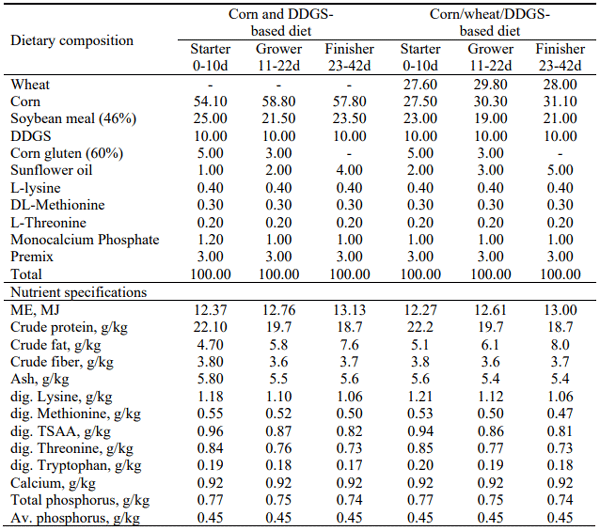
The experimental diets (Table 1) contained no coccidiostat and no AGP. Feed intake (FI), weight gain (BWG) and mortality were measured at 22 and 42 days of age, and feed conversion ratios (FCR) were calculated.
Performance parameters were subjected to ANOVA, with complete randomized design using the ANOVA procedure of XLSTAT (Addinsoft 1995-2014) to establish differences among treatments. The model included probiotic and diet as main factors. Pen was considered as the experimental unit. Results are reported as least square means. LS means were assumed to be different at P < 0.05. Mortality data were arcsin-transformed for ANOVA analysis.
Table 1 - Dietary composition and nutrient specifications of the experimental diets.
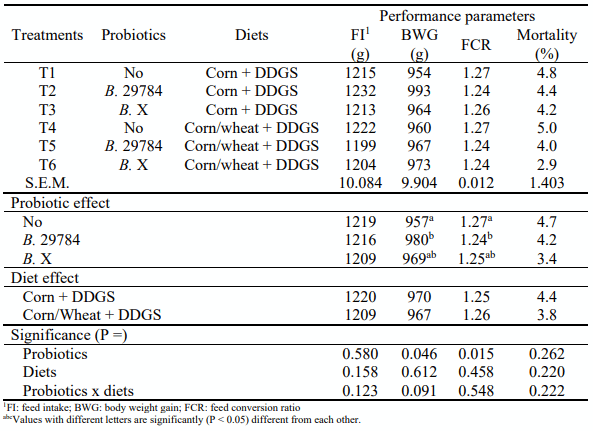
Table 2 - Growth performance of broiler fed either a corn and DDGS-based diet, or a corn/wheat and DDGS-based diet (0-22 d period).
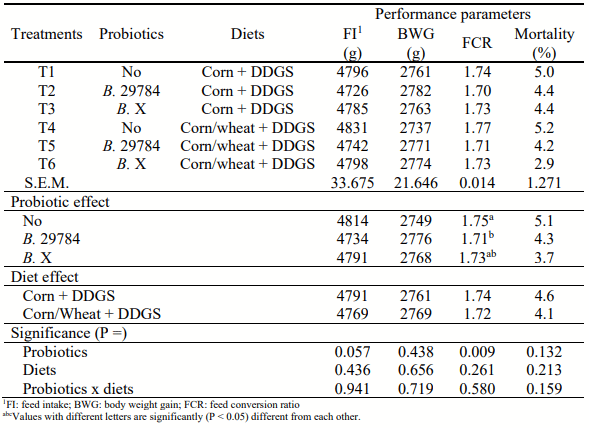
Table 3 - Growth performance of broiler fed either a corn and DDGS-based diet, or a corn/wheat and DDGS-based diet (0-42 d period).
III. RESULTS AND DISCUSSION
At 22 days, a significant effect of probiotics was detected, with no effect of diet, and no interaction between probiotics and diets. Thus, performance of broilers was significantly improved with B. subtilis 29784, with +2.3% in BWG (P = 0.046) and -2.5% in FCR (P = 0.015), whereas there was only a tendency towards improvement with B. subtilis X (+1.25% in BWG and -2.0% in FCR compared to control birds). There was no difference in mortality between groups during this period.
At 42 days, although there was no effect of probiotics on BWG; FCR was improved without interaction with diets. The performance of broilers was increased with the incorporation of B. subtilis 29784 whatever diet type, with an improvement of 2.6% in FCR (P = 0.009). FCR of B. subtilis X group did not significant differ from the control group. Also, mortality was not different between treatments, and was 4.2% in average.
In conclusion, these results suggest consistency of the efficacy of B. subtilis 29784 on broiler performance when corn or corn/wheat diets were used together with DDGS.
Presented at the 29th Annual Australian Poultry Science Symposium 2018. For information on the latest and future editions, click here.