Antioxidant and Antimicrobial Properties of Selected Phytogenics for Sustainable Poultry Production
Author details:
The use of antibiotic growth promoters (AGP) in poultry production not only promotes the emergence of pathogenic multi-drug resistant bacteria, but it also compromises product quality, threatens animal and human health, and pollutes the environment. However, the complete withdrawal of AGP without alternatives could result in uncontrollable disease outbreaks that would jeopardize large-scale poultry intensification. Thus, the use of phytogenic products as potential alternatives to in-feed AGP has attracted worldwide research interest. These phytogenic products contain numerous biologically active substances with antioxidant and antimicrobial activities that can enhance poultry health, growth performance, and meat quality characteristics. In addition, the incorporation of phytogenic products as feed additives in poultry diets could result in the production of high-quality, drug-free, and organic poultry products that are safe for human consumption. Thus, this review examines the current evidence on the antioxidant and antimicrobial properties of a selection of phytogenic products, their effects on nutrient utilization, and physiological and meat quality parameters in poultry. The paper also reviews the factors that could limit the utilization of phytogenic products in poultry nutrition and proposes solutions that can deliver efficient and sustainable poultry production systems for global food and nutrition security.
Keywords: antibiotic growth promoters; bioactive compounds; phytogenics; poultry; sustainability
1. Introduction
2. Antioxidant Properties of Phytogenic Products Used in Poultry Production
3. Antimicrobial Properties of Phytogenic Products in Poultry
4. Selected Plant Sources of Antimicrobial and Antioxidant Compounds
4.1. Moringa oleifera
4.2. Lippia javanica
4.3. Camellia sinensis
4.4. Allium sativum L.
4.5. Allium cepa
4.6. Mentha piperita
4.7. Aloe vera
4.8. Seaweeds
5. Contribution of Phytogenics to Environmental Health and Food Security
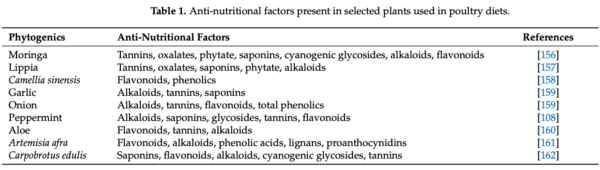
6. Anti-Nutritional Factors as Constraints to the Use of Phytogenics in Poultry Nutrition

7. Amelioration of Antinutritional Effects in Poultry Consuming Phytogenics
8. Prospects and Conclusions
Farag, M. R., Alagawany, M., & Tufarelli, V. (2016). In vitro antioxidant activities of resveratrol, cinnamaldehyde and their synergistic effect against cyadox-induced cytotoxicity in rabbit erythrocytes. Drug and Chemical Toxicology, 17, 1–10.
Patil, S. R., Patil, R. S., & Godghate, A. G. (2016). Mentha piperita Linn.: Phytochemical, antibacterial and dipterian adulticidal approach. International Journal of Pharmacy and Pharmaceutical Sciences, 8, 352–355.
Reis, J. H., Gebert, R. R., Barreta, M., Boiago, M. M., Souza, C. F., Baldissera, M. D., Santos, I. D., Wagner, R., Laporta, L. V., Stefani, L. M., et al. (2019). Addition of grape pomace flour in the diet on laying hens in heat stress: Impacts on health and performance as well as the fatty acid profile and total antioxidant capacity in the egg. Journal of Thermal Biology, 80, 141–149.
Galli, G. M., Gerbet, R. R., Griss, L. G., Fortuoso, B. F., Petrolli, T. G., Boiago, M. M., Souza, C. F., Baldissera, M. D., Mesadri, J., Wagner, R., et al. (2020). Combination of herbal components (curcumin, carvacrol, thymol, cinnamaldehyde) in broiler chicken feed: Impacts on response parameters, performance, fatty acid profiles, meat quality and control of coccidia and bacteria. Microbial Pathogenesis, 139, 1–11.
Reis, J. H., Gebert, R. R., Barreta, M., Baldissera, M. D., dos Santos, I. D., Wagner, R., Campigotto, G., Jaguezeski, A. M., Gris, A., de Lima, J. L. F., et al. (2018). Effects of phytogenic feed additive based on thymol, carvacrol and cinnamic aldehyde on body weight, blood parameters and environmental bacteria in broiler chickens. Microbial Pathogenesis, 125, 168–176.
Starčević, K., Krstulović, L., Brozić, D., Maurić, M., Stojević, Z., Mikulec, Ž., Bajić, M., & Mašek, T. (2014). Production performance, meat composition and oxidative susceptibility in broiler chicken fed with different phenolic compounds. Journal of the Science of Food and Agriculture, 95, 1172–1178.
Ahmed, S. T., Islam, M. M., Bostami, A. B. M. R., Mun, H. S., Kim, Y. J., & Yang, C. J. (2015). Meat composition, fatty acid profile and oxidative stability of meat from broilers supplemented with pomegranate (Punica granatum L.) by-products. Food Chemistry, 188, 481–488.
Gouda, H. N., Charlson, F., Sorsdahl, K., Ahmadzada, S., Ferrari, A. J., Erskine, H., Leung, J., Santamauro, D., Lund, C., Aminde, L. N., et al. (2019). Burden of non-communicable diseases in sub-Saharan Africa, 1990–2017: Results from the Global Burden of Disease Study 2017. The Lancet Global Health, 7, 1375–1387.
Puvača, N., Stanaćev, V., Glamočić, D., Lević, J., Perić, L., & Milić, D. (2013). Beneficial effects of phytoadditives in broiler nutrition. World's Poultry Science Journal, 69, 27–34.
Scalbert, A. (1991). Antimicrobial properties of tannins. Phytochemistry, 30, 3875–3883.
Mehdi, Y., Létourneau-Montminy, M. P., Gaucher, M. L., Chorfi, Y., Suresh, G., Rouissi, T., Brar, S. K., Côté, C., Ramirez, A. A., & Godbout, S. (2018). Use of antibiotics in broiler production: Global impacts and alternatives. Animal Nutrition, 4, 170–178.
Polat, U., Yeşilbağ, D., & Eren, M. (2011). Serum biochemical profile of broiler chickens fed diets containing rosemary and rosemary volatile oil. Journal of Biological and Environmental Sciences, 5, 23–30.
Paraskeuas, V., Fegeros, K., Palamidi, I., Hunger, C., & Mountzouris, K. C. (2017). Growth performance, nutrient digestibility, antioxidant capacity, blood biochemical biomarkers and cytokines expression in broiler chickens fed different phytogenic levels. Animal Nutrition, 3, 114–120.
Rahman, M. M., & Kim, S. J. (2016). Effects of dietary Nigella sativa seed supplementation on broiler productive performance, oxidative status and qualitative characteristics of thigh meat. Italian Journal of Animal Science, 15, 241–247.
Siroma, T. K., Machate, D. J., Zorgetto-Pinheiro, V. A., Figueiredo, P. S., Marcelino, G., Hiane, P. A., Bogo, D., Pott, A., Cury, E. R. J., Guimarães, R. D. C. A., et al. (2022). Polyphenols and ω-3 PUFAs: Beneficial outcomes to obesity and its related metabolic diseases. Frontiers in Nutrition, 8, 781622.
Zdanowska-Ssiadek, A., Lipińska-Palka, P., Damaziak, K., Michalczuk, M., & Marchewka, J. (2018). Antioxidant effects of phytogenic herbal-vegetable mixture additives used in chicken feed on breast meat quality. Animal Science Papers and Reports, 36, 393–408.
Tian, X. Z., Lu, Q., Paengkoum, P., & Paengkoum, S. (2020). Short communication: Effect of purple corn pigment on change of anthocyanin composition and unsaturated fatty acids during milk storage. Journal of Dairy Science, 103, 7808–7812.
Dyshlyuk, L., Babich, O., Ivanova, S., Vasilchenko, N., Atuchin, V., Korolkov, I., & Prosekov, A. (2020). Antimicrobial potential of ZnO, TiO₂ and SiO₂ nanoparticles in protecting building materials from biodegradation. International Biodeterioration & Biodegradation, 146, 104821.
Nakatani, N. (2000). Phenolic antioxidants from herbs and spices. BioFactors, 13, 141–146.
De Castilho, T. S., Matias, T. B., Nicolini, K. P., & Nicolini, J. (2018). Study of interaction between metal ions and quercetin. Food Science and Human Wellness, 7, 215–219.
Na, H. K., & Surh, Y. J. (2008). Modulation of Nrf2-mediated antioxidant and detoxifying enzyme induction by the green tea polyphenol EGCG. Food and Chemical Toxicology, 46, 1271–1278.
Calabrese, V., Cornelius, C., Mancuso, C., Pennisi, G., Calafato, S., Bellia, F., Bates, T. E., Giuffrida Stella, A. M., Schapira, T., Dinkova Kostova, A. T., et al. (2008). Cellular stress response: A novel target for chemoprevention and nutritional neuroprotection in aging, neurodegenerative disorders and longevity. Neurochemical Research, 33, 2444–2471.
Brewer, M. S. (2011). Natural antioxidants: Sources, compounds, mechanisms of action, and potential applications. Comprehensive Reviews in Food Science and Food Safety, 10, 221–247.
Mahfuz, S., Shang, Q., & Piao, X. (2021). Phenolic compounds as natural feed additives in poultry and swine diets: A review. Journal of Animal Science and Biotechnology, 12, 48.
Kuralkar, P., & Kuralkar, S. V. (2021). Role of herbal products in animal production—An updated review. Journal of Ethnopharmacology, 278, 114246.
Rossi, B., Toschi, A., Piva, A., & Grilli, E. (2020). Single components of botanicals and nature-identical compounds as a non-antibiotic strategy to ameliorate health status and improve performance in poultry and pigs. Nutrition Research Reviews, 33, 218–234.
Wojdyło, A., Oszmiański, J., & Czemerys, R. (2007). Antioxidant activity and phenolic compounds in 32 selected herbs. Food Chemistry, 105, 940–949.
Borguini, R. G., Markowicz, C. H., Bastos, J. M., Moita-Neto, F. S., Capasso, E. A., & Ferraz da Silva, T. (2013). Antioxidant potential of tomatoes cultivated in organic and conventional systems. Brazilian Archives of Biology and Technology, 56, 521–529.
Lee, K. W., Everts, H., Kappert, H. J., van der Kuilen, J., Lemmers, A. G., Frehner, M., & Beynen, A. C. (2004). Growth performance, intestinal viscosity, fat digestibility and plasma cholesterol in broiler chickens fed a rye-containing diet without or with essential oil components. International Journal of Poultry Science, 3, 613–618.
Burt, S., & Reindeers, R. D. (2003). Antibacterial activity of selected plant essential oils against E. coli O157:H7. Letters in Applied Microbiology, 36, 162–167.
Mathis, G. F., Hofacre, C., & Scicutella, N. (2007). Performance improvement with a feed-added coated blend of essential oils, a coated blend of organic and inorganic acids with essential oils, or virginiamycin in broilers challenged with Clostridium perfringens. In Proceedings of the International Poultry Scientific Forum, Strasbourg, France, 26–30 August 2007.
Chen, D., Chen, G., Sun, Y., Zeng, X., & Ye, H. (2020). Physiological genetics, chemical composition, health benefits and toxicology of tea (Camellia sinensis L.) flower: A review. Food Research International, 137, 109584.
Dhifi, W., Hamrouni, I., Ayachi, S., Chahed, T., Saidani, M., & Marzouk, B. (2004). Biochemical characterization of some Tunisian olive oils. Journal of Food Lipids, 11, 287–296.
Alloui, M. N., Agabou, A., & Alloui, N. (2014). Application of herbs and phytogenic feed additives in poultry production—A review. Global Journal of Animal Science, 2, 234–243.
Nantapo, C. W. T., & Marume, U. (2022). Exploring the potential of Myrothamnus flabellifolius Welw. (resurrection tree) as a phytogenic feed additive in animal nutrition. Animals, 12, 1973.
Oladeji, I. S., Adegbenro, M., Osho, I. B., & Olarotimi, O. J. (2019). The efficacy of phytogenic feed additives in poultry production: A review. Turkish Journal of Agriculture—Food Science and Technology, 7, 2038–2041.
Perricone, V., Comi, M., Giromini, C., Rebucci, R., Agazzi, A., Savoini, G., & Bontempo, V. (2020). Green tea and pomegranate extract administered during critical moments of the production cycle improves blood antiradical activity and alters cecal microbial ecology of broiler chickens. Animals, 10, 785.
Akşit, M., Göksoy, E., Kok, F., Özdemir, D., & Özdoğan, M. (2006). The impacts of organic acid and essential oil supplementations to diets on the microbiological quality of chicken carcasses. Archiv für Geflügelkunde, 70, 168–173.
Ganguly, S. (2013). Phytogenic growth promoter as replacers for antibiotic growth promoter in poultry birds. Advances in Pharmacoepidemiology & Drug Safety, 2, 119.
Mohebodini, H., Jazi, V., Bakhshalinejad, R., Shabani, A., & Ashayerizadeh, A. (2019). Effect of dietary resveratrol supplementation on growth performance, immune response, serum biochemical indices, cecal microflora, and intestinal morphology of broiler chickens challenged with Escherichia coli. Livestock Science, 229, 13–21.
Vanmarsenille, C., Elseviers, J., Yvanoff, C., Hassanzadeh-Ghassabeh, G., Garcia Rodriguez, G., Martens, E., Depicker, A., Martel, A., & Haesebrouck, F. (2018). In planta expression of nanobody-based designer chicken antibodies targeting Campylobacter. PLOS ONE, 13, e0204222.
Ferreira, P. M. P., Farias, D. F., Oliveira, J. T. D. A., & Carvalho, A. D. F. U. (2008). Moringa oleifera: Bioactive compounds and nutritional potential. Revista de Nutrição, 21, 431–437.
Manzoor, M., Anwar, F., Iqbal, T., & Bhanger, M. I. (2007). Physico-chemical characterization of Moringa concanensis seeds and seed oil. Journal of the American Oil Chemists' Society, 84, 413–419.
Abd El-Hack, M. E., Alagawany, M., Elrys, A. S., Desoky, E. S. M., Tolba, H. M., Elnahal, A. S., Elnesr, S. S., & Swelum, A. A. (2018). Effect of forage Moringa oleifera L. (moringa) on animal health and nutrition and its beneficial applications in soil, plants and water purification. Agriculture, 8, 145.
Ravani, A., Prasad, R. V., Gajera, R. R., & Joshi, D. C. (2017). Potentiality of Moringa oleifera for food and nutritional security—A review. Agricultural Reviews, 38, 228–232.
Dalei, J., Rao, V. M., Sahoo, D., Rukmini, M., & Ray, R. (2016). Review on nutritional and pharmacological potencies of Moringa oleifera. European Journal of Pharmaceutical and Medical Research, 3, 150–155.
Gopalakrishnan, L., Doriya, K., & Kumar, D. S. (2016). Moringa oleifera: A review on nutritive importance and its medicinal application. Food Science and Human Wellness, 5, 49–56.
Mbikay, M. (2012). Therapeutic potential of Moringa oleifera leaves in chronic hyperglycaemia and dyslipidaemia: A review. Frontiers in Pharmacology, 3, 1–12.
Saini, R. K., Shetty, N. P., & Giridhar, P. (2014). GC-FID/MS analysis of fatty acids in Indian cultivars of Moringa oleifera: Potential sources of PUFA. Journal of the American Oil Chemists' Society, 91, 1029–1034.
Maizuwo, A. I., Hassan, A. S., Momoh, H., & Muhammad, J. A. (2017). Phytochemical constituents, biological activities, therapeutic potentials and nutritional values of Moringa oleifera (Zogale): A review. Journal of Drug Design and Medicinal Chemistry, 3, 60–66.
Rodríguez-Pérez, C., Quirantes-Piné, R., Fernández-Gutiérrez, A., & Segura-Carretero, A. (2015). Optimization of extraction method to obtain a phenolic compounds-rich extract from Moringa oleifera Lam. leaves. Industrial Crops and Products, 66, 246–254.
Makkar, H. P. S., & Becker, K. (1996). Nutritional value and antinutritional components of whole and ethanol extracted Moringa oleifera leaves. Animal Feed Science and Technology, 63, 211–228.
Kakengi, A., Kaijage, J., Sarwatt, S., Mutayoba, S., Shem, M., & Fujihara, T. (2007). Effect of Moringa oleifera leaf meal as a substitute for sunflower seed meal on performance of laying hens in Tanzania. Livestock Research for Rural Development, 19, 446.
Khan, I., Zaneb, H., Masood, S., Yousaf, M. S., Rehman, H. F., & Rehman, H. (2017). Effect of Moringa oleifera leaf powder supplementation on growth performance and intestinal morphology in broiler chickens. Journal of Animal Physiology and Animal Nutrition, 101, 114–121.
Wafula, M. C., Mutisya, M. D., & Malombe, I. (2019). Non-volatile chemical composition and botanical extracts from Lippia javanica (Burm. f.) Spreng. in control of cowpea aphids. Journal of Applied Sciences, 19, 325–330.
Ombito, J. O., Salano, E. N., Yegon, P. K., Ngetich, W. K., & Mwangi, E. M. (2014). A review on the chemistry of some species of genus Lippia (Verbenaceae family). Journal of Science and Innovation Research, 3, 460–466.
Viljoen, A. M., Subramoney, S. V., van Vuuren, S. F., Başer, K. H. C., & Demirci, B. (2005). The composition, geographical variation and antimicrobial activity of Lippia javanica (Verbenaceae) leaf essential oils. Journal of Ethnopharmacology, 96, 271–277.
Coopoosamy, R. M., & Naidoo, K. K. (2012). An ethnobotanical study of medicinal plants used by traditional healers in Durban, South Africa. African Journal of Pharmacy and Pharmacology, 6, 818–823.
Maroyi, A. (2017). Lippia javanica (Burm. f.) Spreng.: Traditional and commercial uses and phytochemical and pharmacological significance in the African and Indian subcontinent. Evidence-Based Complementary and Alternative Medicine, 2017, 1–42.
Mahlangeni, N. T., Moodley, R., & Jonnalagadda, S. B. (2018). Elemental composition of Cyrtanthus obliquus and Lippia javanica used in South African herbal tonic, Imbiza. Arabian Journal of Chemistry, 11, 128–136.
Chawafambira, A. (2021). The effect of incorporating herbal (Lippia javanica) infusion on the phenolic, physicochemical, and sensorial properties of fruit wine. Food Science & Nutrition, 9, 4539–4549.
Olivier, D. K., Shikanga, E. A., Combrinck, S., Krause, R. W. M., Regnier, T., & Dlamini, T. P. (2010). Phenylethanoid glycosides from Lippia javanica. South African Journal of Botany, 76, 58–63.
Pascual, M. E., Slowing, K., Carretero, M. E., & Villar, Á. (2001). Antiulcerogenic activity of Lippia alba (Mill.) N.E. Brown (Verbenaceae). Il Farmaco, 56, 501–504.
Chagonda, L. S., & Chalchat, J. C. (2015). Essential oil composition of Lippia javanica (Burm. f.) Spreng. chemotype from Western Zimbabwe. Journal of Essential Oil-Bearing Plants, 18, 482–485.
Mpofu, D. A., Marume, U., Mlambo, V., & Hugo, A. (2016). The effects of Lippia javanica dietary inclusion on growth performance, carcass characteristics and fatty acid profiles of broiler chickens. Animal Nutrition, 2, 160–167.
Mnisi, C. M., Matshogo, T. B., van Niekerk, R., & Mlambo, V. (2017). Growth performance, haemo-biochemical parameters and meat quality characteristics of male Japanese quails fed a Lippia javanica-based diet. South African Journal of Animal Science, 47, 661–671.
Namita, P., Mukesh, R., & Vijay, K. J. (2012). Camellia sinensis (green tea): A review. Global Journal of Pharmacology, 6, 52–59.
Chen, L., Zhou, Z. X., & Yang, Y. J. (2007). Genetic improvement and breeding of tea plant (Camellia sinensis) in China: From individual selection to hybridization and molecular breeding. Euphytica, 154, 239–248.
Tai, Y., Liu, C., Yu, S., Yang, H., Sun, J., Guo, C., Huang, B., Liu, Z., Yuan, Y., Xia, E., et al. (2018). Gene co-expression network analysis reveals coordinated regulation of three characteristic secondary biosynthetic pathways in tea plant (Camellia sinensis). BMC Genomics, 19, 1–13.
Abdo, Z. M. A., Hassan, R. A., Amal, A. E., & Shahinaz, A. H. (2010). Effect of adding Camellia sinensis and its aqueous extract as natural antioxidants to laying hen diet on productive and reproductive performance and egg quality during storage and its cholesterol content. Egyptian Poultry Science Journal, 30, 1121–1149.
Wang, Y., & Ho, C. T. (2009). Polyphenolic chemistry of tea and coffee: A century of progress. Journal of Agricultural and Food Chemistry, 57, 8109–8114.
Reygaert, W. C. (2014). The antimicrobial possibilities of green tea. Frontiers in Microbiology, 5, 434.
Cheng, Y., Sun, J., Zhao, H., Guo, H., & Li, J. (2022). Functional mechanism on stem cells by tea (Camellia sinensis) bioactive compounds. Food Science and Human Wellness, 11, 579–586.
Chen, D., Ding, Y., Chen, G., Sun, Y., Zeng, X., & Ye, H. (2020). Components identification and nutritional value exploration of tea (Camellia sinensis L.) flower extract: Evidence for functional food. International Journal of Food Research, 132, 109100.
Chen, G. J., Yuan, Q. X., Saeeduddin, M., Ou, S. Y., Zeng, X. X., & Ye, H. (2016). Recent advances in tea polysaccharides: Extraction, purification, physicochemical characterization and bioactivities. Carbohydrate Polymers, 153, 663–678.
Gramza-Michałowska, A., Kobus-Cisowska, J., Kmiecik, D., Korczak, J., Helak, B., Dziedzic, K., & Górecka, D. (2016). Antioxidative potential, nutritional value and sensory profiles of confectionery fortified with green and yellow tea leaves (Camellia sinensis). Food Chemistry, 211, 448–454.
Mahlake, S. K., Mnisi, C. M., Lebopa, C. K., & Kumanda, C. (2021). The effect of green tea (Camellia sinensis) leaf powder on growth performance, selected haematological indices, carcass characteristics and meat quality parameters of Jumbo quail. Sustainability, 13, 7080.
Al-Kayali, K. K., Razooqi, B. M., & Mtaab, A. S. (2011). Antibacterial activity of aqueous extract of green tea on bacteria isolated from children with impetigo. Diyala Journal of Medicine, 1, 37–43.
Friesen, N., Fritsch, R. M., & Blattner, F. R. (2002). Phylogeny and new intrageneric classification of Allium L. (Alliaceae) based on nuclear ribosomal DNA ITS sequences. Aliso, 22, 372–395.
Morales-González, J. A., Madrigal-Bujaidar, E., Sánchez-Gutiérrez, M., Izquierdo-Vega, J. A., Valadez-Vega, M. D. C., Álvarez-González, I., Morales-González, Á., & Madrigal-Santillán, E. (2019). Garlic (Allium sativum L.): A brief review of its antigenotoxic effects. Foods, 8, 343.
Tesfaye, A., & Mengesha, W. (2015). Traditional uses, phytochemistry and pharmacological properties of garlic (Allium sativum) and its biologically active compounds. International Journal of Scientific Research and Engineering Technology, 1, 142–148.
Indrasanti, D., Indradji, M., Hastuti, S., Aprilliyani, E., & Rosyadi, K. (2017). The administration of garlic extract on Eimeria stiedai oocysts and the hematological profile of coccidia-infected rabbits. Media Peternakan, 3, 158–164.
Milosevic, N., Stojcic, M. D., Stanacev, V., Peric, L., & Veljic, M. (2013). The performance and carcass traits of broilers fed with garlic (Allium sativum) additive. European Poultry Science, 77, 254–259.
Ogbuewu, I. P., Mbajiorgu, C. A., & Okoli, I. C. (2019). Antioxidant activity of ginger and its effect on blood chemistry and production physiology of poultry. Comparative Clinical Pathology, 28, 655–660.
Clement, F., Pramod, S. N., & Venkatesh, Y. P. (2010). Identity of the immunomodulatory proteins from garlic (Allium sativum) with the major garlic lectins or agglutinins. International Immunopharmacology, 10, 316–324.
Tigu, A. B., Moldovan, C. S., Toma, V. A., Farcaș, A. D., Mot, A. C., Jurj, A., Fischer-Fodor, E., Mircea, C., & Pârvu, M. (2021). Phytochemical analysis and in vitro effects of Allium fistulosum L. and Allium sativum L. extracts on human normal and tumor cell lines: A comparative study. Molecules, 26, 574.
Kimura, S., Tung, Y. C., Pan, M. H., Su, N. W., Lai, Y. J., & Cheng, K. C. (2017). Black garlic: A critical review of its production, bioactivity, and application. Journal of Food and Drug Analysis, 25, 62–70.
Sobolewska, D., Michalska, K., Podolak, I., & Grabowska, K. (2016). Steroidal saponins from the genus Allium. Phytochemistry Reviews, 15, 1–35.
Pagrut, N., Ganguly, S., Tekam, S., & Bhainsare, P. (2018). Effect of supplementation of garlic extract on the productive performance of broiler chicks. Ratio, 11, 12.
Eltazi, S., Ka, M., & Ma, M. (2014). Effect of using garlic powder as natural feed additive on performance and carcass quality of broiler chicks. Assiut Veterinary Medical Journal, 60, 45–53.
Brewster, J. L. (2008). Onions and other vegetable alliums (2nd ed.). CABI.
Sami, R., Elhakem, A., Alharbi, M., Benajiba, N., Almatrafi, M., & Helal, M. (2021). Nutritional values of onion bulbs with some essential structural parameters for packaging process. Applied Sciences, 11, 2317.
Mahmood, N., Muazzam, M. A., Ahmad, M., Hussain, S., & Javed, W. (2021). Phytochemistry of Allium cepa L. (onion): An overview of its nutritional and pharmacological importance. Science Inquiry Review, 5, 41–59.
Goodarzi, M., & Nanekarani, S. (2014). Effect of onion extract in drinking water on performance and carcass traits in broiler chickens. IERI Procedia, 8, 107–112.
Pareek, S., Sagar, N. A., Sharma, S., & Kumar, V. (2018). Onion (Allium cepa L.). In E. M. Yahia (Ed.), Fruit and vegetable phytochemicals: Chemistry and human health (2nd ed., Vol. 2, pp. 1145–1162). John Wiley & Sons.
Metrani, R., Singh, J., Acharya, P. K., Jayaprakasha, G. S., & Patil, B. (2020). Comparative metabolomics profiling of polyphenols, nutrients and antioxidant activities of two red onion (Allium cepa L.) cultivars. Plants, 9, 1077.
Kothari, D., Lee, W. D., Niu, K. M., & Kim, S. K. (2019). The genus Allium as poultry feed additive: A review. Animals, 9, 1032.
Zhao, X. X., Lin, F. J., Li, H., Li, H. B., Wu, D. T., Geng, F., & Gan, R. Y. (2021). Recent advances in bioactive compounds, health functions, and safety concerns of onion (Allium cepa L.). Frontiers in Nutrition, 8, 669805.
Guo, A., Bao, K., Sang, S., Zhang, X., Shao, B., Zhang, C., & Yang, X. (2021). Soft-chemistry synthesis, solubility and interlayer spacing of carbon nano-onions. RSC Advances, 11, 6850–6858.
Goodarzi, M., Nanekarani, S., & Landy, N. (2014). Effect of dietary supplementation with onion (Allium cepa L.) on performance, carcass traits and intestinal microflora composition in broiler chickens. Asian Pacific Journal of Tropical Disease, 4, S297–S301.
Slavin, J. L. (2013). Carbohydrates, dietary fiber, and resistant starch in white vegetables: Links to health outcomes. Advances in Nutrition, 4, 351S–355S.
Aditya, S., Ahammed, M., Jang, S. H., & Ohh, S. J. (2017). Effects of dietary onion (Allium cepa) extract supplementation on performance, apparent total tract retention of nutrients, blood profile and meat quality of broiler chicks. Asian-Australasian Journal of Animal Sciences, 30, 229–235.
Ibrahiem, I. A., Elam, T. A., Mohamed, F. F., Awadalla, S. A., Yousif, Y. I., Ibrahim, I. A., Elam, T. A., Mohamed, F. F., Awadalla, S. A., & Yousif, Y. I. (2004). Effect of onion and/or garlic as feed additives on growth performance and immunity in broiler Muscovy ducks. In Proceedings of the First Scientific Conference of the Faculty of Veterinary Medicine, Moshtohor, Egypt, 1–4 September 2004 (pp. 1–4).
Dosoky, W. M., Zeweil, H. S., Ahmed, M. H., Zahran, S. M., Shaalan, M. M., Abdelsalam, N. R., Abdel-Moneim, A. M. E., Taha, A. E., El-Tarabily, K. A., & Abd El-Hack, M. E. (2021). Impacts of onion and cinnamon supplementation as natural additives on the performance, egg quality, and immunity in laying Japanese quail. Poultry Science, 100, 101482.
Mainasara, M. M., Bakar, M. F. A., Waziri, A. H., & Musa, A. R. (2018). Comparison of phytochemical, proximate and mineral composition of fresh and dried peppermint (Mentha piperita) leaves. Journal of Science and Technology, 10, 85–91.
Trevisan, S. C. C., Menezes, A. P. P., Barbalho, S. M., & Guiguer, É. L. (2017). Properties of Mentha piperita: A brief review. World Journal of Pharmaceutical and Medical Research, 3, 309–313.
Farnad, N., Heidari, R., & Aslanipour, B. (2014). Phenolic composition and comparison of antioxidant activity of alcoholic extracts of peppermint (Mentha piperita). Journal of Food Measurement and Characterization, 8, 113–121.
Sujana, P., Sridhar, T. M., Josthna, P., & Naidu, C. V. (2013). Antibacterial activity and phytochemical analysis of Mentha piperita L. (peppermint)—An important multipurpose medicinal plant. Science Research Journal, 4, 77–83.
Badal, R. M., Badal, D., Badal, P., Khare, A., Shrivastava, J., & Kumar, V. (2011). Pharmacological action of Mentha piperita on lipid profile in fructose-fed rats. Iranian Journal of Pharmaceutical Research, 10, 843–847.
Uribe, E., Marín, D., Vega-Gálvez, A., Quispe-Fuentes, I., & Rodríguez, A. (2016). Assessment of vacuum-dried peppermint (Mentha piperita L.) as a source of natural antioxidants. Food Chemistry, 190, 559–565.
Beigi, M., Torki-Harchegani, M., & Ghasemi Pirbalouti, A. (2018). Quantity and chemical composition of essential oil of peppermint (Mentha × piperita L.) leaves under different drying methods. International Journal of Food Properties, 21, 267–276.
Dorman, H. D., Koşar, M., Başer, K. H. C., & Hiltunen, R. (2009). Phenolic profile and antioxidant evaluation of Mentha × piperita L. (peppermint) extracts. Natural Product Communications, 4, 535–545.
Khempaka, S., Pudpila, U., & Molee, W. (2013). Effect of dried peppermint (Mentha cordifolia) on growth performance, nutrient digestibility, carcass traits, antioxidant properties, and ammonia production in broilers. Journal of Applied Poultry Research, 22, 904–912.
Toghyani, M., Toghyani, M., Gheisari, A., Ghalamkari, G., & Mohammadrezaei, M. (2010). Growth performance, serum biochemistry and blood hematology of broiler chicks fed different levels of black seed (Nigella sativa) and peppermint (Mentha piperita). Livestock Science, 129, 173–178.
Abdel-Wareth, A. A., Kehraus, S., & Südekum, K. H. (2019). Peppermint and its respective active component in diets of broiler chickens: Growth performance, viability, economics, meat physicochemical properties, and carcass characteristics. Poultry Science, 98, 3850–3859.
Dagne, E., Bisrat, D., Viljoen, A., & Van Wyk, B. E. (2000). Chemistry of Aloe species. Current Organic Chemistry, 4, 1055–1078.
Minjares-Fuentes, R., Rodríguez-González, V. M., González-Laredo, R. F., Eim, V., González-Centeno, M. R., & Femenia, A. (2017). Effect of different drying procedures on the bioactive polysaccharide acemannan from Aloe vera (Aloe barbadensis Miller). Carbohydrate Polymers, 168, 327–336.
Boudreau, M. D., Mellick, P. W., Olson, G. R., Felton, R. P., Thorn, B. T., & Beland, F. A. (2013). Clear evidence of carcinogenic activity by a whole-leaf extract of Aloe barbadensis Miller (Aloe vera) in F344/N rats. Toxicological Sciences, 131, 26–39.
Zhang, Y., Bao, Z., Ye, X., Xie, Z., He, K., Mergens, B. M., & Zheng, Q. B. (2018). Chemical investigation of major constituents in Aloe vera leaves and several commercial Aloe juice powders. Journal of AOAC International, 101, 1741–1751.
Christaki, E. V., & Florou-Paneri, P. C. (2010). Aloe vera: A plant for many uses. Journal of Food, Agriculture and Environment, 8, 245–249.
Aida, P. U. I. A., Cosmin, P. U. I. A., Emil, M. O. I. S., Graur, F., Fetti, A., & Florea, M. (2021). The phytochemical constituents and therapeutic uses of genus Aloe: A review. Notulae Botanicae Horti Agrobotanici Cluj-Napoca, 49, 12332.
Darabighane, B., Zarei, A., Shahneh, A. Z., & Mahdavi, A. (2011). Effects of different levels of Aloe vera gel as an alternative to antibiotic on performance and ileum morphology in broilers. Italian Journal of Animal Science, 10, 189–194.
Dai, B. S., Jiang, L., & Chen, S. X. (2007). Effects of medicinal herb and polysaccharide from Aloe on gut microflora, immune function and growth performance in broiler. China Poultry, 29, 21–24. (In Chinese.)
Darabighane, B., & Zarei, A. (2012). The effects of the different levels of Aloe vera gel on oocysts shedding in broilers with coccidiosis. Planta Medica, 78, 496.
Michalak, I., & Mahrose, K. (2020). Seaweeds, intact and processed, as a valuable component of poultry feeds. Journal of Marine Science and Engineering, 8, 620.
Stengel, D. B., Connan, S., & Popper, Z. A. (2011). Algal chemodiversity and bioactivity: Sources of natural variability and implications for commercial application. Biotechnology Advances, 29, 483–501.
van Hal, J. W., Huijgen, W. J. J., & López-Contreras, A. M. (2014). Opportunities and challenges for seaweed in the biobased economy. Trends in Biotechnology, 32, 231–233.
Choi, Y. J., Lee, S. R., & Oh, J. W. (2014). Effects of dietary fermented seaweed and seaweed fusiforme on growth performance, carcass parameters and immunoglobulin concentration in broiler chicks. Asian-Australasian Journal of Animal Sciences, 27, 862–870.
Abudabos, A. M., Okab, A. B., Aljumaah, R. S., Samara, E. M., Abdoun, K. A., & Al-Haidary, A. A. (2013). Nutritional value of green seaweed (Ulva lactuca) for broiler chickens. Italian Journal of Animal Science, 12, 177–181.
Nhlane, L. T., Mnisi, C. M., Mlambo, V., & Madibana, M. J. (2020). Nutrient digestibility, growth performance, and blood indices of Boschveld chickens fed seaweed-containing diets. Animals, 10, 1296.
Mohammadigheisar, M., Shouldice, V. L., Sands, J. S., Lepp, D., Diarra, M. S., & Kiarie, E. G. (2020). Growth performance, breast yield, gastrointestinal ecology and plasma biochemical profile in broiler chickens fed multiple doses of a blend of red, brown and green seaweeds. British Poultry Science, 61, 590–598.
El-Deek, A. A., & Brikaa, M. A. (2009). Nutritional and biological evaluation of marine seaweed as a feedstuff and as a pellet binder in poultry diet. International Journal of Poultry Science, 8, 875–881.
Peng, W., & Berry, E. M. (2019). The concept of food security. Encyclopedia of Food Security and Sustainability, 2, 1–7.
Ogundeji, A. A., Danso-Abbeam, G., & Jooste, A. (2022). Climate information pathways and farmers’ adaptive capacity: Insights from South Africa. Environment, Development and Sustainability, 44, 100743.
Mthiyane, D. M. N., & Mhlanga, B. S. (2017). The nutritive value of marula (Sclerocarya birrea) seed cake for broiler chickens: Nutritional composition, performance, carcass characteristics and oxidative and mycotoxin status. Tropical Animal Health and Production, 49, 835–842.
Food and Agriculture Organization of the United Nations. (2020). Meat market review: Emerging trends and outlook. https://www.fao.org/publications/card/en/c/CB2423EN/
Andretta, I., Hickmann, F. M. W., Remus, A., Franceschi, C. H., Mariani, A. B., Orso, C., Kipper, M., Létourneau-Montminy, M. P., & Pomar, C. (2021). Environmental impacts of pig and poultry production: Insights from a systematic review. Frontiers in Veterinary Science, 8, 750733.
Lovatto, P. A., Hauschild, L., Hauptli, L., Lehnen, C. R., & Carvalho, A. A. (2005). Modelagem da ingestão, retenção e excreção de nitrogênio e fósforo pela suinocultura brasileira. Revista Brasileira de Zootecnia, 34, 2348–2354.
Russ, A., & Schaeffer, E. (2017). Ammonia emissions from broiler operations higher than previously thought. Environmental Integrity Project. https://www.environmentalintegrity.org/wp-content/uploads/2017/02/Ammonia-Report.pdf
Glibert, P. M. (2020). From hogs to HABs: Impacts of industrial farming in the US on nitrogen and phosphorus and greenhouse gas pollution. Biogeochemistry, 150, 139–180.
de Mesquita Souza Saraiva, M., Lim, K., do Monte, D. F. M., Givisiez, P. E. N., Alves, L. B. R., de Freitas Neto, O. C., Kariuki, S., Júnior, A. B., de Oliveira, C. J. B., & Gebreyes, W. A. (2022). Antimicrobial resistance in the globalized food chain: A One Health perspective applied to the poultry industry. Brazilian Journal of Microbiology, 53, 465–486.
Torres, A. G. (2010). Airborne particulate matter from livestock production systems: A review of an air pollution problem. Environmental Pollution, 158, 1–17.
Forgetta, V., Rempel, H., Malouin, F., Vaillancourt, R., Jr., Topp, E., Dewar, K., & Diarra, M. S. (2012). Pathogenic and multidrug-resistant Escherichia fergusonii from broiler chicken. Poultry Science, 91, 512–525.
International Federation for Animal Health. (2012). The costs of animal disease (White Paper). Oxford Analytica.
Soetan, K. O., & Oyewole, O. E. (2009). The need for adequate processing to reduce the anti-nutritional factors in plants used as human foods and animal feeds: A review. African Journal of Food Science, 3, 223–232.
Emiola, I. A., Ologhobo, A., Akinlade, J., Adedeji, S. O., & Bamgbabe, O. (2003). Effect of inclusion of differently processed Mucuna utilis seed meal on performance characteristics of broilers. Tropical Animal Health and Production, 6, 13–21.
Erdaw, M. M., Wu, S., & Iji, P. A. (2017). Growth and physiological responses of broiler chickens to diets containing raw, full-fat soybean and supplemented with a high-impact microbial protease. Asian-Australasian Journal of Animal Sciences, 30, 1303–1313.
Kavoi, B. M., Gakuya, D. W., Mbugua, P. N., & Kiama, S. G. (2016). Effects of dietary Moringa oleifera leaf meal supplementation on chicken intestinal structure and growth performance. Journal of Morphological Sciences, 33, 186–192.
Tang, D. F., Ru, F., Song, S. Y., & Choct, M. (2014). The effect of cassava chips, pellets, pulp and maize-based diets on performance, digestion and metabolism of nutrients for broilers. Journal of Animal and Veterinary Advances, 11, 1332–1337.
Akapo, A. O., Oso, A. O., Bamgbose, A. M., Sanwo, K. A., Jegede, A. V., Sobayo, R. A., Idowu, O. M., Fan, J., Li, L., & Olorunsola, R. A. (2014). Effect of feeding cassava (Manihot esculenta Crantz) root meal on growth performance, hydrocyanide intake and haematological parameters of broiler chicks. Tropical Animal Health and Production, 46, 1167–1172.
Jelveha, K., Rasoulia, B., Seidavia, A., & Diarra, S. S. (2018). Comparative effects of Chinese green tea (Camellia sinensis) extract and powder as feed supplements for broiler chickens. Journal of Applied Animal Research, 46, 1114–1117.
Hassan, S. M. (2013). Effects of guar meal, guar gum and saponin-rich guar meal extract on productive performance of starter broiler chicks. African Journal of Agricultural Research, 8, 2464–2469.
Farhadi, D., Karimi, A., Sadeghi, G., Sheikhahmadi, A., Habibian, M., Raei, A., & Sobhani, K. (2017). Effects of using eucalyptus (Eucalyptus globulus L.) leaf powder and its essential oil on growth performance and immune response of broiler chickens. Iranian Journal of Veterinary Research, 18, 60–62.
Kulshreshtha, G., Rathgeber, B., Stratton, G., Thomas, N., Evans, F., Critchley, A., & Prithiviraj, B. (2014). Feed supplementation with red seaweeds, Chondrus crispus and Sarcodiotheca gaudichaudii, affects performance, egg quality, and gut microbiota of layer hens. Poultry Science, 93, 2991–3001.
Nduku, X. P., Mabusela, S. P., & Nkukwana, T. T. (2020). Growth and meat quality of broiler chickens fed Moringa oleifera leaf meal, a probiotic and an organic acid. South African Journal of Animal Science, 50, 710–718.
Igwilo, I. O., Okonkwo, J. C., Ugochukwu, G. C., Ezekwesili, C. N., & Nwenyi, V. (2017). Comparative studies on the nutrient composition and anti-nutritional factors in different parts of Moringa oleifera plant found in Awka, Nigeria. Bioscientist, 5, 1–12.
Narzarya, H., & Basumatary, S. (2019). Amino acid profiles and anti-nutritional contents of traditionally consumed six wild vegetables. Current Chemistry Letters, 8, 137–144.
Mahlake, S. K., Mnisi, C. M., Kumanda, C., Mthiyane, D. M. N., & Montso, P. K. (2022). Green tea (Camellia sinensis) products as alternatives to antibiotics in poultry nutrition: A review. Antibiotics, 11, 565.
Salawu, K., Owolarafe, T. A., Ononamadu, C. J., Ihegboro, G. O., Lawal, T. A., Aminu, M. A., & Oyekale, A. J. (2019). Phytochemical, nutritional composition and heavy metals content of Allium cepa (onion) and Allium sativum (garlic) from Wudil Central Market, Kano State, Nigeria. Biokemistri, 33, 311–317.
Nalimu, F., Oloro, J., Kahwa, I., & Ogwang, P. E. (2021). Review on the phytochemistry and toxicological profiles of Aloe vera and Aloe ferox. Future Journal of Pharmaceutical Sciences, 7, 1–21.
Trendafilova, A., Moujir, L. M., Sousa, P. M. C., & Seca, A. M. L. (2021). Research advances on health effects of edible Artemisia species and some sesquiterpene lactones constituents. Foods, 10, 65.
Castañeda-Loaiza, V., Placines, C., Rodrigues, M. J., Pereira, C., Zengin, G., Uysal, A., Jeko, J., Cziáky, Z., Reis, C. P., & Gaspar, M. M. (2020). If you cannot beat them, join them: Exploring the fruits of the invasive species Carpobrotus edulis (L.) N.E. Br. as a source of bioactive products. Industrial Crops and Products, 144, 112005.
Nnenna, A. O., Okwudil, A., Kelechi, A. K., Kenechukwu, O. C., Izuchukwu, U. I., & Mayer, E. M. (2020). Nutritional profile, bioactive compound content and antioxidant activity of ethanol leaf extract of Eucalyptus tereticornis. European Journal of Biomedical and Pharmaceutical Sciences, 7, 61–73.
Feng, Y., Carroll, A. R., Addepalli, R., Fechner, G. A., Avery, V. M., & Quinn, R. J. (2007). Vanillic acid derivatives from the green algae (Cladophora socialis) as potent protein tyrosine phosphatase 1B inhibitors. Journal of Natural Products, 70, 1790–1792.
Lizardi-Jimenez, M. A., & Hernandez-Martínez, R. (2017). Solid state fermentation (SSF): Diversity of applications to valorize waste and biomass. 3 Biotech, 7, 1–9.
de Pereira, G. V. M., de Coelho, B. O., Júnior, A. I. M., Thomaz-Soccol, V., & Soccol, C. R. (2018). How to select a probiotic? A review and update of methods and criteria. Biotechnology Advances, 36, 2060–2076.
Olukomaiya, O. O., Adiamo, O. Q., Fernando, W. C., Mereddy, R., Li, X., & Sultanbawa, Y. (2020). Effect of solid-state fermentation on proximate composition, anti-nutritional factor, microbiological and functional properties of lupin flour. Food Chemistry, 315, 126238.
Shi, H., Su, B., Chen, X., & Pian, R. (2020). Solid state fermentation of Moringa oleifera leaf meal by mixed strains for the protein enrichment and the improvement of nutritional value. PeerJ, 8, e10358.
Ijarotimi, O. S., Adeoti, O. A., & Ariyo, O. (2013). Comparative study on nutrient composition, phytochemical, and functional characteristics of raw, germinated, and fermented Moringa oleifera seed flour. Food Science & Nutrition, 1, 452–463.
Choi, J., & Kim, W. K. (2020). Dietary application of tannins as a potential mitigation strategy for current challenges in poultry production: A review. Animals, 10, 2389.
Batista, K. A., Pereira, K. W. J., Moreira, B. R., Silva, C. N. S., & Fernandes, K. F. (2020). Effect of autoclaving on the nutritional quality of hard-to-cook common beans (Phaseolus vulgaris). International Journal of Environment, Agriculture and Biotechnology, 5, 22–30.
Tarimbuka, L. I., Yusuf, H. B., & Wafar, R. J. (2017). Response of weaner rabbits fed toasted sickle pod (Senna occidentalis) seed meal. Asian Journal of Agricultural Research, 1, 1–7.
Hwang, I. G., Shin, Y. J., Lee, S., Lee, J., & Yoo, S. M. (2012). Effects of different cooking methods on the antioxidant properties of red pepper (Capsicum annuum L.). Preventive Nutrition and Food Science, 17, 286–292.
Dosković, V., Bogosavljević-Bosković, S., & Pavlovski, Z. (2013). Enzymes in broiler diets with special reference to protease. World's Poultry Science Journal, 69, 343–360.
Costa, M. M., Pestana, J. M., Carvalho, P., Alfaia, C. M., Martins, C. F., Carvalho, D., Mourato, M., Gueifão, S., Delgado, I., Coelho, I., et al. (2022). Effect on broiler production performance and meat quality of feeding Ulva lactuca supplemented with carbohydrases. Animals, 12, 1720.
Abou-Arab, A. A., & Abu-Salem, F. M. (2010). Nutritional quality of Jatropha curcas seeds and effect of some physical and chemical treatments on their anti-nutritional factors. African Journal of Food Science, 4, 93–103.












United States