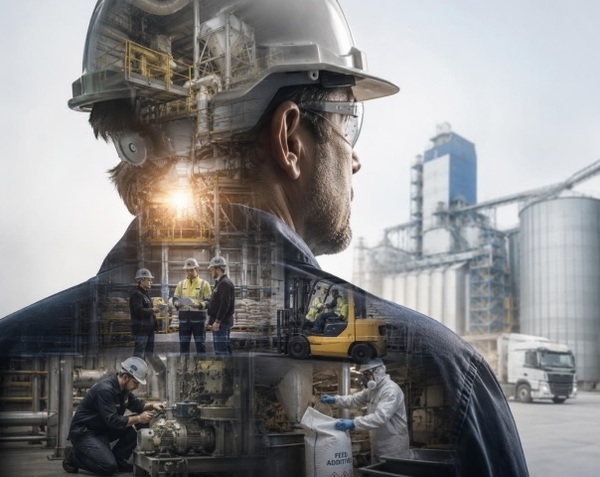
AI-generated image for illustrative purposes
What years in feed manufacturing taught me about safety
When I started my career as a feed mill manager, safety was already part of the conversation. Procedures existed, inspections were carried out, and most companies genuinely wanted to avoid accidents.
Yet, looking back, the industry was very different from what it is today.
In many plants, high-visibility clothing was not systematically worn. Respiratory protection was often limited to specific situations. Contractors sometimes entered production areas with only basic instructions. Certain risks were accepted as part of the job. They were not ignored, but they were tolerated.
Over the years, I have seen significant progress. Safety standards have improved. Regulations have become more demanding. Companies have invested in training, equipment, and prevention programs. Most importantly, the mindset has evolved.
And that is good news. But despite this progress, I have also known colleagues whose physical integrity was permanently affected by workplace accidents. Some incidents resulted in injuries that changed lives forever. Those experiences leave a mark. They remind us that behind every safety indicator, every audit score, and every regulatory requirement, there are human beings.
That is why I have always considered safety as something much bigger than compliance. For me, safety is not primarily about avoiding fines, satisfying auditors, or complying with legal obligations. It is about ensuring that every person who enters a site returns home in the same condition as when they arrived.
This includes employees, of course. But it also includes truck drivers, visitors, contractors, maintenance technicians, and anyone else who contributes, directly or indirectly, to the operation of a feed or premix plant.
We are not simply protecting machines, buildings, or production assets. We are protecting lives, families, and futures.
The hidden complexity of feed and premix plants
People unfamiliar with our industry often underestimate the complexity of feed manufacturing.
A modern feed mill combines mechanical processes, thermal processes, electrical installations, chemical products, vehicle movements, storage facilities, and human interactions. Each element brings its own hazards. When combined, they create an environment where risks must be managed continuously.
Some dangers are well known. Combustible dust is probably the most emblematic example. Feed mills handle large quantities of cereals, meals, powders, additives, and premixes. Under specific conditions, these materials can generate explosive atmospheres. Dust explosions remain one of the most severe industrial hazards in our sector because they can develop rapidly and affect multiple areas of a facility.
Most professionals are familiar with the theory. The challenge lies in daily execution. A clogged filter that creates overheating. A worn bearing is generating excessive temperature. Dust accumulation in difficult-to-access areas. An electrostatic discharge during the unloading of powdered materials. Cleaning activities performed with compressed air create dust clouds that should never exist in the first place.
None of these situations is particularly unusual. In fact, that is precisely the problem. They are part of everyday operations. The risk is often born where familiarity replaces vigilance.
The same applies to fire prevention. Pellet presses, coolers, dryers, electrical cabinets, and conveying systems can all become sources of ignition under certain conditions. Most fires do not start with a dramatic event. They often begin with a small anomaly that goes unnoticed: an overheating component, a lack of preventive maintenance, or an accumulation of combustible material.
By the time smoke becomes visible, valuable time has already been lost. This is why fire prevention cannot rely solely on emergency response capabilities. It must begin with maintenance quality, housekeeping standards, inspection routines, and operational discipline.
The accidents that should never happen
Among all industrial risks, I have always found mechanical accidents particularly frustrating. Not because they are less serious than others, but because they are often preventable. Feed mills contain bucket elevators, conveyors, mixers, screw conveyors, pellet mills, bagging systems, and numerous rotating or moving components.
The dangers are obvious. Entanglement, crushing, shearing, and trapping hazards have been known for decades.
Yet accidents continue to occur. In many investigations, the root causes are remarkably similar. An operator attempts to clear a blockage without stopping the equipment. A protective guard has been removed and not reinstalled. A maintenance intervention is carried out without proper isolation of energy sources. Production pressure encourages shortcuts.
The technical causes may vary, but the underlying mechanisms are often the same. Someone believed that nothing would happen this time. This is where safety culture becomes more important than procedures alone. A company may have excellent written instructions. But if employees feel pressured to prioritize production over safety, those procedures gradually lose their effectiveness.
The most dangerous moment is often not when people ignore the rules. It is when they know the rules and decide, for seemingly good reasons, not to follow them.
Looking beyond physical hazards
Historically, industrial safety has focused on physical risks. And rightly so. Machinery, electricity, explosions, chemicals, and falls from height deserve constant attention.
However, one aspect of safety is still underestimated in many organizations: the human and organizational dimension. When discussing workplace accidents, we often ask what happened. We do not always ask why people behaved the way they did.
Fatigue, excessive workload, staffing shortages, poor communication, unclear responsibilities, and constant production pressure all influence decision-making. An exhausted operator is more likely to make a mistake. A stressed supervisor may overlook warning signs. A team working with insufficient resources may develop unsafe habits simply to keep production running.
These factors rarely appear on equipment specifications or engineering drawings, but they are present in almost every serious incident. As the industry becomes more automated and technically sophisticated, human factors become increasingly important. Technology can eliminate certain risks, but it cannot eliminate poor decisions, organizational weaknesses, or unhealthy working environments.
A truly mature safety approach must address both.
Safety is not perceived the same way everywhere
Having worked with companies in different countries, I have also observed that safety is not understood uniformly across cultures. Regulations differ, inspection systems differ, and economic realities differ. But cultural attitudes also play an important role. In some environments, safety is deeply embedded in management practices and employee expectations. Unsafe situations are challenged immediately. In others, there can be a certain degree of fatalism. Accidents are viewed as unfortunate but inevitable consequences of industrial activity.
This mindset creates significant challenges for international organizations. A procedure can be translated into multiple languages. A safety standard can be implemented globally. But culture cannot simply be copied from one site to another.
Building a strong safety culture requires leadership, consistency, and time. People must see that safety is genuinely valued when decisions become difficult. They must see that managers are willing to stop production when necessary. They must see that the same standards apply to employees, contractors, and visitors. Most importantly, they must believe that safety is not negotiable.
What really makes a difference
After many years in the industry, I have become convinced that the most effective safety improvements are not always the most sophisticated. Of course, modern detection systems, ATEX-compliant equipment, automation, and advanced monitoring technologies provide tremendous value. But many accidents can still be prevented through relatively simple actions. Good housekeeping remains one of the most powerful fire and explosion prevention measures available. Well-designed traffic plans significantly reduce interactions between pedestrians and vehicles. Proper lockout and tagout practices prevent countless maintenance-related incidents. Structured permit-to-work systems improve the management of hot work, confined space entry, and high-risk interventions.
Comprehensive risk assessments help organizations identify weaknesses before accidents occur. And regular training ensures that safety remains present in daily activities rather than becoming a forgotten document stored on a server. Perhaps most importantly, organizations should pay close attention to near misses. Every near miss is a warning. It is an opportunity to learn before someone gets hurt.
Companies with strong safety performance are often not those that experience fewer incidents by chance. They are the ones that learn faster from weak signals.
A responsibility we all share
The feed industry has made considerable progress over the past decades, and that progress should be recognized. But there is still work to do.
New technologies, new ingredients, evolving production models, labor shortages, and increasing operational complexity continuously create new challenges. Safety can never be considered finished. It requires constant attention because industrial environments are constantly changing.
If there is one lesson I have learned throughout my career, it is that safety cannot be delegated exclusively to a safety manager, a consultant, or a regulatory authority. It belongs to everyone.
The best safety equipment remains an alert and responsible mind. Yet people are human. They become tired. They become distracted. They become accustomed to risks that once seemed unacceptable. That is why systems, procedures, leadership, and culture matter. They exist to support people when human attention inevitably fluctuates.
At the end of the day, production targets will be forgotten. Tonnage records will eventually be surpassed. Equipment will be replaced.
People are the only assets that cannot be replaced. And that is why safety must always come first.