Artificial intelligence in animal feed mills: A gradual evolution in support of processes and human expertise
Published: February 25, 2026
Source : Marc Perel, Independent Consultant in Feed Technology | Premix | Additives
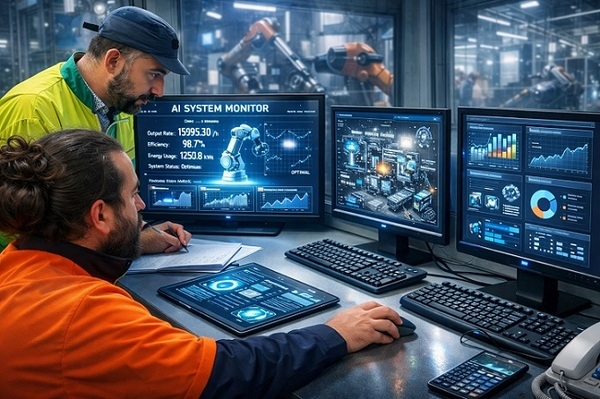
AI-generated image for illustrative purposes, based on photos of the author
Summary
Artificial intelligence is gaining attention in animal feed manufacturing, but its adoption in plants remains gradual rather than disruptive. Based on industry conferences, field experience and sector reports, this article argues that AI should be seen as a practical support tool, not a replacement for human expertise. It reviews the most relevant use cases — maintenance, process optimization, loss reduction and planning — and highlights a key condition for success: reliable, well-structured industrial data.
Over the past few years, artificial intelligence has become part of everyday conversations. The animal feed industry is no exception. Conferences, white papers and trade articles now regularly address the topic. Yet, from an operational point of view, the reality appears more nuanced. AI is progressing, but it is not transforming feed mills through sudden disruption. It is being integrated step by step into already complex industrial organizations.
In animal feed mills, AI is neither a magic solution nor an end in itself. It is a tool. A powerful one, certainly, but its value depends entirely on data quality, process understanding and the expertise of the teams using it.
A technology that remains poorly defined in industrial environments
When discussing artificial intelligence, very different realities are often grouped under the same term. In industry, and particularly in animal feed manufacturing, AI does not refer to an autonomous system that “takes control” of operations. It mainly refers to a set of methods capable of analyzing large volumes of data, identifying patterns and proposing predictions or recommendations.
Presentations shared during recent Feed Mill of the Future conferences have consistently highlighted three main pillars of industrial AI: historical data analysis, machine learning, and continuous optimization of operational decisions. This is far from a technology replacing human judgment. Instead, it helps reveal relationships that are not always visible, or not visible early enough.
In feed mills, this distinction is essential. Processes are multi-step, highly sensitive to raw material variability and operating conditions. Assuming AI could fully replace human experience would be a mistake.
An evolution rather than a revolution
AI does not arrive in a technological vacuum. Animal feed mills have been automated for decades. Programmable logic controllers, supervisory systems, production databases and manufacturing execution systems are already widely deployed.
What AI adds is an additional layer. It makes better use of existing data. It connects information that was previously under-used. It highlights correlations that conventional tools struggle to detect.
For this reason, it is more accurate to speak of evolution rather than revolution. AI is part of a continuum that includes automation, digitalization and the ongoing search for industrial performance. It does not challenge the fundamentals of the profession. It strengthens them.
Many industrial players interviewed during conferences and technical discussions confirm this view. The real challenge is not “doing AI”, but understanding one’s own process better, its limits, its variability and its improvement potential.
Human expertise remains central
One message appears consistently in field feedback: AI must not weaken internal expertise. On the contrary.
AI models are built on historical data. They learn from past situations. But they do not understand industrial context in the human sense. They do not know why an operator adjusts a setting as a precaution, or why a team decides to run production differently on a given day.
Blind trust in a model is risky. Several speakers at the Feed Mill of the Future Conference emphasized this point: poorly understood AI systems can lead to poor decisions, especially when they operate as black boxes.
The right approach is to use AI as a decision-support tool. It suggests. Humans decide. And, most importantly, humans understand what the tool does and why it does it.
Data: the real tipping point
All serious stakeholders agree on one point: without reliable data, AI brings little value.
The white paper “AI in Agricultural Cooperatives” published by La Coopération Agricole (France) in 2025 clearly highlights that the main difficulties are not related to algorithms themselves, but to access to clean, structured and usable industrial data.
In most feed mills, data already exist. But they are often scattered, poorly structured, manually entered, or stored in parallel files. This severely limits the relevance of AI-based approaches.
Before discussing models or predictions, several fundamentals must be secured:
- the right sensors are installed,
- they are correctly positioned,
- they are calibrated and maintained,
- data are centralized and consistent.
This work is rarely spectacular. It takes time. But it conditions everything that follows.
What industrial AI really covers
In animal feed mills, AI can take several very concrete forms:
- Predictive analytics for equipment maintenance
- Real-time optimization of production parameters
- Automated anomaly detection using machine vision (image analysis)
- Simulation and digital twins to test scenarios
- Support for production planning and scheduling
In all cases, AI relies on existing data and a solid understanding of the industrial process.
Predictive maintenance: a credible first application
Maintenance is often the first area where AI delivers tangible value. Key equipment in feed mills — grinders, mixers, pellet presses, conveying systems — already generate large amounts of data: electrical loads, operating time, temperatures, vibrations and more.
AI makes it possible to analyze these signals over time. It identifies gradual drifts that may go unnoticed by the human eye and can issue alerts before failures occur.
According to several technical case studies published in the agri-food sector, some plants have reduced unplanned downtime by 20 to 40% using data-driven predictive maintenance approaches.
Once again, AI does not replace maintenance teams. It provides better tools to prioritize interventions and anticipate issues.
Optimizing the process, not making it rigid
Another application area concerns process optimization itself. In sensitive operations such as pelleting or extrusion, settings still largely rely on operator experience.
AI can help clarify the real impact of each parameter: moisture, temperature, residence time, throughput, raw material characteristics.
By correlating these inputs with observed outcomes, it highlights more stable operating zones.
Automation and engineering companies in our sector describe approaches that reduce start-up phases, limit non-conformities and ultimately improve productivity.
But interpretation remains essential. A model may suggest an optimal setting. It does not know the operational constraints of the day, nor the trade-offs between quality, throughput and energy consumption.
Reducing losses and rework
Loss reduction is another natural application for AI. A significant share of hidden costs in feed mills comes from diffuse waste: dosing inaccuracies, rework, start-ups and end-of-run losses.
AI can help identify these losses and, more importantly, understand their root causes.
In some cases, data analysis has reduced line start-up time by 10 to 30%. In others, it has revealed overly conservative settings that were no longer necessary.
Individually, these gains may seem modest. Combined, they have a real impact on overall plant performance.
Planning and logistics: underestimated gains
AI is still rarely associated with logistics in feed mills, yet this is a major application area.
Production scheduling, raw material inventory management and delivery planning are complex problems with many constraints.
AI is particularly effective at quickly exploring scenarios and proposing balanced solutions.
Studies presented at Feed Strategy conferences show that logistics optimization based on digital twins can reduce transportation costs and improve service levels, especially in multi-site organizations.
Five high-impact AI levers in feed mills
- Predictive maintenance of critical equipment
- Process stabilization
- Loss and rework reduction
- Production planning optimization
- Continuous improvement of product quality
These levers are complementary. Their effectiveness depends on the plant's digital maturity.
Putting numbers behind the discussion
Discussions around AI benefit from being grounded in data. Here again, the La Coopération Agricole white paper provides useful insight.
The survey shows that a majority of respondents expect AI to have a significant impact on industrial activities, particularly in process optimization, maintenance and decision support.
Other sector studies in agri-food report productivity gains in the range of 10 to 20% for well-structured AI projects. These figures must be interpreted carefully. Such results are only achievable when the fundamentals are in place.
Limits not to be underestimated
AI is not without risks.
The first limitation is data quality. Poor data lead to poor decisions. No algorithm can compensate for that.
The second is cybersecurity. As systems become more connected, they also become more vulnerable. Feed mills are not immune to cyberattacks.
The third limitation is human. Without training, explanation and transparency, AI is perceived as a threat. Many projects fail not for technical reasons, but for organizational ones.
Checklist before launching an AI project
- Are data reliable and accessible?
- Are sensors properly installed and maintained?
- Is the use case clearly defined?
- Do teams understand the project objectives?
- Are success indicators defined?
- Is cybersecurity addressed?
Practical advice for industrial managers
For plant managers willing to move forward, a few principles stand out.
Start small. A well-defined pilot project is better than a poorly controlled large-scale deployment.
Involve teams from the beginning. AI should not be perceived as an IT project disconnected from operations.
And accept that AI is also a learning tool. Initial results are not always spectacular. But they help build a better understanding of the process and progressively improve decisions.
A trajectory to build, not a target to reach
Artificial intelligence will not transform animal feed mills overnight. And that is probably a good thing.
It is part of a continuous improvement trajectory, where data, process understanding and human expertise remain the pillars.
The plants that will benefit most from AI are those that use it to better understand how they operate, not to step away from responsibility.
AI is not an end. It is a means. And like any industrial tool, its value depends on how it is used.
Related topics:
Authors:

FeedSphere Solutions
Recommend
Comment
Share

Would you like to discuss another topic? Create a new post to engage with experts in the community.







Featured users in Animal Feed