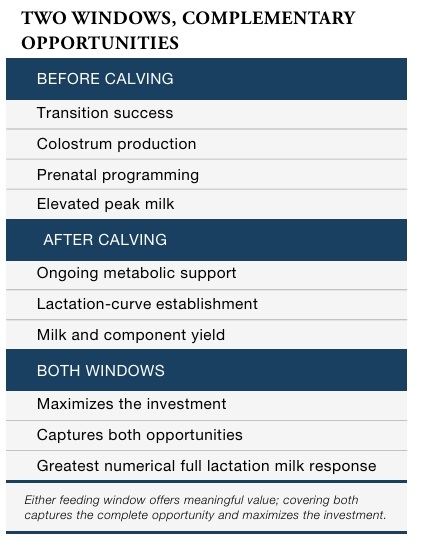
For more than 25 years, nutritionists have debated whether rumen-protected choline delivers greater value before calving, after calving, or across both periods. Recent research comparing these strategies offers new insight into how each window contributes to milk production. Either window provided benefits; covering both produced the largest numerical response.
For more than two decades, rumen-protected choline (RPC) has been a cornerstone of transition cow nutrition programs. During that time, one recommendation has remained consistent: begin supplementation approximately 21 days before calving and continue through the first 21 days of lactation.
The recommendation makes biological sense. The transition period is one continuous physiological process, not two isolated events separated by calving. Yet a practical question has persisted:
If a dairy can supplement during only one phase of transition, which matters more: pre-fresh, postfresh, or both?
Some dairies can reliably deliver RPC to close-up cows but struggle to continue postpartum supplementation for logistical reasons. Others can more easily supplement fresh cows than dry cows.
The question itself reflects how our understanding of choline has evolved. Twenty-five years ago, rumen-protected choline was often viewed primarily as a tool for managing fatty liver and supporting over-conditioned cows during transition. Decades of research have broadened that perspective considerably. Today we recognize that choline influences numerous biological processes affecting transition success (Lima et al. 2024), calf development (Zenobi et al. 2018), milk production (Arshad et al. 2020; Swartz et al. 2023), and overall profitability.
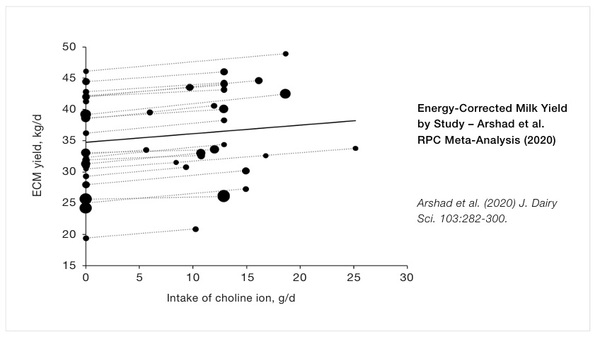
Just as importantly, benefits have been observed across body condition scores (Bollatti et al. 2020), production levels (Arshad et al. 2020), and management systems, from confinement dairies to pasture-based operations. Collectively, the evidence has led to an important shift in how choline is viewed: not as an optional intervention for problem cows, but as a required nutrient for essentially every transition cow, regardless of production level, body condition, or dairy production system. The discussion is no longer whether a particular type of cow should receive supplemental choline. The question is how to deliver this required nutrient effectively and capture its full biological and economic value.
For more than 25 years, nutritionists have debated whether rumen-protected choline delivers greater value before calving, after calving, or across both periods. Recent research comparing these strategies offers new insight into how each window contributes to milk production. Either window provided benefits; covering both produced the largest numerical response.
The practical question is not whether a partial program is worthwhile. It is how much additional value can be captured when both windows are covered. Until recently, little research had directly compared prepartum-only, postpartum-only, and full-transition supplementation within the same experiment.
WHY TIMING MATTERS
Before calving, dry matter intake declines while fetal growth accelerates and colostrum is produced. Body fat mobilization also increases, placing additional demands on the liver. After calving, milk synthesis rises rapidly while feed intake takes time to recover. The metabolic and productive challenge therefore spans both sides of calving.
Because the transition period spans both sides of calving, nutritionists have long recommended supplementing rumen-protected choline before and after calving. What has remained less clear is how much each feeding window contributes to the overall response.
WHY FEED CHOLINE BEFORE CALVING?
The value of prepartum choline supplementation extends far beyond preparing the cow for freshening. It provides an opportunity to influence the upcoming transition, the next lactation, the newborn calf, and potentially future generations.
One immediate benefit is improved transition success. As feed intake declines and body fat mobilization increases, the liver must process a growing supply of fatty acids. Supplemental choline supports the liver’s ability to package and export fat, helping reduce triglyceride accumulation (Cooke et al. 2007; Arshad et al. 2023 a & b). Lower liver fat can contribute to a smoother transition, fewer metabolic disorders, stronger performance, and improved productive lifespan.
Prepartum supplementation also overlaps with colostrum production. Adequate quantities of high-quality colostrum are essential to passive transfer and can influence calf immunity, health, growth, and survivability well beyond the first days of life. Research at multiple universities has shown that choline supplementation during the prepartum period can increase both the quantity and quality of colostrum (Zenobi et al. 2018; Swartz et al. 2022; Holdorf et al. 2023). Supporting colostrum production before calving therefore creates an opportunity for lifelong benefits to the calf that cannot be recovered through postpartum supplementation.
Late gestation is also a critical period of fetal development. Nutrients supplied to the dam can influence fetal development through prenatal programming, including epigenetic regulation of gene expression. Research suggests that maternal choline supplementation can affect calf health, growth, and future productivity. Evidence that daughters of supplemented cows can produce more milk during their own lactations indicates that a relatively short prepartum intervention may influence performance far beyond the transition cow. The possibility of effects extending across generations is compelling, although the extent and mechanisms require further study.
Prepartum supplementation can also influence the ensuing lactation. Responses initiated before calving can contribute to higher peak milk and persist long after supplementation ends (Zenobi et al. 2018). Because a stronger peak can shape the lactation curve, benefits established during the close-up period can extend throughout the lactation.
Viewed collectively, the prepartum opportunity reaches far beyond the close-up pen: smoother transitions, reduced metabolic risk, improved colostrum production, healthier calves, prenatal programming, higher peak milk, and greater lifetime productivity.
WHY CONTINUE FEEDING CHOLINE AFTER CALVING?
While prepartum supplementation helps establish the foundation, postpartum supplementation helps capitalize on it.
Following calving, milk production accelerates faster than feed intake recovers. The cow remains in negative energy balance; body fat mobilization continues, and the liver must process a sustained flow of fatty acids while supporting rapidly increasing milk synthesis. Supplemental choline continues to support lipid transport and liver function during this demanding period.
Postpartum supplementation also coincides with the establishment of the lactation curve. This is when the cow begins converting transition preparation into productive output. Research has reported improvements in milk yield, energy-corrected milk, milk components, and metabolic indicators when RPC is supplied through early lactation. Responses achieved during these weeks can persist after supplementation ends, increasing the value of a relatively short feeding period.
The postpartum window is therefore more than an extension of the close-up program. It addresses a distinct physiological and productive phase. Prepartum supplementation supports preparation, colostrum production, fetal development, and programming. Postpartum supplementation supports the onset of lactation, helps sustain metabolic function, and allows the cow to express more of her productive potential.
The two windows are not competing strategies. One helps prepare the future. The other helps realize it. Each window offers a valuable opportunity on its own. When both can be implemented, the two programs work together to capture even more of the potential return.
NEW RESEARCH SHEDS LIGHT ON A 25-YEAR QUESTION
For more than 25 years, nutritionists have recommended feeding RPC before and after calving because each period offers important but different opportunities. The unresolved question was how much each window contributes to the overall response.
A 2026 study by Bugoni and colleagues provides new insights. Using a commercial dairy herd in Brazil, the researchers evaluated four treatments of RPC supplementation using ReaShure®-XC (Balchem Corporation, Montvale, NJ, USA) as the RPC source:
• Control, with no supplemental RPC
• Prepartum RPC supplementation only
• Postpartum RPC supplementation only
• Full-transition RPC supplementation before and after calving
Supplemented cows received 30 g/day of ReaShure®-XC, providing 13.4 g/day of choline ion. Supplementation began approximately four weeks before calving and continued through 26 days of lactation according to treatment. Milk production was monitored through 40 weeks of lactation.
The study’s importance lies in its design. By directly comparing all four treatment strategies in one experiment, the researchers could evaluate the individual and combined contributions of the prepartum and postpartum windows.
KEY TAKEAWAY: Either feeding window can deliver value. Covering both produced the largest numerical milk response and provides the greatest opportunity to maximize the investment.
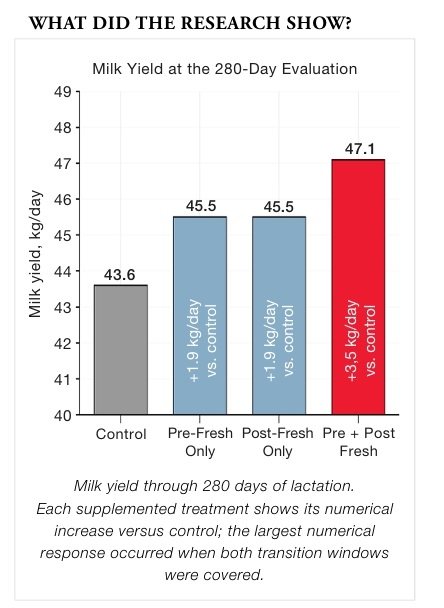
The results show that an operation does not need a perfect full-transition feeding period to capture value from RPC supplementation. Prepartum-only and postpartum-only supplementation each averaged 1.9 kg/day more milk than the control through 280 days of lactation. Full-transition supplementation averaged 3.5 kg/ day more than the control, showing the additional opportunity available when both windows can be covered.
These treatment differences are numerical; the study did not report a specific statistical contrast between the full-transition and control treatments.
Viewed together, the results suggest that the two feeding windows are complementary rather than competitive. Each offers value independently, while covering both produced the largest numerical response.
WHAT IF ONLY ONE WINDOW IS POSSIBLE?
Management realities still matter. Not every dairy has a dedicated fresh-cow group, and not every operation can consistently deliver a postpartum supplement. Those limitations should not discourage RPC use. The new research indicates that feeding RPC during either the prepartum or postpartum window can still provide meaningful productive value.
When only one window is feasible, however, the prepartum period should be prioritized. This recommendation is not based on prepartum-only supplementation outperforming postpartum-only supplementation in the Bugoni study; both partial programs produced the same numerical milk response through 280 days of lactation. Rather, it reflects the broader opportunities available only before calving.
Prepartum supplementation supports metabolic preparation while colostrum production and fetal development are underway. It also creates opportunities to influence prenatal programming, calf outcomes, peak milk, and performance during the ensuing lactation. Once calving occurs, these opportunities cannot be recovered through postpartum supplementation.
Postpartum supplementation remains a valuable strategy when that is the window a dairy can consistently manage. Full-transition supplementation remains the preferred recommendation because it captures both sets of benefits and produced the largest numerical milk response. In practical terms, either window can deliver value; if only one can be protected, prioritize pre-fresh. To maximize the investment, cover both.
TWENTY-FIVE YEARS LATER, THE RECOMMENDATION HASN’T CHANGED
For more than two decades, nutritionists have recommended feeding RPC before and after calving because transition is one continuous physiological event. The newest data do not change that recommendation.
They strengthen it.
Another important lesson from 25 years of research is how broadly applicable rumen-protected choline has proven to be. What began as a technology often associated with over-conditioned cows and fatty liver has consistently demonstrated benefits across body condition scores, production levels, and management systems.
The science has expanded our understanding of choline far beyond liver fat metabolism alone. Today, choline is recognized for its role in supporting transition success, colostrum production, calf development, prenatal programming, milk production, and overall biological efficiency.
The central finding is not that one window was superior. It is that both contributed. Prepartum-only and postpartum-only supplementation each produced a meaningful numerical response, confirming that either strategy can be worthwhile when management limits coverage to one period.
When both windows can be covered, the opportunities combine. Prepartum supplementation helps prepare the future. Postpartum supplementation helps realize it. Together, they offer the greatest opportunity to maximize the return from RPC supplementation.
After 25 years of discussion, the answer appears both simple and practical:
Feed RPC during the window or windows your management system can support. Either window can deliver value. If only one window is possible, prioritize pre-fresh to capture opportunities that cannot be recovered after calving. To maximize the investment, cover both.
After 25 years of research, perhaps the most important lesson is how fundamentally our understanding of choline has changed. Choline is no longer viewed only as an intervention for over-conditioned cows or herds experiencing metabolic problems. The evidence supports its role as a required nutrient for essentially every transition cow, regardless of production level, body condition, or production system.
About Dr. Clay Zimmerman
Dr. Clay Zimmerman currently serves as the Director of Science and U.S. Ruminant Technical Services at Balchem Animal Nutrition & Health, having joined the company in 2013. In this role, he oversees all of Balchem’s external animal research and manages the U.S.-based Ruminant Technical Team.
A native of Maryland, he obtained his Bachelor of Science degree in Dairy Science from Virginia Tech and his Master’s and Ph.D. in Animal Nutrition from North Carolina State University. For the first 22 years of his career, he served as the head dairy nutritionist for two large feed companies, one in the Midwestern US, and one in the Northeastern US.
About Dr. Marcos Zenobi Marcos
Zenobi is originally from Argentina. After receiving his Master of Science degree in 2013, he moved to Gainesville, Florida to start his PhD under Dr. Charles Staples and Dr. Jose Santos in the Animal Sciences Graduate Program at the University of Florida. Dr. Zenobi is a specialist in dairy nutrition and management. He now lives in Córdoba, Argentina, where he serves as Technical & Commercial Manager | Latin America at Balchem Animal Nutrition & Health, leading technical services activities in the region. He also teaches undergraduate and graduate students in Argentina.