INTRODUCTION
Benthic invertebrates are those animals which spend all or most of their life in, on or near the bottom of any aquatic habitat. Information about benthos is required for studies on productivity, fisheries and in recent years particularly on field population on which a long- term work on aquatic benthic communities and its possible indicator species can make a valuable contribution (Holme and mcintry, 1971). Benthos are classified by size into three categories a) macrobenthos are the larger, more visible, benthos that are greater than 0.5 mm in size such as polychaete worms, bivalves, echinoderms, sea anemones, sponges, turebellarians and larger crustaceans such as crabs and lobsters. b) meiobenthos are tiny benthos that are less than 0.5 mm but greater than 63 µm in size. Some examples are nematodes, foraminifrans, water beers and smaller crustaceans such as copepods and ostracodes. C) microbenthos are microscopic benthos that are less than 63 µm in size. Some examples are, bacteria, flagellates, amoebae and ciliates (Giere, 1993). Benthos feed mostly on detritis, plankton, algae and on eachother (Abdel Gawad, 2001). Macroinvertebrates feeding showed high selectivity towards the epiphytic diatoms (Abd El-Karim et al., 2009). The depth of water, temperature, salinity, and type of local substrates all affect what benthos is present. The present work aimed to study the community composition, distribution and seasonal variations of macrobenthic and meiobenthic invertebrate fauna, with reference to the ambient variables in the area of Ashtoum El Ggamil Protected Area (Lake Manzalah).
MATERIALS AND METHODS
Area of Investigation
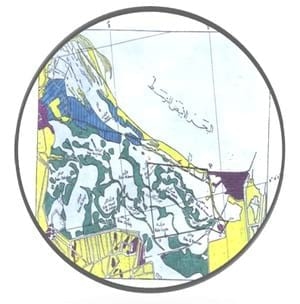
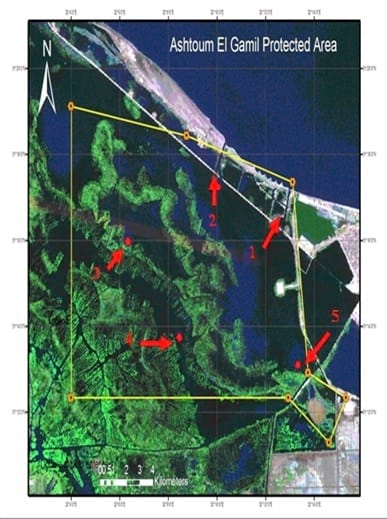
LakeManzalahis the largest of the Nile Delta lakes. It is located in the northeastern part of Egypt. It is bounded on the east by the Suez Canal and on the west by Damiettabranch of the Nile and is separated from the Mediterranean Seaby a narrow sandy fringe at the north. The lake is connected to the Mediterranean Seathrough a narrow channel (Boughaz El-Gamil). The islands and reed beds divide the lake into well defined basins each is known as Bahr, having more or less distinctive ecological conditions (Abdel-Baky etal., 1991). Samples were collected from Ashtoum El Gamil Protected Area which is located in the north western corner ofLakeManzalah, including new and old El Gamil inlets (Fig.1). Samples were collected from five stations, namely: station 1: inlet of El Gamil old in the north-east, station 2: inlet of El Gamil new in the north-west, station 3: Sea Kassab near to the middle, station 4: Sea Bashtier in the south-west and station 5: Sea Kur in the south-east, as illustrated in Fig. 2.
Fig. 1: Position of Ashtoum El Gamil Protected Area in Lake Manzalah
Fig. 2: Map of the study area, showing sampling stations (red colored spots)
Physicochemical parameters
The pH, dissolved oxygen and salinity were measured seasonally in the field at the same time of sampling by using Digital Dissolved Oxygen Meter (DO-5509).
Biological parameters
Sampling and treatment of samples
Macrobenthic invertebrates
Macrobenthic invertebrates' samples were collected seasonally during 2010 from the above five sampling localities covering the area of investigation, using Ekman Grab sampler (sampling area 250 cm2). The collected samples were washed through a screen of mesh size 500 µm, to remove any adhering bottom sediment and mud. The samples were stored in a plastic jars with 10% formalin solution. Each Jar was labeled with the relevant data. In the laboratory, samples were washed again in a net of 500 µm mesh size diameter. By using Zoomsterio microscope, the animals were separated into groups and identified as much as possible to species level. Each species was counted and the population density was estimated and expressed as a number of organisms / m2.
Meiobenthic invertebrates
Sampling of meiobenthic fauna was performed at the same five localities and the same period of macrobenthos sampling. Samples were collected by using Ekman Grab (opening area of 250 cm²). At each site, an area of 33.17 cm² was taken from the upper sediment surface. The samples were stained with Rose Bengal (1g / L) and preserved in 4% formalin solution. In Laboratory, the stained samples were passed through two sieves, the top one with a mesh opening of 500 µm (captured macrofauna) and the bottom one with a mesh of 63 µm. Animals retained in the sediment in the lower sieve were considered as meiofauna. These samples were diluted to 100 ml and few drops of Rose Bengal were added. From each sample, three sub samples (1 ml each) were examined under a dissecting microscope for sorting and identification to the species or higher taxa level. The population density was calculated and expressed as a number of organisms /10cm2.
RESULTS
Physicochemical parameters
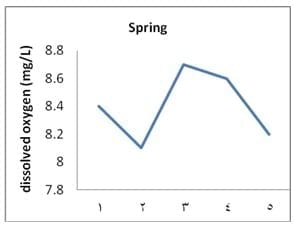
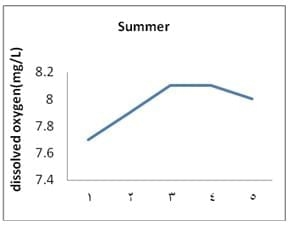
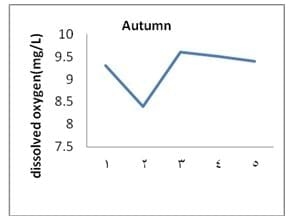
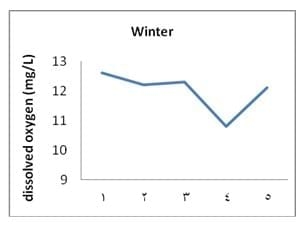
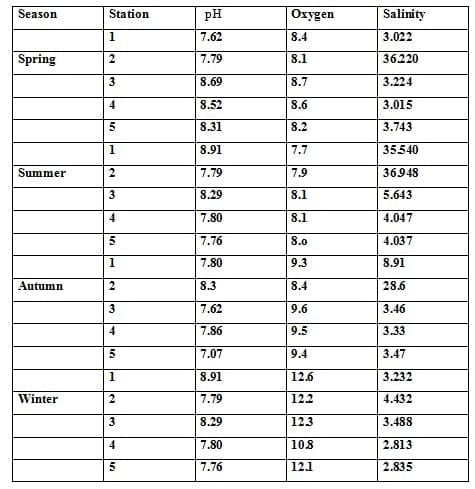
Temperature of the water followed the corresponding value of air temperature. Water temperature reached its maximum in summer and decreases gradually until it reached its minimum in winter. The water in the area lies at alkaline side, the maximum value of pH (8.91 was recorded in station 1 during summer and winter, while the minimum one (7.07) was recorded in station 5 during autumn (Table 1). As shown from Fig. 3, the concentration of dissolved oxygen reached its maximum value (12.6) in station 1 during winter, while the minimum (7.7) was recorded in station 1 during summer. It was found that the average value of dissolved oxygen reached its maximum in the whole area during winter. Salinity readings show big differences between the stations in the area of investigation. Station 1 and station 2 had saline water, Station 3 was brackish and station 4, 5 were considered fresh water (Table 1). The bottom sediment of the area investigated was homogenous and consisted of clay, silt, sand and broken shells in a proportion varying from one station to another. Mud (silt and clay) was abundant in station 1, 2, 3 while broken and dead shells, calcareous tubes of some species, as shells of Balanus were dominant in stations 4 and 5.
Fig.3: Dissolved oxygen (mg/L) in the different stations during different seasons
Table 1: Seasonal records of pH values, dissolved oxygen (mg/L) and salinity (g/L) in the stations during the period of study
Macrobenthos
Community composition
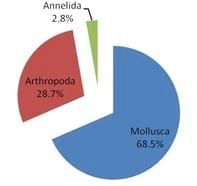
A total of fifteen species of macro invertebrates were identified in the collected samples during the period of investigation. including, two Arthropoda, two Annelida and eleven Mollusca. Mollusca ranked the highest percentage of population density (P.D.) of community (68.5 %) followed by Arthropoda( 28.7 %) and Annelida (2.8 %) (Fig. 4). Some of species had a marine origin that were introduced into the lake through Boughaz El- Gamil.
Fig. 4: Percentages of different groups of macrobenthic invertebrates in the area investigated
The spatial and temporal distribution of total macrobenthic invertebrates
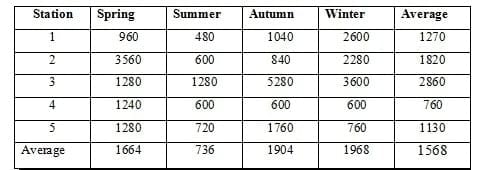
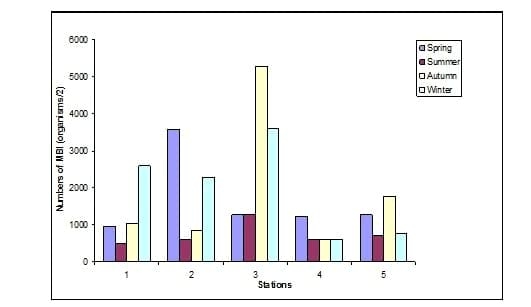
The average P.D. of total macrobenthic invertebrates during the whole period of investigation in the whole area of study was 1568 organisms / m2. the highest average P. D. (2860 organisms / m2) was recorded in station 3 , while the lowest average P. D. (760 organisms / m2) was recorded in station 4 (Table 2). Regarding seasonal variation, average P. D. of total macrobenthic invertebrates show its maximum value in Winter and Autumn, while its minimum value appeared in Summer (Fig. 5).
Table (2): Seasonal variation of the population density of total macrofauna (organisms / m2) in sampled localities
Fig. 5: Population densities of total MBI in different stations during the period of study
The spatial and temporal distribution of Mollusca
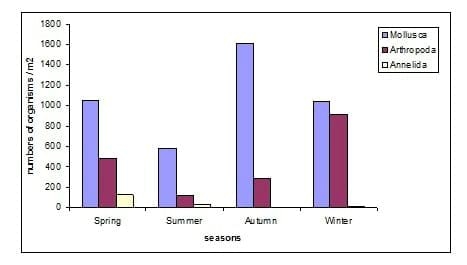
Mollusca were the most dominant group in the area investigated during this study. The average P.D. was 1074 organisms / m2, constituting about 68.5 % of the total macrobenthic fauna in the area. Station 3 was the most productive one with Mollusca, where the average population density of 2760 organisms / m2 . The lowest P. D. (190 organisms/ m2) was found in station 1. With regard to temporal distribution, Mollusca reached its peak during autumn, when 1616 organisms / m2 were recorded. The lowest P. D. of Mollusca (584 organisms / m2) was recorded during summer in the whole area (Fig. 6) that was represented by 8 species of gastropods and 3 species of bivalves). The species of gastropods were Pirenella conica, Melanoides tuberculata, Gyraulus erenbergi, Thiodoxis niloticus, Bulinus truncatus, Biomphalaria alexandrina, Semisalsa sp. and Physa acuta. Thespecies of bivalves were Cerastoderma glucum, Corbicula consobrina, and Abra ovata. The most common molluscs in the area were Melanoides tuberculata, Cerastoderma glucum and Abra ovate, while Physa acuta was very rare in the area during this study. There were many broken and dead shells of these mollusc species as seen in the samples and not taken into consideration in calculation.
The spatial and temporal distribution of Arthropoda
Arthropoda formed about 28.7 % of the total density of macrobenthic fauna in the area and represented by two species only, namely: Balanasamphitrite and Chironomid larvae. The first was the most common species of the total macrobenthos. It was recorded in all sampling stations and constituted 26.8 % of the totalmacrobenthic invertebrates and 93.3 % of the arthropods in the area during this study. Balanas amphitrite was abundant, reaching its maximum density in stations 1, 2 while it had a weak representation in other stations (3, 4 & 5). This species was flourished during winter and decreased gradually until reaching its lowest P. D. during summer. Chironomid larvae appeared only an occasion in the whole area during the period of study (in stations 4 & 5 during winter with 40 and 80 organisms / m2, respectively).
The spatial and temporal distribution of Annelida
Annelida ranked the third position of the total P. D. of the study area, constituting 2.8 %. The distribution of this group showed weak abundance in all seasons if it compared with Mollusca or Arthropoda (Fig. 6). It appeared only in station 1, 4, 5, and absent totally from stations 2, 3 during the whole period of study. It was represented by a polychaete Nereis diversicolor and an oligochaete Chaetogaster liminaei.
Fig. 6: seasonal variation of different groups of macrobenthic invertebrates in the area investigated
Meiobenthic invertebrates
Density and composition
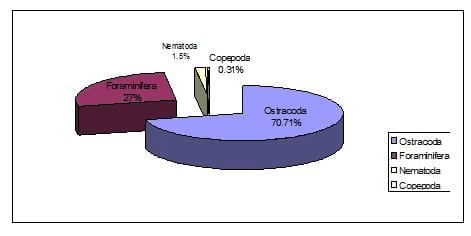
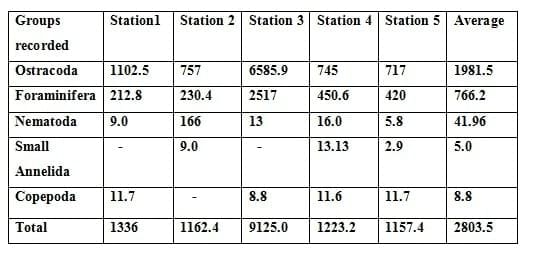
Four major meiobenthic groups were recorded in the area investigated (Ostracoda, Foraminifera, Nematoda and Copepoda). Few numbers of small Annelida, and fish eggs were also recorded. Ostracoda was the most abundant group, constituting 70.71% of the total number of meiofauna in the area. Foraminifera, Nematoda and Copepoda followed Ostracoda, constituting about 27%, 1.5% and 0.31% of the total number of meiofauna in the area, respectively (Fig. 7). The average P. D. of meiofauna was 2803 organisms / 10 cm2 in the whole area during this study. The highest number (9125 organisms/ 10 cm2 was recorded in station 3 while the lowest densities (1157.3 organisms / 10 cm2 and 1164.4 organisms /10 cm2) were recorded in stations 5 and 2, respectively (Table 2).
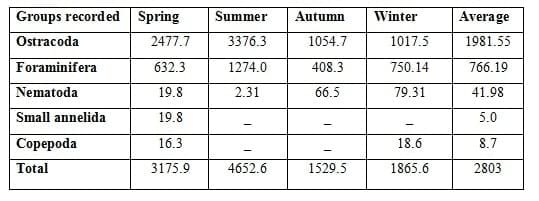
Regarding seasonal variation, summer and spring were the most productive seasons, when the highest population densities (4652 organisms /10 cm2, 3176 organisms /10 cm2) were estimated, respectively. The lowest population density (1529 organisms / 10 cm2) was recorded during autumn (Table 4).
Fig. 7: Percentages of different groups of meiobenthic invertebrates in the area investigated
Table 3: Average population density of meiofauna (organisms/10 cm2) of different groups in sampled localities during the whole period of study
The spatial and temporal distribution of major groups
Ostracoda
Ostracoda was the most common group in the area. The average population density of Ostracoda was 1981 organisms/10 cm2 in the area during this study. The highest P. D. was recorded in station 3 and the second peak was in station 1. Stations 2, 4, 5 were nearly similar in P. D. of Ostracoda. Concerning seasonal variation, a remarkable increase was recorded during summer and spring.
Foraminifera
The average P.D. of Foraminifera in whole area was 766 organisms/10 cm2. Station 3 was the most favorable ground in the area investigated, where its highest number (2517 organisms/10 cm2) was recorded. The Lowest P. D. of Foraminifera was recorded in station 1. Foraminifera were represented by two species in the area, namely Ammonia sp. and Qunqueloculina sp., while summer was the most productive season for Foraminifera (Table 4).
Nematoda
Nematoda occupied the third group in the area investigated after Ostracoda and Foraminifera, with an average number of 41 organisms/10 cm2 in the whole area during the period of study. The highest P, D. (166 organisms/10 cm2) was estimated in station 2, while the lowest P. D. was recorded in station 5. Nematoda was flourished in winter and autumn seasons. A sharp decrease in P. D. of nematode worms was shown in summer and spring (Table 4).
Copepoda
The average P. D. of copepods in the area was 8.7 organisms /10 cm2. The numbers of Copepoda were nearly similar in stations 1, 4 & 5 and it was missing totally from station 2 (Table 3). Copepoda was recorded during winter and spring and absent from the area during summer and autumn (Table 4).
Small Annelida
Few numbers of small Annelida were recorded in the area, especially in stations 2, 4 & 5 (Table 3). It was found only in the area during spring.
Table 4: Seasonal variation inpopulation density (P. D.) of meiofauna (organisms /10 cm2) of different groups in the whole area of investigation
DISCUSSION
The importance of benthos lies in its position as a secondary producer in the food chain and any change in benthos is reflected on the growth and production of fish. Macroinvertebrate communities can be used as a good indicator for monitoring which can help in management and conservation ofLakeManzala (Fishar and Abdel-Gawad, 2009).
Temperature is known to have a direct effect on aquatic organisms and indirect effect through its influence on other environmental factors such as solubility of gases including oxygen (Abdel Gawad, 1993). The lowest P. D. of macrobenthic invertebrates (M.B.I.) was recorded in summer and the highest one was recorded in winter. A strong negative correlation (r = -0.87) was reported between P. D. of macrobenthic fauna and temperature of water during this study. This agrees with the observation of Abdel Gawad (2001) who recorded a negative correlation between temperature and total P. D. of M.B.I. in the NileRiverat Helwan region. Changes in the temperature can also alter or completely inhibit the normal growth and spawning activities of some organisms (Hammerton, 1972 and Payne, 1986). Chironomid larvae disappeared during summer, spring, autumn. This may be due to the increase of water temperature which accelerates the development of larval stages, which agrees with Ramadan et al. (1998).
Difference in salinity in sampling sites can affect on distribution of some species such as Chatogaster limnaei which is a fresh water oligochaete that was recorded in stations 4 and 5, where salinity was too low ( between 2.81 and 4.05 g /L) . This agrees with Ahmed (1991) who stated that the salinity can determine species distribution and Khalil (1985) who stated the diversity and distribution of organisms in Manzalah Lake are largely determined by salinity and reported also that, the mean abundance of benthic fauna ranged from 1494 to 2820 organisms / m2. Mollusca species which were found in the area during this study are freshwater and marine in origin. Cerastoderma glucum , Abra ovata, Pirinela conica and Semisalsa sp. had marine origin, coming to the lake from the Mediterranean Sea. Fishar (1999) recorded these species in Lake Manzalah. Bulinus truncatus, Biomphilaria alexandrina, Melanoides tuberculata, Corbicula consobrina dominate the low salinity sites in the study area and this agrees with Khalil (1985) who stated that these species are freshwater in origin.
Dissolved oxygen is one of the most important key factors in the metabolic processes of aquatic organisms. In this study, the highest average of dissolved oxygen (12 mg / L) was recorded in winter in the whole area. This may be due to water movement and low temperature which increase the solubility of oxygen in water (Delince, 1992). Dissolved oxygen affects positively on the abundance of total macrobenthic invertebrates. During this study, the highest P. D. of M.B.I. was recorded in winter.
Meiobenthic invertebrates community plays an important role in the lakes food web. It serves as food for a variety of higher trophic levels and its high sensitivity to anthropogenic inputs making them excellent monitors for the study of pollution (Coull, 1999). Meiofauna in the area investigated showed its abundance peaks during summer and spring. This agrees with the results of Rudnick et al. (1985) who recorded high meiofaunal densities in some coastal marine ecosystem during summer. Fishar (1999 and 2000) recorded the highest densities of meiofauna during June and July; Abdel Gawad (2001 and 2007) recorded the highest number of meiofauna in the Nile River and El Serw Fish Farm respectively during summer. This may be attributed to the rapid rise in water temperature which was accompanied by abundanced food supply and increased rate of reproduction.
Ostracoda dominated the meiofauna in the area during this study and showed the highest peak in summer. This agrees with Smol et al. (1994) who stated that the abundancepeak ofOstracoda was noted either in summer or spring and their minimum density was observed in winter.
Another factor that affects the distribution of meiofauna was the interaction between meiofauna and macrofauna. In this study, the lowest P. D. of macrofauna was recorded in summer season when the P. D. of meiofauna was high. Moreover, there was a strong negative correlation (r = - 0.95) between P. D. of macro and P. D. of meiofauna in the area. Macrobenthic invertebrates decreased the number of meiobenthic invertebrates through mechanical disturbance of sediment (Bell, 1980) or due to predation (Wilson, 1991).
Sedimentological analysis also affects the density of meiobenthos, where high densities of meiofauna were recorded in station 3 with sediment of higher mud content than other stations and the mud is related to high content of organic matter, in accordance with Coull ( 1988).
Free living Nematodes were few in the investigated area. This may be due to high dissolved oxygen (from 7.7 to 12.6 mg / L) and low contamination . This agrees with Bouwman et al. (1984) who stated that abundance of nematodes occurs in contaminated environment and they are more tolerant to low oxygen content than other taxa. Fishar and Abdel Gawad (2004) confirmed this result in Wadi El Rayyan Lakes.
REFERENCES
Abdel-Baky, T. E., S. H. Hasan and K. A. H. Shallof (1991). Growth of Cichild species inLake Manzala,Egypt. Bull. Fac. Sci.,MansouraUniv., 18: 442-453.
Abdel Gawad, S. S. (1993). Studies on macrobenthic invertebrates in El Serw Fish Farm region. M. Sc. thesis, Fac. Sci.,MansouraUniv., 203 p.
Abdel Gawad, S. S. (2001). Studies on benthic invertebrates of theNileRiverat Helwan region. Ph. D. thesis, Fac. Sci.,MansouraUniv., 138 p.
Abdel Gawad, S. S. (2007). Some ecological aspects of meiobenthic community in El Serw Fish Farm (Dakahlyia,Egypt).Egypt. J. Aquat. Biol. & Fish., 11(3): 589-601.
Abd El-Karim, M. S., M. R. Fishar, and S. S. Abdel-Gawad (2009). Epiphytic algae and macroinvertebrates communities of Myriophyllum spicatum Lemn and their Cascade in the littoral food Web of Lake Nasser, Egypt. Global Veterinaria, 3 (3): 165-177.
Ahmed, R. S. S. (1991). Studies of aquatic insects inSuez Canalregion. M. Sc. thesis,Suez CanalUniv., 237 p.
Bell, S. S. (1980). Meiofauna – macrofauna interactions in a high salt marsh habitat. Ecol. Monoger, 50: 487-505.
Bouwman, L. A., K. Romeijn and W. Admiral (1984). On the ecology of meiofauna in an organically polluted estuarine mudflat. Estuarine, Coastal Shelf Sci., 19: 633-653.
Coull, B. C. (1988). Ecology of the marine meiofauna. In: R. P. Higgins & H. Theil (eds.) Introduction to the Study of Meiofauna. Smithsonian Institute Press.Washington, D. C.,London, pp: 18-38.
Coull, B.C. (1999). Role of meiofauna in estuarine soft bottom habits. Aust. J. Ecol., 24: 327-343.
Delince, G. (1992). The ecology of the fish pond ecosystem with special reference ofAfrica, Kluwer academic publisher, 230 p.
Fishar, M. R. A. (1999). Distribution and abundance of benthic assemblages in El Gamil Basin (Lake El Manzalah,Egypt) (A) meiobenthos. Bull. Nat. Inst. Oceanogr. & Fish. A.R.E., 25: 155-166.
Fishar, M. R. A. (2000). Composition, distribution andabundance of the meiobenthic fauna inLakeQarun (Faiyom,Egypt).Egypt. J. Aquat. Biol. Fish., 4 (3): 45-60.
Fishar, M. R. and S. S. Abdel Gawad (2004). Ecologyof meiobenthic fauna inWadiEl-RayyanLakes,Fayoum,Egypt. J. Egypt.Ger.Soc. Zool., 45D: Invertebrate Zoology and Parasitology, 23-35.
Fishar, M. R. and S. S. Abdel Gawad (2009). Macroinvertebrate communities associated with the Macrophyte Potamogeton pectinatus L. inLake Manzalah,Egypt. Global Veterinaria, 3 (3): 239-247.
Giere, O. (1993). Meiobenthology .The microscopic fauna in aquatic sediments (ed.)HumburgUniv., 328 p.
Hammerton, D. (1972). Studies of primary production in theNileRiver. Thirteen Ann. Rep., 1965-1966, Hydrobiol. Res. Unit, Univ.Khartoum. PP: 16-17.
Holme, N. A. and A. D. Mcintry (1971). Methods for the study of Marine Benthos. Internatinal Biological Programme 7 Marylebone Road NWI. Blackwell Scientific Publications,OxfordandEdinburgh.
Khalil, M. T. (1985). Ecological studies on the bottom fauna ofLake Manzala,Egypt.QatarUniversityScience Journal, p: 789.
Payne, A. I. (1986). The Ecology of TropicaLakesand Rivers. John Wily & Sons Chichester, New York, Tornoto, Brisbaneand Singapore, 300 p.
Ramadan, Sh. E., A. M. Kheiralla and Kh. M. Abdel Salam (1998). Benthic communities in the Nile River, Egypt 1- Aquatic stages of Insecta. Proceeding of the 8th Intern. Conf. on: Environmental protection is a must, 5-7, May, 1998.Egypt, pp: 178-189.
Rudnick,D. K., R. Elmagren and J. B. Frithsen (1985). Meiofauna prominence and benthic seasonality in a costal marine ecosystem. Oecologia, 7: 157-168.
Smol N., K. A. Willems, J. C. R. Govaere and A. J. J. Sandee (1994). Composition, distribution and biomass of meiobenthos in the Oasteschelde estuary (SW Netherlands). Hydrobiol., 282/283: 197-217.
Wilson, W. H. (1991). Competition and predation in marine soft sediment communities. Ann. Rev. Ecol. Syst., 21: 221-241.