Evaluating the impact of age, sex, and lameness on the problem-solving ability of broiler chickens
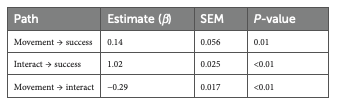
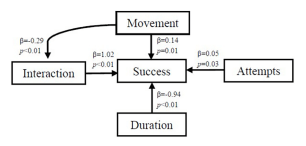
Problem-solving abilities help individuals analyze, understand and solve challenges effectively. These abilities are important for adaptability and environmental changes. This study aimed to evaluate how sex, age, and lameness affect problem-solving abilities of broiler chickens. A total of 75 broiler chickens (Ross 708), 39 females and 36 males underwent three different problem-solving tasks at 14, 28 and 42 days of age. Birds were tested individually and in groups. Birds were given five minutes to solve the task. Latency of the first movement, latency of the first interaction with the task, duration to solve the task, number of attempts and their success rate were measured. Gait score (GS) was determined for each bird after the problem-solving task. For individual birds, age impacted the latency to first movement and latency to first interaction, with birds at 14 and 28 d taking longer than birds at 42 d. Birds at 42 days solved the task faster and had a higher success rate, then birds at 14 d (0.54 and 0.31, respectively). There was also a difference in sex, with males being faster to interact with and solve the task, as well as being more successful at solving the task then females (0.47 and 0.37, respectively). GS only impacted the duration, birds with a GS of 0, 1, and 2 (183.3s, 201.5s, and 194.9s, respectively) solved the task faster than birds with GS of 3 (216.1s). Pathway analysis showed that birds that took longer to interact with task were more likely to complete the task, birds who took longer to solve the task were less likely to succeed, and birds that made more attempts were more likely to succeed. Presence of conspecifics impacted the success rate, birds presented the task in groups (0.89) were more successful than individually (0.69). Paired success outcomes of birds tested individually and in groups, showed that 56% were successful both in a group and individually and 40% were successful in a group but not individually. The likelihood of success on the task increased when birds were in a group, indicating a social effect. Sex, age, and presence of conspecifics all impact problem solving abilities. Broilers already have problem-solving skills at 14 d and this improve with age.
KEYWORDS cognition, gait score, Gallus gallus, innovative problem-solving, welfare
Introduction
Materials and methods
Animal husbandry
Experimental design
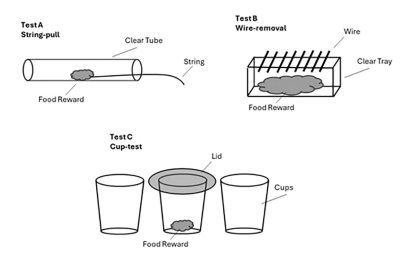
Data collection
Problem solving
Gait score and foot pad dermatitis score
Statistical analysis
Results
Individual results
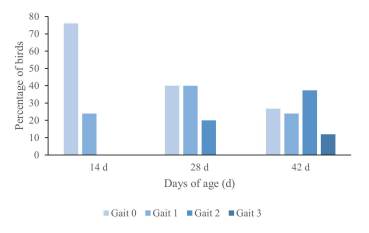
Gait score
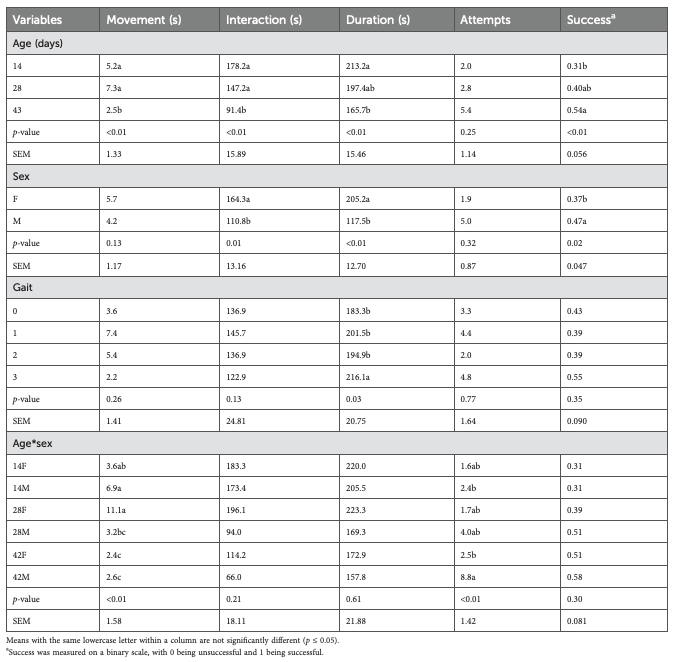
Latency to first movement
Latency to first interaction with the tasks
Duration to solve the tasks
Attempts to solve the task
Success rate

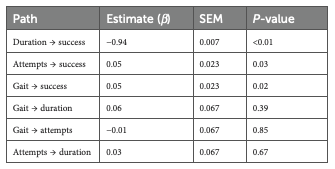
Pathway analysis
Group results
Discussion
Conclusion
- Arnould, C., Foucher, C., Calandreau, L., Bertin, A., Gigaud, V., & Berri, C. (2024). Deleterious effect of social instability on broiler chicken learning abilities and behaviour. Applied Animal Behaviour Science, 279, 106398. https://doi.org/10.1016/j.applanim.2024.106398
- Barrett, L. P., Marsh, J. L., Boogert, N. J., Templeton, C. N., & Benson-Amram, S. (2022). Links between personality traits and problem-solving performance in zebra finches (Taeniopygia guttata). Royal Society Open Science, 9. https://doi.org/10.1098/rsos.212001
- Bassler, A., Arnould, C., Butterworth, A., Colin, L., De Jong, I., Ferrante, V., et al. (2013). Potential risk factors associated with contact dermatitis, lameness, negative emotional state, and fear of humans in broiler chicken flocks. Poultry Science, 92, 2811–2826. https://doi.org/10.3382/ps.2013-03208
- Bokkers, E. A. M., & Koene, P. (2002). Sex and type of feed effects on motivation and ability to walk for a food reward in fast growing broilers. Applied Animal Behaviour Science, 79, 247–261. https://doi.org/10.1016/S0168-1591(02)00151-X
- Bradshaw, R. H., Kirkden, R. D., & Broom, D. M. (2002). A review of the aetiology and pathology of leg weakness in broilers in relation to welfare. Avian and Poultry Biology Reviews, 13, 45–103. https://doi.org/10.3184/147020602783698421
- Butterworth, A., Weeks, C., Crea, P., & Kestin, S. (2002). Dehydration and lameness in a broiler flock. Animal Welfare, 11, 89–94. https://doi.org/10.1017/S0962728600024337
- Caplen, G., Colborne, G. R., Hothersall, B., Nicol, C. J., Waterman-Pearson, A. E., Weeks, C. A., et al. (2013). Lame broiler chickens respond to non-steroidal antiinflammatory drugs with objective changes in gait function: A controlled clinical trial. The Veterinary Journal, 96, 477–482. https://doi.org/10.1016/j.tvjl.2012.12.007
- Collins, L. M., & Sumpter, D. J. T. (2007). The feeding dynamics of broiler chickens. Journal of the Royal Society Interface, 4, 65–72. https://doi.org/10.1098/rsif.2006.0157
- Daisley, J. N., Vallortigara, G., & Regolin, L. (2010). Logic in an asymmetrical (social) brain: Transitive inference in the young domestic chick. Social Neuroscience, 5, 309–319. https://doi.org/10.1080/17470910903529795
- Danbury, T., Weeks, C., Chambers, P., Waterman-Pearson, A., & Kestin, S. (2000). Self-selection of the analgesic drug carprofen by lame broiler chickens. Veterinary Record, 146, 307–311. https://doi.org/10.1136/vr.146.11.307
- de Haas, E., Lee, C., & Rodenburg, B. (2017). Learning and judgment can be affected by predisposed fearfulness in laying hens. Frontiers in Veterinary Science, 4, 113. https://doi.org/10.3389/fvets.2017.00113
- Dukas, R. (2004). Evolutionary biology of animal cognition. Annual Review of Ecology, Evolution, and Systematics, 35, 347–374. https://doi.org/10.1146/annurev.ecolsys.35.112202.130152
- Edgar, J., Held, S., Paul, E., Pettersson, I., I’Anson Price, R., & Nicol, C. (2015). Social buffering in a bird. Animal Behaviour, 105, 11–19. https://doi.org/10.1016/j.anbehav.2015.04.007
- Ferreira, V. H. B., Guesdon, V., & Calandreau, L. (2021). How can the research on chicken cognition improve chicken welfare: A perspective review. World’s Poultry Science Journal, 77, 679–698. https://doi.org/10.1080/00439339.2021.1924920
- Forkman, B., Boissy, A., Meunier-Salaün, M., Canali, E., & Jones, R. (2007). A critical review of fear tests used on cattle, pigs, sheep, poultry, and horses. Physiology & Behavior, 92, 240–374. https://doi.org/10.1016/j.physbeh.2007.03.016
- Franks, B. (2018). Cognition as a cause, consequence, and component of welfare. En Advances in Agricultural Animal Welfare: Science and Practice, 3–24. https://doi.org/10.1016/B978-0-08-101215-4.00001-8
- Garnham, L., & Løvlie, H. (2018). Sophisticated fowl: The complex behaviour and cognitive skills of chickens and red junglefowl. Behavioral Sciences, 8, 13. https://doi.org/10.3390/bs8010013
- Granquist, E. G., Vasdal, G., De Jong, I. C., & Moe, R. O. (2019). Lameness and its relationship with health and production measures in broiler chickens. Animal, 13, 2365–2372. https://doi.org/10.1017/S1751731119000466
- Griffin, A. S., & Diquelou, M. C. (2015). Innovative problem solving in birds: A cross-species comparison of two highly successful passerines. Animal Behaviour, 100, 84–94. https://doi.org/10.1016/j.anbehav.2014.11.012
- Gupta, S. K., Behera, K., Pradhan, C. R., Mandal, A. K., Sethy, K., Behera, D., et al. (2017). Cognitive performance for 2 strains of broiler birds in homogenous and mixed grouping system. Journal of Veterinary Behavior, 20, 109–115. https://doi.org/10.1016/j.jveb.2017.03.008
- Hillemacher, S., & Tiemann, I. (2024). Domestic chickens solving mirror-mediated spatial location tasks uncovering their cognitive abilities. Scientific Reports, 14, 1–11. https://doi.org/10.1038/s41598-024-64743-9
- Hothersall, B., Caplen, G., Parker, R. M. A., Nicol, C. J., Waterman-Pearson, A. E., Weeks, C. A., et al. (2016). Effects of carprofen, meloxicam and butorphanol on broiler chickens’ performance in mobility tests. Animal Welfare, 25, 55–67. https://doi.org/10.7120/09627286.25.1.055
- Howlider, M. A. R., & Rose, S. P. (1992). The response of growing male and female broiler chickens kept at different temperatures to dietary energy concentration and feed form. Animal Feed Science and Technology, 39, 71–78. https://doi.org/10.1016/0377-8401(92)90032-2
- Jackson, A., Quino, M., Gautam, A., Gilpin, M., Still, K., Landers, D., et al. (2025). The impact of multiple exposures and movement on the fear response of poultry. Poultry Science, 104, 104594. https://doi.org/10.1016/j.psj.2024.104594
- Kestin, S. C., Knowles, T. G., Tinch, A. E., & Gregory, N. G. (1992). Prevalence of leg weakness in broiler chickens and its relationship with genotype. Veterinary Record, 131, 190–194. https://doi.org/10.1136/vr.131.9.190
- Kestin, S. C., Gordon, S., Su, G., & Sørensen, P. (2001). Relationships in broiler chickens between lameness, liveweight, growth rate and age. Veterinary Record, 148, 195–197. https://doi.org/10.1136/vr.148.7.195
- Khera, T., & Rangasamy, V. (2021). Cognition and pain: A review. Frontiers in Psychology, 12, 673962. https://doi.org/10.3389/fpsyg.2021.673962
- Kittelsen, K. E., David, B., Moe, R. O., Poulsen, H. D., Young, J. F., & Granquist, E. G. (2017). Associations among gait score, production data, abattoir registrations, and postmortem tibia measurements in broiler chickens. Poultry Science, 96, 1033–1040. https://doi.org/10.3382/ps/pew433
- Knowles, T. G., Kestin, S. C., Haslam, S. M., Brown, S. N., Green, L. E., Butterworth, A., et al. (2008). Leg disorders in broiler chickens: Prevalence, risk factors and prevention. PLOS ONE, 3, e1545. https://doi.org/10.1371/journal.pone.0001545
- Lindqvist, C., & Jensen, P. (2009). Domestication and stress effects on contrafreeloading and spatial learning performance in red jungle fowl (Gallus gallus) and White Leghorn layers. Behavioural Processes, 81, 80–84. https://doi.org/10.1016/j.beproc.2009.02.005
- Liu, K., He, Y., Xu, B., Lin, L., Chen, P., Iqbal, M., et al. (2023). Leg disorders in broiler chickens: A review of current knowledge. Animal Biotechnology, 34, 5124–5138. https://doi.org/10.1080/10495398.2023.2270000
- Lormant, F., Ferreira, V. H. B., Meurisse, M., Lemarchand, J., Constantin, P., Morisse, M., et al. (2020). Emotionality modulates the impact of chronic stress on memory and neurogenesis in birds. Scientific Reports, 10. https://doi.org/10.1038/s41598-020-71680-w
- Louton, H., Bergmann, S., Reese, S., Erhard, M., Bachmeier, J., Rosler, B., et al. (2018). Animal- and management-based welfare indicators for a conventional broiler strain in 2 barn types (Louisiana barn and closed barn). Poultry Science, 97, 2754–2767. https://doi.org/10.3382/ps/pey111
- Low, L. A. (2013). The impact of pain upon cognition: What have rodent studies told us? Pain, 154, 2603–2605. https://doi.org/10.1016/j.pain.2013.06.012
- Marino, L. (2017). Thinking chickens: A review of cognition, emotion, and behavior in the domestic chicken. Animal Cognition, 20, 127–147. https://doi.org/10.1007/s10071-016-1064-4
- McGeown, D., Danbury, T. C., Waterman-Pearson, A. E., & Kestin, S. C. (1999). Effect of carprofen on lameness in broiler chickens. Veterinary Record, 144, 668–671. https://doi.org/10.1136/vr.144.24.668
- Mendl, M. (1999). Performing under pressure: Stress and cognitive function. Applied Animal Behaviour Science, 65, 221–244. https://doi.org/10.1016/S0168-1591(99)00088-X
- Ogura, Y., & Matsushima, T. (2011). Social facilitation revisited: Increase in foraging efforts and synchronization of running in domestic chicks. Frontiers in Neuroscience, 5, 91. https://doi.org/10.3389/fnins.2011.00091
- Panigrahy, K. K., Behera, K., Mandal, A. K., Sethy, K., & Panda, S. (2017). Effect of age and sex in determining cognitive ability in Vanaraja chickens. British Poultry Science, 58, 605–609. https://doi.org/10.1080/00071668.2017.1373388
- Regolin, L., & Vallortigara, G. (1995). Perception of partly occluded objects by young chicks. Perception & Psychophysics, 57, 971–976. https://doi.org/10.3758/BF03205456
- Regolin, L., Vallortigara, G., & Zanforlin, M. (1995). Detour behaviour in the domestic chick: Searching for a disappearing prey or a disappearing social partner. Animal Behaviour, 50, 203–211. https://doi.org/10.1006/anbe.1995.0232
- Riber, A. B., & Wurtz, K. E. (2024). Impact of growth rate on the welfare of broilers. Animals, 14, 3330. https://doi.org/10.3390/ani14223330
- Rowell, M. K., Pillay, N., & Rymer, T. L. (2021). Problem solving in animals: Proposal for an ontogenetic perspective. Animals, 11, 866. https://doi.org/10.3390/ani11030866
- Rugani, R. (2018). Towards numerical cognition's origin: Insights from day-old domestic chicks. Philosophical Transactions of the Royal Society B, 373, 20160509. https://doi.org/10.1098/rstb.2016.0509
- Schmelz, M., & Krause, E. T. (2021). Simple but complex—A laying hen study as proof of concept of a novel method for cognitive enrichment and research. Frontiers in Animal Science, 2, 671905. https://doi.org/10.3389/fanim.2021.671905
- Shettleworth, S. J. (2001). Cognition, Evolution, and Behavior. New York: Oxford University Press. Disponible en Google Books.
- Sørensen, P., Su, G., & Kestin, S. C. (2000). Effects of age and stocking density on leg weakness in broiler chickens. Poultry Science, 79, 864–870. https://doi.org/10.1093/ps/79.6.864
- Steimer, T. (2002). The biology of fear- and anxiety-related behaviors. Dialogues in Clinical Neuroscience, 4, 231–249. https://doi.org/10.31887/DCNS.2002.4.3/tsteimer
- Tahamtani, F. M., Hinrichsen, L. K., & Riber, A. B. (2018). Welfare assessment of conventional and organic broilers in Denmark, with emphasis on leg health. Veterinary Record, 183, 192. https://doi.org/10.1136/vr.104817
- Tahamtani, F. M., Nordgreen, J., Nordquist, R. E., & Janczak, A. M. (2015). Early life in a barren environment adversely affects spatial cognition in laying hens (Gallus gallus domesticus). Frontiers in Veterinary Science, 2, 130491. https://doi.org/10.3389/fvets.2015.00003
- Vallortigara, G., Regolin, L., Rigoni, M., & Zanforlin, M. (1998). Delayed search for a concealed imprinted object in the domestic chick. Animal Cognition, 1, 17–24. https://doi.org/10.1007/s100710050003
- Weeks, C. A., Danbury, T. D., Davies, H. C., Hunt, P., & Kestin, S. C. (2000). The behaviour of broiler chickens and its modification by lameness. Applied Animal Behaviour Science, 67, 111–125. https://doi.org/10.1016/S0168-1591(99)00102-1
- Wiles, L., Cowie, S., & Bizo, L. (2023). Not bird-brained: Chickens use prior experience to solve novel timing problems. PLOS ONE, 18, e0282667. https://doi.org/10.1371/journal.pone.0282667
- Zidar, J., Balogh, A., Favati, A., Jensen, P., Leimar, O., Sorato, E., et al. (2018). The relationship between learning speed and personality is age- and task-dependent in red junglefowl. Behavioral Ecology and Sociobiology, 72, 1–13. https://doi.org/10.1007/s00265-018-2579-2