
Content sponsored by:
FIGAP MEXICO 2026 - INTERNATIONAL EXHIBITION
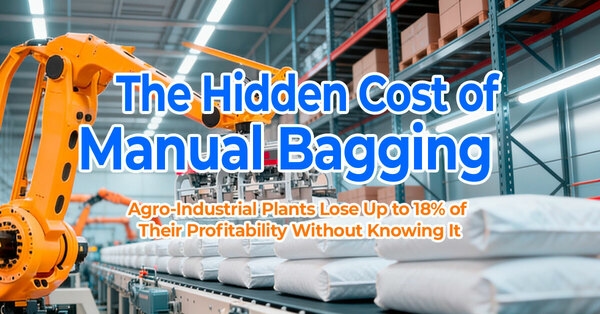
The Hidden Cost of Manual Bagging: How Agro-Industrial Plants Lose Up to 18% of Their Profitability Without Knowing It
Published: June 16, 2026
Source : FIGAP
The issue that never shows up in financial statements
In most agro-industrial operations, executive attention isrightlyfocused on production, raw materials, and commercial strategy. Yet a critical value leakage point often remains underexamined: the end-of-linespecifically, the bagging process.
It rarely appears as a distinct line item in the P&L. It does not trigger immediate alerts. But it operates every day, quietly eroding efficiency, inflating costs, and compressing margins.
The real question is not whether this loss existsbut how much it is costing you today.
The “hidden cost”: where value is actually lost
Manual or semi-automated bagging introduces variability into a process that should be tightly controlled. That variability translates into cumulative losses:
- Weight deviations (overfill and underfill)
- Product loss and spillage
- Low throughput and bottlenecks
- Labor-intensive dependency
- Human error and rework
- Unplanned downtime
Individually, these may appear marginal. Collectively, they create a structural drag on profitability.
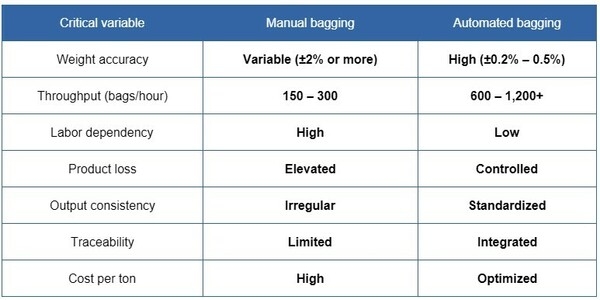
Operational benchmark: manual vs. automated
Financial impact: a silent but persistent loss
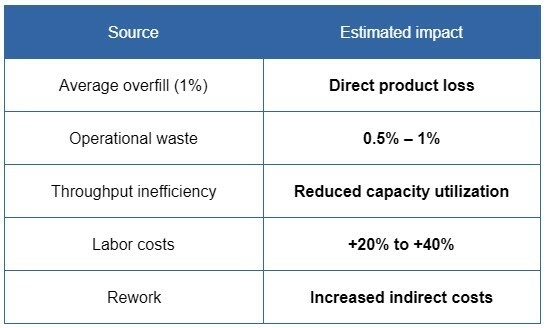
To quantify the issue, consider a realistic scenario:
Feed mill operation
- Output: 200 tons/day
- Operating days: 300/year
Primary value leakages:
Outcome:
An estimated 8% to 18% erosion in operating profitability.
Crucially: This is rarely treated as a strategic issue.
The inflection point: where marginal efficiency defines profit
In increasingly competitive markets, margins are no longer driven solely by volumethey are won through precision and control in critical processes.
The end-of-linehistorically underestimatedhas become a decisive control point because it is where:
- The final product is realized
- Commercial accuracy is defined
- Production efficiency is either captured or lost
In practical terms: It is no longer enough to produce wellyou must finish better.
The transition: from manual execution to intelligent automation
Leading operations are migrating toward integrated solutions that combine:
High-precision automated bagging
Real-time weight control
Reduced variability
Intelligent weighing systems
Integrated process control
Data-driven decision-making
Automated palletizing
Higher throughput
Lower labor dependency
ERP and systems integration
Full traceability
Financial control by batch
This approach turns bagging into a strategic control node, not just an operational step.
Case insight: efficiency translated into financial results
A Latin American agro-industrial company faced:
- Elevated labor costs in bagging
- Persistent weight deviations
- Dispatch bottlenecks
After implementing automation:
-22% reduction in operating costs
Significant decrease in product loss
-Increased dispatch speed
-Enhanced traceability and control
The impact extended beyond operations: margin expansion and improved scalability.
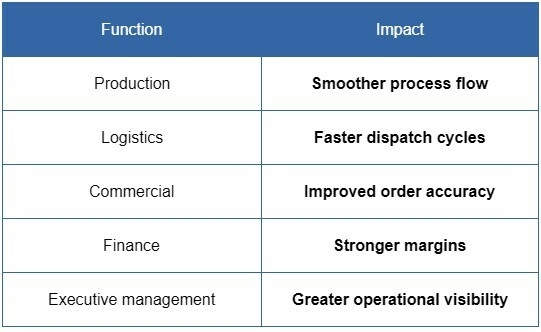
Beyond bagging: enterprise-wide impact
Optimizing the end-of-line generates cascading benefits:
Strategic risk: the cost of inaction
Ignoring this critical point implies:
- Persistently inefficient cost structures
- Competitive disadvantage vs. automated peers
- Constrained growth capacity
- Margin compression in price sensitive markets
In an environment where basis points matter, these inefficiencies can determine market leadership.
Conclusion: from tolerated inefficiency to structural advantage
The bagging processand the broader end-of-linecan no longer be treated as a secondary operational concern. It is a direct lever of profitability and enterprise value.
For executive leadership, this requires a shift in mindset:
1) From unit cost to Total Cost of Ownership (TCO)
Investment decisions must reflect lifecycle impact:
- Reduced waste and overfill
- Lower labor cost per ton
- Fewer reworks and stoppages
- Increased throughput and effective capacity
The outcome is shorter payback and sustained EBITDA improvement.
2) From operations to real-time financial control
Automation enables:
- Batch-level traceability and inventory reconciliation
- ERP integration for accurate cost accounting
- Conversion of operational data into actionable financial KPIs
The end-of-line becomes a financial control center, not just a production step.
3) From variability to scalable standardization
Standardization delivers:
- Consistent product quality
- Reliable commercial compliance
- A foundation to scale volume without margin dilution
In premium and regulated markets, consistency sustains pricing power.
4) From reaction to risk prevention
With data and automation:
- Deviations are anticipated before impact
- Exposure to commercial penalties is reduced
- Compliance and auditability improve
Operations evolve from reactive to predictive management.
5) From bottleneck to growth enabler
An inefficient end-of-line constrains revenue. Optimization:
- Unlocks hidden capacity
- Accelerates dispatch
- Improves service levels (OTIF)
Bagging shifts from constraint to revenue accelerator.
Executive synthesis
Efficiency is only valuable if it is captured at the point of delivery.
Bagging automation is not a tactical upgradeit is a strategic investment that directly impacts profitability, scalability, and competitive positioning.
Organizations that act decisively will convert a historically overlooked process into a measurable and sustainable source of value. Those that do not will continue absorbing invisible losses that ultimately define annual performance.
Related topics:
Recommend
Comment
Share

Would you like to discuss another topic? Create a new post to engage with experts in the community.

Featured users