Feed Expanding in Poultry Nutrition: Theory, Process, Benefits, and Practical Optimization
Published: February 6, 2026
Source : Hesham H Elbhairy
Feed expanding has become an important thermo mechanical process in modern poultry feed manufacturing. It is used to “cook” feed, improve hygiene by reducing pathogenic bacteria, and enhance pellet quality and bird performance, while limiting nutrient damage through high temperature, short time (HTST) treatment (Aliiev & Linko, 2022; Fancher et al., 1996; Zentek & Boroojeni, 2020).
Theory and Principle of Feed Expanding
Extruders and expanders are classified as HTST equipment: they heat feed to high temperatures for only a few seconds under high pressure (Aliiev & Linko, 2022). Because exposure time is short, denaturation of proteins, vitamins, amino acids and enzymes is limited, even though temperatures may reach 80–140 °C and pressures 1–10 MPa (Aliiev & Linko, 2022; Fancher et al., 1996; Zentek & Boroojeni, 2020).
From an engineering view, expanders exploit:
• Conversion of mechanical energy to heat through friction and shear.
• Simultaneous action of heat, moisture, pressure and shear on feed particles.
• A sudden pressure drop at discharge, which causes water to flash to steam, expanding the partly plasticized mass and altering its structure (Aliiev & Linko, 2022; Fancher et al., 1996).
This barothermal (pressure–temperature) treatment leads to:
• Starch gelatinization and disruption of cell walls.
• Partial protein denaturation and reduction of some anti nutritional factors.
• Changes in particle structure and density, helping subsequent pelleting or forming an expanded “grit” as a final feed (Aliiev & Linko, 2022; Bogomolov et al., 2021; Zentek & Boroojeni, 2020).
How an Annular Gap Expander Works
The annular gap expander, widely used in poultry feed mills, is essentially a single screw device with a special outlet:
1. Feeding and pre compression
Conditioned mash (usually 14–20 % moisture) is fed into the barrel, where a screw conveys and compresses the material.
2. Compression and plasticization zone
As material moves forward, screw geometry and barrel design increase pressure and shear. Mechanical energy raises temperature and, together with injected steam, converts the mash into a viscoplastic melt (Aliiev & Linko, 2022; Fancher et al., 1996).
3. High pressure, short time treatment
In this zone, the feed experiences high pressure (up to several MPa) and elevated temperature (often ~100–130 °C) for a few seconds, fulfilling the HTST principle (Aliiev & Linko, 2022; Fancher et al., 1996; Zentek & Boroojeni, 2020).
4. Annular gap discharge and expansion
Instead of a fixed die, the expander discharges the melt through a narrow annular gap around an adjustable cone. The cone setting determines back pressure and specific mechanical energy. When the mass exits to atmospheric pressure, water partially flashes off as steam, the product expands, and its structure sets (Aliiev & Linko, 2022; Fancher et al., 1996).
Depending on the line, this expanded material can:
• Be cooled and crumbled as an expanded feed (“grits”), or
• Be fed directly to a pellet press, where it is compacted into pellets with improved durability (Aliiev & Linko, 2022; Fancher et al., 1996).
Bactericidal and Hygienic Effects
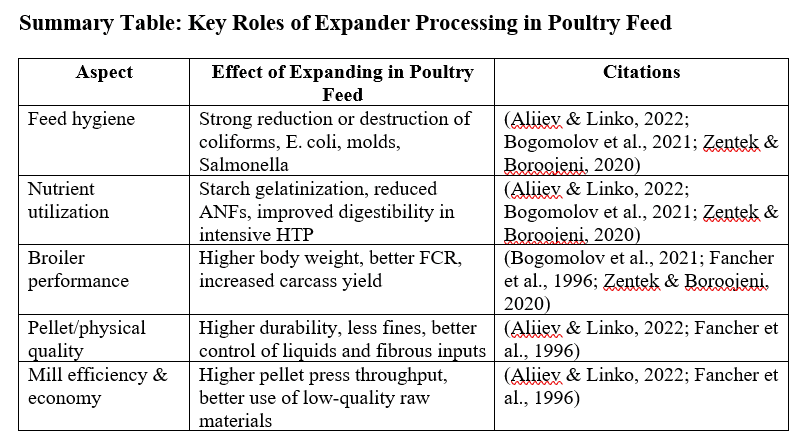
Baro thermal treatment in an expander can markedly improve feed hygiene. In a study on grain mixtures for broiler feeds, expander processing reduced bacterial contamination and completely destroyed coliforms, E. coli, molds and Salmonella (Bogomolov et al., 2021).
On a broader scale, hydrothermal processing (pelleting, expanding, extrusion) is recognized as a key tool to improve the hygiene status of poultry and pig feed, reducing feed wastage and lowering the load of non spore forming pathogenic bacteria (Zentek & Boroojeni, 2020). The combination of:
• High temperature,
• Elevated moisture,
• High pressure and mechanical shear, and
• Short residence time,
makes expanders suitable to hygienize bacteriologically contaminated materials in pellet lines (Aliiev & Linko, 2022; Zentek & Boroojeni, 2020).
Nutritional and Technological Benefits in Poultry Feed
Improved Feed Hygiene and Biosecurity
The main hygienic benefit is sterilization or strong reduction of pathogenic microorganisms:
• Reduced total bacterial counts and complete destruction of coliforms, E. coli, molds and Salmonella in expanded grain mixtures (Bogomolov et al., 2021).
• Contribution to meeting thermal processing standards for biosecurity, which drove early adoption of expanders in Europe (Fancher et al., 1996).
This is particularly important as poultry production moves away from in feed antibiotics; hygienic feed is a critical component of controlling enteric pathogens without antimicrobial growth promoters (Rafiq et al., 2022; Yadav & Jha, 2019; Zhu et al., 2021).
Better Nutritional Value and Bird Performance
By modifying starch and the protein–carbohydrate complex, expansion can:
• Enhance starch digestibility and energy utilization, especially when combined with pelleting (Aliiev & Linko, 2022; Zentek & Boroojeni, 2020).
• Reduce some anti nutritional factors, which can improve amino acid digestibility in more intensive hydrothermal processes (Zentek & Boroojeni, 2020).
In broiler trials with expanded compound feed:
• Barothermal treatment produced expanded grits and expanded pellets that significantly improved growth. At 28 days, chickens fed expanded compounds had 2.5–3 fold higher body weight than those on traditional feed, with the highest weight in birds fed grits from granulated expandate (915 g) (Bogomolov et al., 2021).
• At 42 days, control broilers weighed 2246 g, whereas birds receiving granulated expandate reached 2574 g, with an average daily gain 7.9 % higher than control (Bogomolov et al., 2021).
• Carcass yield increased: 69.5 % in expanded feed birds vs. 67.6 % in controls (Bogomolov et al., 2021).
These results indicate that properly designed expanded feeds can increase growth rate, improve feed conversion and raise carcass meat yield in broiler production.
Pellet Quality and Feed Mill Efficiency
Expanders were initially adopted to enhance pellet lines, and documented benefits include (Aliiev & Linko, 2022; Fancher et al., 1996):
• Improved pellet durability and hardness, fewer fines, and easier crumbling.
• Ability to use higher levels of liquids and by products without sacrificing pellet quality or throughput.
• Better control of liquid additives and possibility to incorporate more fibrous materials.
• Reduced dust emissions and handling losses during granulation.
• Lower specific energy consumption at the pellet press and higher pellet mill throughput (although total plant energy per ton can increase due to the expander itself) (Aliiev & Linko, 2022).
Economic assessments suggest that while an expander–granulator line may raise production cost by 10–15 % compared to pelleting alone, the overall income–expenditure balance is positive because of quality gains and performance improvements that offset added costs (Aliiev & Linko, 2022).
Process Parameters and “Optimum Use” in Practice
There is no single universal setting; optimum conditions depend on formula, equipment and objectives (hygiene, pellet quality, performance). However, research and industry experience define a rational window.
Key Operating Variables
1. Moisture (after conditioning)
o Typical range: 14–20 % moisture via steam conditioning before entry to the expander (Aliiev & Linko, 2022; Bogomolov et al., 2021; Zentek & Boroojeni, 2020).
Adequate moisture promotes plasticization, starch gelatinization and microbial inactivation.
2. Temperature
o General HTST expander range: 80–140 °C (Aliiev & Linko, 2022; Zentek & Boroojeni, 2020).
o Practical poultry settings: often ~100–130 °C at expander outlet, especially when used ahead of a pellet mill (Aliiev & Linko, 2022; Bogomolov et al., 2021; Fancher et al., 1996; Zentek & Boroojeni, 2020).
Higher temperatures increase bacterial kill and starch modification but must be balanced against possible heat damage to sensitive nutrients.
3. Pressure and Specific Mechanical Energy
o Internal pressure: typically 1–10 MPa in the working chamber; some designs may briefly reach higher local values (Aliiev & Linko, 2022; Zentek & Boroojeni, 2020).
o Pressure is regulated mainly by the outlet cone / annular gap; closing the cone increases resistance, energy input and expansion (Aliiev & Linko, 2022; Fancher et al., 1996).
o Practical operation aims at a stable motor load corresponding to a specific mechanical energy that achieves desired expansion and pellet quality.
4. Residence Time
o Expanders are HTST systems with short residence times (a few seconds), often about 4–8 s in the high temperature zone (Aliiev & Linko, 2022; Bogomolov et al., 2021; Zentek & Boroojeni, 2020).
o This short exposure limits nutrient degradation while enabling microbial inactivation.
5. Particle Size and Formula
o For mechanical and structural reasons, medium grinding (e.g. around 0.5 mm mean size in some optimization work) and suitable fat, starch and fiber levels favor stable operation and good expandate characteristics (Aliiev & Linko, 2022; Bogomolov et al., 2021; Zentek & Boroojeni, 2020).
o Diets with more structural fiber may help preserve gizzard function and mitigate negative effects of fine grinding and hydrothermal processing noted in poultry (Zentek & Boroojeni, 2020).
Steps to Reach Optimum Use
An evidence based approach to optimizing an expander in a poultry feed mill can be outlined as follows:
1. Define clear objectives
o Target microbial reduction (e.g. Salmonella absence, coliform counts).
o Desired pellet durability, fines level and bulk density.
o Expected broiler performance (growth, feed conversion, carcass yield).
2. Start within proven operating ranges
o Condition mash to 16–20 % moisture.
o Set expander to reach ~105–120 °C outlet temperature with estimated 4–8 s residence time.
o Adjust cone to achieve visible expansion, acceptable discharge temperature and stable amperage, implying adequate specific mechanical energy (Aliiev & Linko, 2022; Bogomolov et al., 2021; Fancher et al., 1996; Zentek & Boroojeni, 2020).
3. Evaluate feed hygiene and quality
o Conduct microbiological testing (Salmonella, coliforms, total bacteria) before and after expanding to verify hygienic effect (Bogomolov et al., 2021; Zentek & Boroojeni, 2020).
o Measure pellet durability, fines, bulk density and, when possible, starch gelatinization and digestible energy.
4. Adjust conditions systematically
o If microbial reduction is insufficient: increase temperature (within nutrient safety limits), raise moisture, or increase mechanical energy by tightening the cone (Aliiev & Linko, 2022; Bogomolov et al., 2021; Zentek & Boroojeni, 2020).
o If excessive nutrient or additive loss occurs: lower temperature slightly, decrease cone pressure, or post apply heat sensitive vitamins, enzymes or probiotics.
o Modify particle size distribution and fiber level to maintain gizzard function and gut health, considering that fine grinding plus intense hydrothermal processing can under develop the gizzard in poultry (Zentek & Boroojeni, 2020).
5. Integrate expanding with pelleting and nutrition strategy
Expanded feed is often followed by pelleting. Research and reviews on gut health and alternatives to antibiotics stress that feed form, hygiene and functional additives (e.g. probiotics, organic acids, phytobiotics) work together to reduce dependence on in feed antibiotics and maintain performance (Rafiq et al., 2022; Yadav & Jha, 2019; El-Ghany, 2024; Zhu et al., 2021). An optimized expander can:
o Provide hygienic, well cooked pellets that support gut health.
o Allow inclusion of non antibiotic growth promoting additives (e.g. probiotics, prebiotics, organic acids) that modulate the microbiota and immunity (Rafiq et al., 2022; Yadav & Jha, 2019; Alagawany et al., 2018; El-Ghany, 2024; Zhu et al., 2021).
Conclusion
An expander is a powerful HTST device for poultry feed processing that uses combined heat, moisture, pressure and shear to cook feed, markedly reduce pathogenic bacteria and improve pellet quality, while largely preserving nutrient value due to the very short treatment time (Aliiev & Linko, 2022; Bogomolov et al., 2021; Fancher et al., 1996; Zentek & Boroojeni, 2020). Properly applied, expansion of broiler feeds has been shown to increase body weight, improve feed conversion and enhance carcass yield, while contributing to feed hygiene and biosecurity (Bogomolov et al., 2021; Fancher et al., 1996; Zentek & Boroojeni, 2020).
Optimal use requires careful control of moisture, temperature, pressure, residence time and particle size, and continuous monitoring of hygiene, pellet quality and bird performance to balance technological and nutritional goals under each mill’s specific conditions (Aliiev & Linko, 2022; Bogomolov et al., 2021; Fancher et al., 1996; Zentek & Boroojeni, 2020).
Related topics:
Authors:

Recommend
Comment
Share

Would you like to discuss another topic? Create a new post to engage with experts in the community.







Featured users in Animal Feed