From Nutrient Surplus to Export Commodity – How Moisture Measurement Makes Manure Pelletizing More Efficient
Published: March 23, 2026
Source : Martin Stoll / ACO
Summary
High livestock densities in many regions lead to significant nutrient surpluses. Manure pelletizing is considered a technical approach to make these nutrients transportable. Precise moisture measurement plays a central role in the drying process.
The Netherlands, which are among the leading agricultural export nations, have been struggling for decades with a self-inflicted environmental problem: eutrophication caused by manure surpluses.
The high livestock density in a limited area results in annual amounts of plant-available nutrients such as nitrogen (N) and phosphorus (P) that far exceed what domestic soils can absorb.
The result is pollution of surface waters and groundwater, forcing authorities to implement stricter regulatory measures.
A key technical solution lies in the industrial processing of manure into pellets, which are transportable and stable during storage.
Each year, the Netherlands export several hundred thousand tonnes of these fertilizer pellets, thereby deliberately relieving the national nutrient balance.
The critical role of moisture measurement in the process
Drying manure into pellets is an energy-intensive and sensitive process. Even a few percentage points of moisture determine product quality, energy efficiency, and operational reliability.
Export capability and volume reduction through pelletizing
In contrast to liquid manure, pellets can be easily transported by truck or ship over long distances, thereby reducing the nutrient surplus in the country of origin.
Through drying and pressing, the volume is significantly reduced, which substantially lowers transport and logistics costs.
Energy efficiency through controlled moisture measurement
The drying stage represents the largest energy consumer within the plant.
Without continuous moisture monitoring, more energy is otien used than technically necessary.
Through continuous moisture measurement, the drying process can be precisely controlled and operated in a stable manner.
Ensuring process stability and pellet quality
For mechanically stable pellets that neither disintegrate nor swell atierward, the residual moisture content typically lies in the range of 10–15%.
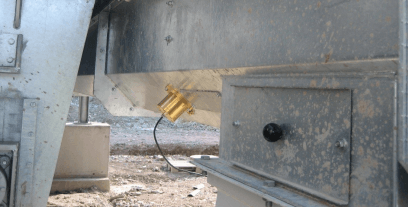
The capacitive moisture measurement from ACO enables continuous and accurate determination of this value in real time.
Measurement points in the screw conveyor, at the conditioner, or directly downstream of the dryer provide reliable data for process automation.
Ensuring storage stability and hygiene
During production, the pellets are thermally treated, which reduces or eliminates pathogens.
This is a regulatory requirement in many export countries.
Excessive residual moisture increases the risk of self-heating and mold growth during storage and represents a fire and quality hazard.
A dry and hygienically stable product is therefore a prerequisite for marketability in many export markets.
ACO: Robust moisture measurement for industrial applications
ACO Feuchtemessung has many years of experience in the moisture measurement of organic fertilizer materials, including poultry manure as well as pig and catle manure.
The capacitive measurement principle of the DMMS/BMMS systems is designed for applications with highly variable and contaminated material conditions.
The sensors can be integrated into existing PLC control systems via Profibus DP, Profinet, or analog signals. Up to 16 sensors per system can be operated.
For potentially explosive areas with high dust exposure, ATEX-certified versions are available.
In addition, variants for elevated process temperatures or with enhanced corrosion resistance can be supplied.
Rely on proven measurement technology to make nutrient utilization efficient, safe, and process-stable.
Related topics:
Authors:

ACO Automation Components
Recommend
Comment
Share

Would you like to discuss another topic? Create a new post to engage with experts in the community.







Featured users in Animal Feed