
Content sponsored by:
FIGAP MEXICO 2026 - INTERNATIONAL EXHIBITION
Sensors and Predictive Analytics in the Management of Silos and Forage Warehouses
Published: June 12, 2026
Source : FIGAP
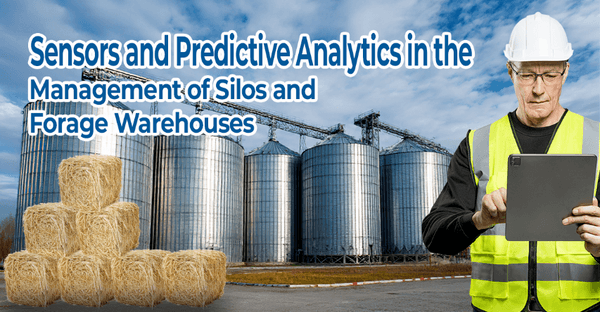
Modern management of silos and forage warehouses is no longer just about storage and supervision it has evolved into a data-driven operation where IoT sensors and predictive analytics prevent losses, enhance feed quality, and optimize operational costs.
For executives, business owners, and decision-makers in the agribusiness and livestock industries, these technologies represent a strategic lever to increase productivity, ensure feed safety, and strengthen competitiveness particularly in developing economies.
What Do Sensors Measure and Why Does It Matter?
Sensors installed in silos and forage stacks continuously record critical variables such as:
- Temperature and thermal gradients: detect early signs of spoilage or hotspots.
- Relative humidity: control moisture levels to prevent mold and fermentation.
- Gas concentrations (CO₂, O₂): identify microbial activity, contamination, or pest presence.
- Level or volume of stored product: ensure accurate inventory control and logistics planning.
- Seal integrity: detect leaks or breaks in hermetic storage bags.
Continuous monitoring of these variables enables a shift from reactive management to a predictive and preventive model, where corrective actions are taken before significant losses occur.
The Value of Predictive Analytics
Predictive analytics combines historical data with machine learning algorithms to:
- Anticipate potential deterioration points.
- Optimize stock rotation and usage timing.
- Reduce ventilation, fumigation, and maintenance costs.
- Provide real-time alerts and actionable insights.
Recent studies demonstrate that the integration of IoT sensors with AI models can reduce storage losses by 25–45% on average.
Practical Applications
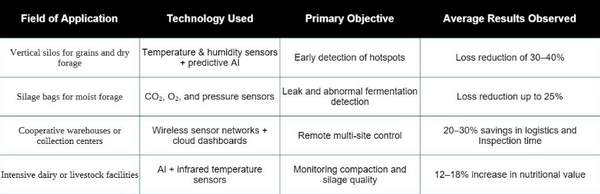
Common applications of sensors and predictive analytics in silo management.
Source: Adapted from FAO (2024), Centaur Analytics, and USDA Post-Harvest Technology Report 2023.
Source: Adapted from FAO (2024), Centaur Analytics, and USDA Post-Harvest Technology Report 2023.
Economic and Operational Advantages for Executive Management
Implementing smart monitoring systems provides measurable benefits:
- Reduced spoilage: 25–45% annual loss reduction.
- Lower chemical treatment costs: 20–35% savings.
- Shorter inspection times: up to 40% less labor time.
- Improved traceability: easier audits and certification processes.
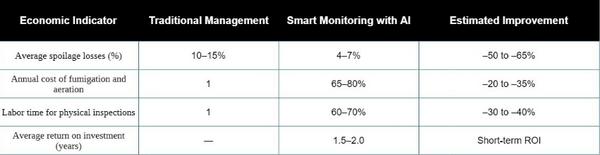
Economic impact of smart storage monitoring.
Source: FAO Smart Storage Study (2024), Global Postharvest Losses Index (2025).
Source: FAO Smart Storage Study (2024), Global Postharvest Losses Index (2025).
Impact in Developing Economies
The adoption of these technologies can significantly transform emerging agricultural markets:
- Reduced post-harvest losses and higher marketable output.
- Enhanced competitiveness and export potential.
- Improved sustainability and energy efficiency.
- Faster technology adoption and formalization in rural industries.
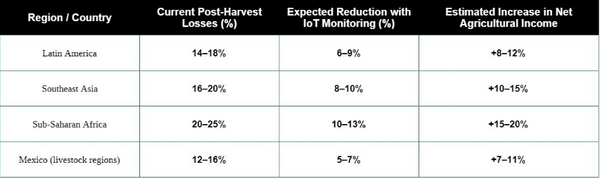
Impact of predictive monitoring in developing regions.
Source: World Bank – Smart Agriculture Outlook 2025; FAO Postharvest Data Portal (2024).
Source: World Bank – Smart Agriculture Outlook 2025; FAO Postharvest Data Portal (2024).
These statistics reveal how digitalization and sensor-based management can drive competitive transformation in regions where inefficiency and post-harvest losses still limit sustainable growth.
Implementation Roadmap for Agribusiness Leaders
- Rapid diagnostics: Identify key loss points and prioritize storage sites.
- Pilot program (3-6 months): Install sensors in selected silos to validate ROI.
- Economic evaluation: Compare pre- and post-monitoring results.
- Scaling phase: Integrate sensor data with ERP and logistics systems.
- Training and governance: Build technical capacity and standardize protocols.
IoT sensors and predictive analytics transform silos and warehouses into intelligent assets—reducing losses, improving feed quality, and optimizing resources. For agribusiness and livestock companies, these technologies are not just an upgrade, but a strategic investment that drives profitability and sustainability.
In developing economies, their implementation narrows the technological and competitive gap, improves food security, and strengthens rural development.
FAO (2024). Smart Storage and Post-Harvest Technologies Report. Roma.
Centaur Analytics (2025). IoT and Predictive Analytics for Grain and Forage Storage.
USDA (2023). Post-Harvest Technology and Loss Prevention Report.
World Bank (2025). Smart Agriculture Outlook and Impact in Emerging Economies.
Related topics:
Recommend
Comment
Share

Would you like to discuss another topic? Create a new post to engage with experts in the community.

Featured users