
Content sponsored by:
FIGAP MEXICO 2026 - INTERNATIONAL EXHIBITION
Climate Prediction Systems with Artificial Intelligence for the Agricultural Sector
Published: May 28, 2026
Source : FIGAP
Accurate climate forecasting has become a vital tool for the sustainability and competitiveness of the agricultural sector. In a global context marked by climate variability, traditional weather forecasting models are insufficient for operational needs in the field. Artificial Intelligence (AI) is revolutionizing predictive modeling, enabling the anticipation of extreme weather events, optimization of natural resource use, and improved planning for both farming and livestock operations. This article explores how AI-powered climate prediction systems are impacting agriculture in developing countries by enhancing their productive capabilities, resilience, and global market competitiveness.
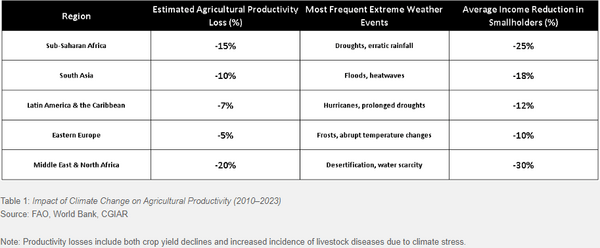
The Climate Challenge in Agriculture
Agricultural activities are deeply dependent on weather conditions. Phenomena such as prolonged droughts, untimely rains, frosts, and extreme heat waves directly affect yields, animal health, production cycles, and water availability. Producers—especially in developing nations—face significant challenges in adapting due to limited access to technology, infrastructure, and timely climate information.
According to the Food and Agriculture Organization (FAO), over 70% of the world's smallholder farmers lack access to reliable climate forecasting systems. This limits their ability to plan effectively, increases their vulnerability to climate change, and widens the productivity gap with industrialized nations.
What Is AI-Based Climate Prediction?
AI-based climate prediction uses machine learning algorithms and deep neural networks to analyze massive volumes of meteorological, historical, and satellite data. Unlike traditional statistical models, AI systems can learn complex patterns, adjust forecasts in real time, and detect hidden variables that influence micro- and macro-climate behavior.
Key components of an AI-based climate prediction system:
- Data collection: weather stations, IoT sensors, satellite imagery, historical agricultural records, and global climate models (e.g., ECMWF, Copernicus).
- Processing and training: algorithms such as recurrent neural networks (RNNs), decision trees, or transformer models, trained on millions of records.
- Forecasting and visualization: short-, medium-, and long-term predictions for rainfall, temperatures, soil moisture, wind, and more.
- Integration with agricultural management systems (AgTech): automatic recommendations for irrigation, fertilization, planting, harvesting, or livestock handling
Practical Applications in the Agricultural Sector
1. Precision agriculture:
Agri-companies are integrating AI-based climate forecasts into precision farming platforms to optimize water and fertilizer use. For example, startups like aWhere and Corteva use AI to send tailored alerts on rainfall and pest risks by crop and location.
2. Livestock disease prevention:
Temperature and humidity fluctuations impact the spread of zoonotic diseases and parasites. Systems like IBM Watson Decision Platform for Agriculture cross-reference weather data with veterinary databases to issue risk alerts, improving biosecurity in livestock farms.
3. Agricultural insurance and risk management:
In countries like India and Kenya, platforms like AgriPredict use AI to anticipate droughts or floods, allowing farmers to insure their crops with premiums based on real-time dynamic risk assessments.
4. Crop planning in vulnerable regions:
In rural areas of Mexico and Central America, pilot projects supported by the IDB and FAO are using AI to identify which crops are most resilient to projected climate conditions over the next 10–20 years, aiding in productive reconversion.
Advantages for Developing Countries
✔️ Democratization of climate information access:
Cloud-based AI systems or mobile applications provide highly accurate forecasts even to smallholder farmers, without the need for costly infrastructure.
✔️ Increased productivity and reduced losses:
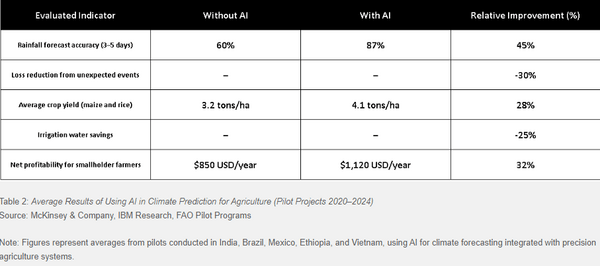
Advance knowledge of weather conditions allows for timely decisions on irrigation, spraying, or harvesting—cutting waste and improving yields by up to 25% in some regions.
✔️ Mitigation of extreme weather impacts:
AI enables early warning and response planning for droughts, frosts, or cyclones, reducing both economic and human losses.
✔️ Data-driven public policy formulation:
Governments can leverage AI-generated data to design more efficient subsidy programs, agricultural insurance, water management systems, and supply chain strategies.
Challenges and Ethical Considerations
Data quality and local availability: AI depends on high-quality, localized data; many regions still lack modern meteorological networks.
Technological accessibility: Investments are needed in connectivity, digital literacy, and context-adapted platforms.
Technological accessibility: Investments are needed in connectivity, digital literacy, and context-adapted platforms.
Transparency and explainability of algorithms: Models must be understandable to end-users to avoid “black box” decisions.
Business model sustainability: These systems must scale affordably and sustainably, avoiding overdependence on large corporations.
Business model sustainability: These systems must scale affordably and sustainably, avoiding overdependence on large corporations.
AI-powered climate prediction systems represent a silent revolution for the agricultural sector. Their transformational potential is especially relevant for developing countries, where timely information can mean the difference between total loss and a successful harvest. However, to ensure this technology’s effectiveness and equity, coordinated action is needed among private industry, governments, multilateral organizations, and rural communities. The future of agriculture is intelligent—and AI will be its key ally.
FAO (2023). Digital Agriculture and Climate-Smart Practices: Global Framework and Case Studies
World Bank Group (2022). Harnessing AI for Climate Resilience in Agriculture
IBM Watson Decision Platform for Agriculture
Nature (2022). Artificial intelligence for weather and climate modelling
Related topics:
Recommend
Comment
Share

Would you like to discuss another topic? Create a new post to engage with experts in the community.

Featured users