Use of egg yolk antibodies in the neutralization of shiga toxin
Published: October 20, 2011
Source : YR Parma1,2, PA Chacana3*, PMA Lucchesi2,4, ME Fernández-Miyakawa1,2 - 1Instituto de Patobiología, CNIA INTA, Argentina; 2CONICET; 3IncuINTA, Instituto de Virología, CNIA INTA, Argentina; 4Depto. Sanidad Animal y Medicina Preventiva, Fac. Cs. Veterin
Summary
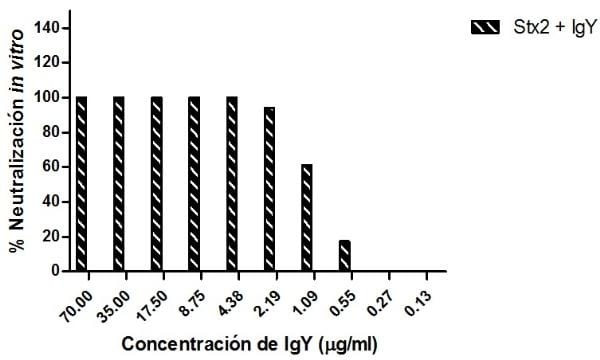
Two Lohmann Brown laying hens were immunized with the type-2 Shiga toxin B Subunit of enterohemorrhagic Escherichia coli. The IgY antibodies were obtained from the egg yolk and through water dilution. Eight point four (8.4) mg of antibodies per egg were obtained, with a titter of 64.000. These antibodies recognized the Stx2 holotoxin and and had the ability of neutralizing Vero cells toxicity. The complete inhibition of the cytotoxic effect was accomplished by a minimum concentration of 4.38 µg/ml of total IgY. These results suggest that the IgY Technology could be a useful tool in Uremic Hemolytic Syndrome.
Key words: IgY Technology, Shiga Toxin, In Vitro Neutralization
Introduction
The IgY Technology (use of egg yolk antibodies) is experiencing an enormous growth mainly due to the low production costs of IgY as compared to mammal antibodies. This economic advantage allows for its application not only in the design of diagnostic systems, but also in generating prevention and treatment products for various deceases, both in animals and humans (Chacana et al., 2004; Schade & Chacana, 2007). The IgY Technology has been successfully applied in assays for newborn diarrhea, human dental cavities, gastric ulcer caused by Heliobacter pylori, fishdiseases, etc. (Schade et al., 2005). The Hemolytic Uremic Syndrome is of special interest, since our country has the highest number of incidents in the world, with 500 cases per year in children under the age of 5 (Rivas et al., 2010). The main cause of this disease is the infection with enterohemorrhagic Escherichia coli (EHEC) which produces the Shiga toxins. Nowadays, there are no specific strategies for preventing or treating EHEC-related infections, or measures to prevent its complications (Tzipori et al., 2004)
As a first step in designing a prophylactic or therapeutic product, the objective of this research was to immunize laying hens with the non-toxic Stx2B subunit of the Shiga toxin, purify the egg yolk antibodies produced, and evaluate IgY´s effectiveness in neutralizing the toxin.
As a first step in designing a prophylactic or therapeutic product, the objective of this research was to immunize laying hens with the non-toxic Stx2B subunit of the Shiga toxin, purify the egg yolk antibodies produced, and evaluate IgY´s effectiveness in neutralizing the toxin.
Materials and Methods
Birds and inoculation plan
Birds and inoculation plan
Two 16-week-old Lohmann Brown layers were immunized intramuscularly according to the following inoculation plan: On day 0, day 15 and day 38, the birds were immunized with 150 µg of purified recombinant Stx2B. On day 100 and day 130, the birds received 200 µg of purified recombinant Stx2B. The first immunization was made using Complete Freund´s adjuvant; while for the other immunizations, Incomplete Freund´s adjuvant was used.
Egg harvest and IgY purification
Egg harvesting started after the third immunization and the IgY antibodies that were present in the purified egg yolks were harvested by two methods: water dilution (Akita & Nakai, 1992) and PEG precipitation (Polson, 1990). The IgY antibody ability to recognize the Stx2 holotoxin was analyzed through Western Blot.
IgY antibody Neutralizing Activity
The antibodies´ capacity to neutralize the Stx2 toxic effects on Vero cells (Gentry & Dalrymple, 1980) was evaluated. The Stx2 (4 CD50) was pre-incubated with the purified antibodies, for one hour at 37°C. Then, they were added to the cell monolayer and incubated for 48 hours at 37°C under a 5% C02 atmosphere. The toxin without antibodies and the pre-incubated toxin with the pre-immune antibodies were used as controls. The viability of the Vero cells was determined using crystal violet stain, and the absorbance was measured at 490 nm. The neutralization percentage was calculated using the following formula: OD (toxin + antibody) - OD (toxin without antibody) / OD (without toxin) - OD (toxin without antibody) x 100. The results were shown as the percent neutralization against the total IgY concentration in µg/ml. All the data is represented as the average of the assays, in triplicate.
Results and Discussion
Anti-Stx2B, IgY antibodies in egg yolk with a titer of 64.000 and a yield of 8.4 mg IgY per egg were obtained. These antibodies did not only recognize the B subunit of the Shiga toxin, but also the Stx2 Holotoxin (Fig. 1). Through dilution in water, we obtained antibodies with a smaller amount of contaminating agents, than those obtained through PEG precipitation (Fig. 2)
As for the neutralizing capacity of the total IgY antibodies, a concentration of 4.38 µg/ml was enough to fully neutralize the 4CD50 of Stx2 (Fig. 3)
Figure 1. Western blot
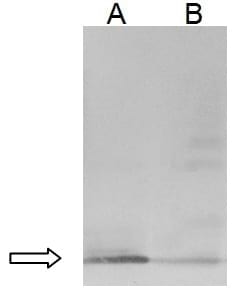
A. Recombining B Stx2B B. Stx2 Holotoxin(wild type)
The membrane was incubated with anti-Stx2B IgY (1/ 5000) and anti-IgY HRP (1/ 6000)
Arrow: position of the B subunit for Stx2
The membrane was incubated with anti-Stx2B IgY (1/ 5000) and anti-IgY HRP (1/ 6000)
Arrow: position of the B subunit for Stx2
Figure 2. SDS-PAGE (12.5% in reducing conditions) of IgY, purified from egg yolk by water dilution (A) and PEG precipitation (B)
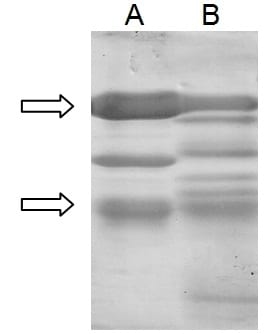
Arrows position the heavy (H) and light (L) IgY chains
Figure 3. Stx2 in Vitro Neutralization (4CD50) with the total IgY antibodies.
Conclusion
Birds immunized with the recombinant Stx2B produced specific antibodies in the egg yolk in spite of being a small protein ((~11kDa). These anti-Stx2B IgY antibodies had the ability to recognize the enterohemorrhagic E. coli Stx2 holotoxin (EHEC) and to neutralize it´s toxicity in vitro.
Therefore, the IgY Technology is a cost effective, efficient alternative to obtain large amounts of antibodies that can be applied both in the prophylaxis and the treatment of infected patients.
Bibliography
Akita EM & Nakai S.1992. Immunoglobulins from egg yolk: isolation and purification. J. Food Sci. 57:629.
Chacana PA, Terzolo HR, Gutierrez Calzado E, Schade R. 2004. Tecnología IgY o aplicaciones de los anticuerpos de yema de huevo de gallina. Revista de Medicina Veterinaria 85(5):179-189.
Gentry MK & Dalrymple JM.1980. Quantitative microtiter cytotoxicity assay for Shigella toxin. J Clin Microbiol. 12(3):361-366.
Polson A. 1990. Isolation of IgY from the yolks of eggs by a chloroform polyethylene glycol procedure. Immunol Invest. 19:253-258.
Rivas M, Padola NL, Lucchesi PMA, Massana M. 2010. Chapter 10: Diarrheagenic Escherichia coli in Argentina. pp. 142-161. In: Torres AG (Ed.). Pathogenic Escherichia coli in Latin America. Editado por: Bentham Science Publishers Ltd, Oak Park (IL), Estados Unidos.
Schade R, Gutierrez Calzado E, Sarmiento R, Chacana PA, Porankiewicz-Asplund J, Terzolo HR. 2005. Chicken egg yolk antibodies (IgY-technology): A review of progress in production and use in research and in human and veterinary medicine. ATLA 33(2):129-154.
Schade R & Chacana PA. 2007. Egg yolk compounds - Livetin fractions. pp. 25-32. En: Bioactive Egg Compounds. R. Huopalahti, Lopez-Fandiño R, Antón M, Schade R (Eds.). Springer, Germany.
Tzipori S, Sheoran A, Akiyoshi D, Donohue-Rolfe A, Trachtman H. 2004. Antibody therapy in the management of Shiga toxin-induced hemolytic uremic syndrome. Clin. Microbiol. Rev. 17:926-941.
Content from the event:

Recommend
Comment
Share

Would you like to discuss another topic? Create a new post to engage with experts in the community.









FIGAP MEXICO 2026 - INTERNATIONAL EXHIBITION
FIGAP Mexico is the International Exhibition for the Feed Industry
HATO agricultural lighting
HATO is a global leader in animal-specific agricultural lighting solutions, designing advanced LED systems that enhance the well-being of animals.
Featured users in Poultry Industry


Shivaram Rao
Pilgrim´s
PhD Director Principal de Nutrición y Servicios Técnicos de Pilgrim’s Pride Corporation
United States
United States