Introduction
The two diseases of birds to be more afraid of are those caused by two hemoagglutinating agents: Highly pathogenic Avian Influenza (HPAI) and virulent avian paramixovirus type 1 viruses or Newcastle Disease viruses (ND). Avian Influenza (AI) is one of the greatest concerns for public health that has emerged from animals in recent years. HPAI caused especially by subtype H5N1, represents one of the major animal health problems worldwide. However, no Asian-lineage HPAI viruses of the H5N1 have been detected in the Americas. Notifiable AI (NAI) infections have led to significant human health issues including the risk of generating a pandemic. Surveillance is an essential activity for the disease control and early detection will allow the implementation of measures in a timely fashion (Buscaglia, 2008).
Thus far AI virus (AIV) has never been isolated from poultry in Argentina nor have AIV antibodies been detected (Buscaglia et al., 2007). Although there are references that indicate that HPAI was affecting the chickens by the early part of the twentieth century in Brazil and Argentina (Mohler, 1926; Pereda et al., 2008), it is difficult to attribute this occurrence to HPAI since ND or another similar pathologic disorder could have been the cause (Buscaglia et al., 2007; Swayne, 2008). By any means it can be concluded that it was HPAI. The research that took place in the last fifty five years has never detected AI in the country. An epidemiological surveillance program is conducted with the aim to monitor the presence or absence of AIV or antibodies to the virus in all commercial and noncommercial poultry. Results of the survey for AI for the period of 1998 to 2006 were reported (Espinoza et al., 2007) while a surveillance program for AI in backyard poultry from 1998 to 2005 was published (Buscaglia et al., 2007). The Surveillance Program for ND during 1998-2007 was also informed (Buscaglia et al., 2008).
To determine whether avian hemoagglutnating viruses are circulating in aquatic wild birds in the coast of Montecarlo, Pinamar, Ostende, Valeria del Mar and Cariló, places that belong to the district of Pinamar, Buenos Aires Province, Argentina, free-living bird environmental fresh fecal samples were collected and examined during a year starting October 2008. As a consequence of the isolation of only one AIV from a healthy kelp sea gull in the coast of the Province of Buenos Aires after an extensive surveillance of 2995 waterfowl and shorebirds (Pereda et al., 2008), a monitoring of fecal samples from this type of birds and another sea gulls named brown -hooded gull that are very common in this area and are often seeing together, was initiated. This report is a preliminary survey of hemoagglutinating viruses in these two types of sea gulls.
Materials & Methods
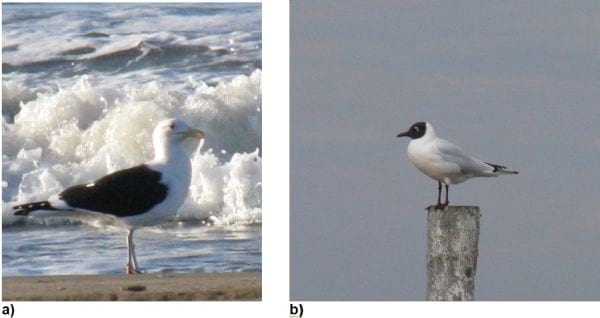
Kelp gull (fig. 1a) and brown-hooded gull (fig. 1b) were observed and identified so that 967 fresh fecal samples were collected from them during a year and a half from approximately 20 specimens every 15 days in the coast of the district of Pinamar. Samples such as cloacae or tracheal swabs were also obtained from healthy, sick or dead ones that arrived to the Fundación Ecológica Pinamar. They were transported in PBS, pH 7.0-7.4 plus antibiotics at 4ºC to the laboratory with cool packs, kept refrigerated and processed within 4 days. Each pool consisted of 8-12 samples and was done according to date, species and area. Chicken embryos specific pathogens free of 9 to 11 day old, were inoculated with pooled samples as described by Swayne et al. (2008). Allantoic fluid from live and dead embryos was tested for hemoagglutination activity after 5 days of incubation. First-passage negative pools were blind passage a second time to confirm absence of hemagglutinating agents.
Results & Discussion
All virus isolation attempts were negative. None of the pools of samples tested showed hemoagglutinating activity. Neither AIV nor paramixovirus were isolated from the samples obtained from 780 Larus maculipennis and 187 Larus dominicanus.
AI has zoonotic potential and is a disease mainly of poultry. Preventing infections and eradicating outbreaks in poultry are the primary ways to prevent human infections and thereby reduce its pandemic potential. However, migratory waterfowl have been implicated in the transmission of AI to poultry (Fouchier et al., 2004).
This study arise after the first isolation of an AIV from a free living sea gull (Pereda et al., 2008) and it is based on the AI prevention program, which also tests for ND virus (Buscaglia et al., 2007; 2008; Espinoza et al., 2007). This program followed the science-based standards, guidelines and recommendations issued by the World Organization for Animal Health (OIE, 2010).
Many countries have reported surveillance programs (Bokma et al., 2006; Baumer et al., 2010; Goujgoulova & Oreshkova, 2007; Pant & Selleck, 2007), but the first report from Latin America was presented by Buscaglia in Beijing in 2007 (Espinoza et al., 2007). The inclusion of samples from free-living, especially from migratory birds, and the improvement of testing by using RT PCR techniques started in 2005/6 (D''''Amico et al., 2007; Pereda et al., 2008).
The role of wildlife and in particular of migratory birds, in the transmission of AIV still needs further clarification (Guberti & Newman, 2007). Migratory waterfowl have been implicated in the transmission of the H5N1 strain from Asia to Europe (Keawcharoen et al., 2008). Thus far, very little is known as to the species that are capable of AVI transmission and their ability to remain infected and infective through time. The fact that AIV were isolated from wild birds (Pereda et al., 2008) indicates that the potential exists for the transmission and emphasized the importance of the surveillance programs. This is a preliminary survey and more samples should be tested. However, it is clear that the incidence of AIV in gulls is lower in South America than in North America (Pearce et al., 2010, Pedersen et al., 2010, Pereda et al., 2008). The possibility of adding RTq-PCR to detect AIV-specific RNA as done in other countries (Baumer et al., 2010) should be considered although isolation is still the best tool to show the presence of any virus as shown in Peru (Ghersi et al., 2009). Little is known about the kelp gulls and brown-hooded gulls resident or migratory habits. Brown-hooded gulls are not only seen in the coast, but in the continent as well.
Figure 1. a) Kelp gull (Larus dominicanus) in the coast of Montecarlo, disctrict of Pinamar, b) Brown-hooded gull (Larus maculipennis) in the coast of Cariló, district of Pinamar
Conclusions
More studies are needed to determine the role of these gulls in the epidemiology of hemoagglutinating viruses since only one virus was isolated up to now from this specie (Pereda et al., 2008). For that reason the evidence of a potentially unique phylogenetic linkage in South America should be reviewed. More samples and from different species should be tested. Supports are necessary to continue the monitoring in order to preserve the AIV-free status of poultry in Argentina.
Acknowledgments
I wish to thank Fabian Rabufetti, Coordinador de Aves Marinas (coordinator of sea birds), Aves Argentinas.
Bibliography
Baumer A, Feldmann J, Renzullo S, Müller M, Thür B, Hofmann MA. 2010. Epidemiology of avian influenza virus in wild birds in Switzerland between 2006 and 2009. Avian Dis. 54:875-884.
Bokma BH, Hall C, Siegfried LM, Weaver JT. 2006. Surveillance for avian influenza in the United States. Annals of the New York Academy of Sciences 1081:163.
Buscaglia C. 2008. Estado actual de la Influenza Aviar en el continente americano. Libro: Temas de Zoonosis IV. Comité Editorial: Roberto A. Cacchione, Ricardo Durlach, Pablo Martino. Asociación Argentina de Zoonosis. pp. 103-109.
Buscaglia C, Espinoza C, Terrera MV, De Benedetti R. 2007. Avian influenza surveillance in backyard poultry of Argentina. Avian Dis. 51:467-469.
Buscaglia C, Espinoza C,Terrera MV, De Benedetti R, Brogna P, Kaloghlian A, Cannillia ML, Parrado E. 2008. Surveillance program for newcastle disease conducted since 1998 in Argentina. Proceedings: 57th Western Poultry Disease Conference. Puerto Vallarta, Mexico pp. 9-11.
D''''Amico VL, Bertellotti M, Baker AJ, Diaz LA. 2007. Exposure of red knots (Calidris canutus rufa) to avian pathogen; Patagonia, Argentina. J. Wildlife Dis. 43:794-797.
Espinoza C, Terrera MV, De Benedetti R, Buscaglia C. 2007. Surveillance program for avian influenza conducted during 1998-2006 in Argentina. IVX Congress of the World Veterinary Poultry Association. Beijing, China, pp 111.
Fouchier RAM, Schneeberger PM, Rozendaal FW, Broekman JM, Kemink SAG, Munster V, Kuiken T, Rimmelzwaan GF, Schutten M, van Doornum GJJ, Koch G, Bosman A, Koopmans M, Osterhaus ADME. 2004. Avian influenza A virus (H7N7) associated with human conjunctivitis and a fatal case of acute respiratory distress syndrome. Proceedings of the National Academy of Science of the United States of America 101:1356-1361.
Ghersi BM, Blazes DL, Icochea E, Gonzalez RI, Kochel T, Tinoco Y, Sovero MM, Lindstrom S, Shu B, Klimov A, Gonzalez AE, Montgomery JM. 2009. Avian influenza in wild birds, central coast of Peru. Emerg. Infect. Dis. 15:935-938.
Goujgoulova G & Oreshkova N. 2007. Surveillance on avian influenza in Bulgaria. Avian Dis. 51:382-386.
Guberti V & Newman SH. 2007. Guidelines on wild bird surveillance for highly pathogenic avian influenza H5N1 virus. J. Wildlife Dis. 43:29-34.
Keawcharoen J, van Riel D, van Amerongen G, Bestebroer T, Beyer WE, van Lavieren R, Osterhaus ADME, Fouchier RAM, Kuiken T. 2008. Wild ducks as long-distance vectors of highly pathogenic avian influenza virus (H5N1). Emerg. Inf. Dis. 14:600-607.
Mohler JR. 1926. Fowl pest in the United States. Journal of American.Veterinary. Medical Association 21:549-559.
OIE (Office International des Epizooties). 2010. Avian Influenza. Chapter 10.4. Terrestrial Animal Health Code. http://www.oie.int/fileadmin/Home/eng/Health_standards/tahc/2010/en_chapitre_
1.10.4.htm.
Pant GR & Selleck PW. 2007. Surveillance for avian influenza in Nepal 2004-2005 Avian Dis. 51:352-354.
Pearce JM, Ramey AM, Ip HS, Gill J. 2010. Limited evidence of trans-hemispheric movement of avian influenza viruses among contemporary North American shorebird isolates. Virus Res. 148:44-50.
Pedersen K, Swafford SR, Deliberto TJ. 2010. Low pathogenicity avian influenza subtypes isolated from wild birds in the United States, 2006-2008. Avian Dis. 54:405-410.
Pereda AJ, Uhart M, Perez AA, Zaccagnini MA, La Sala L, Decarre J, Goijman A, Solari L, Suarez R, Craig MI, Vagnozzi A, Raimondi A, Koning G, Terrera MV, Kaloghlan A, Song H, Sorrell E, Perez DR. 2008. Avian influenza virus isolated in wild waterfowl in Argentina: Evidence of a potentially unique phylogenetic lineage in South America. Virol. 378:363-370
Swayne DE, Senne DA, Suarez DL. 2008. Avian influenza. pp. 128-134. In: A laboratory manual for the isolation, identification and characterization of avian pathogens, 5th Edition.Dufour-Zavala L, Swayne DE, Glisson JR, Pearson JE, Reed WM, Jackwood MW, Woolcock PR (eds.) American Association of Avian Pathologists, Jacksonville, Florida.
Swayne DE. 2008. Highly Pathogenicity Avian Influenza in the Americas. pp. 191-216. In: Swayne DE (ed.) Avian influenza. Blackwell Publishing, Iowa, USA