Introduction
The shortage of conventional food for Monogastrics species, due to high price, has encouraged the exploration of unconventional foods (Nieves, 2006). In this context, by-products of citrus and sugar production play a major role (González & Vergara 2004).
Valdivié (2005) suggested non-conventional alternatives to solve the shortage of food in the field of poultry feed, with the use of these by-products. In these considerations, not only total production, but also the quality of eggs and meat were taken into account. These topics are being explored by many researchers (Solano et al. 2001; Ojeda & Cáceres, 2002; Valdivié, 2003).
Knowledge of the animal physiology plays an important role in explaining many productive responses in animals and the impact that the use of any new food may have upon their health. Based on this, the objective of this study was to determine the effect of vinasse at 5% in the morphometry of the gastrointestinal tract of broilers.
Materials & Methods
Animals
20 male, 1 day old broilers (EB-34) were used. The birds were housed in metal cages. The treatments consisted in adding or not vinasse at 0.5% (Table 1) in the daily diet as a supplement from the first day of age, to a corn-soy based diet. The supply of vinasse took place gradually in the feed; at the initial stage (1-20 days) 50 ml/feeder; at the growth stage (21-35 days) 100 ml/feeder and at the final stage (36-42 days) 150 ml/feeder. The birds had access to food and water ad libitum.
Table 1. . Characterization of vinasse at 0.5%.
Diets
The animals were subjected to diets that were formulated according to the requirements established by NRC (1994) for the different stages of development (Table 2).
Table 2. Experimental diets for the different development periods (initial - growth - final)
Experimental Procedure:
On day 42, the animals are weighed and slaughtered by use of the jugular vein bleeding method described by Sánchez (1990), to extract the auxiliary organs (liver) and the gastrointestinal tract (stomach muscle, small intestine and cecum).
The digestive organs were weighed in full and empty state using a SARTORIUS ISO 9001 technical scale. For statistical analysis, the weights were expressed as relative to the live weight (LW %).
Hematological indicators
For measuring the hematocrit, Hawkley microhematocrit measurement equipment of English manufacture was used. The cyano-meta-hemoglobin method described by Lynch et al. was used for measurement of hemoglobin. (1969).
Statistical method
A completely randomized design with two treatments and 10 repetitions was used. Data were processed using the Statgraphics Plus computerized statistical package
(2001), version 5.0 on Windows XP. The average values were compared using the Duncan Test (1955).
Results and Discussion
The weights of the digestive tract, the stomach muscle, the small intestine and the secum are indicated in Table 3.
An increase was observed in the weight of the digestive tract (p < 0.01) in birds that consumed diet supplemented with vinasse; this may have been determined by the additive effect of vinasse which consists in the improvement of the physiological, biochemical and microbiological patterns at this level. Urrutia (1997) reports that the weight reached by broilers, is not in proportion with the size of its GIT, since the genetic muscle growth rate is much higher than the growth of the organs.
Table 3. Weight of the different segments of the gastrointestinal tract and liver, as an auxiliary organ.
* p<0.05, ** p<0.01 y *** p < 0.001 (Duncan, 1955).
This result could contribute to the improvement of production indicators of poultry, since it translates into increased absorption surface, which favors the digestive efficiency of food. Onifade (1997) employed four doses of a strain of dry yeast as an additive in broilers (1.5, 3.0, 4.5 and 6.0 g/kg of feed) and on day 42 a greater GIT/live weight ratio was observed in the treatment groups, compared to the control group.
Nieto (1999) reports that vinasse stimulates the acidification of the intestinal chyme, to inhibit the growth of pathogenic micro-organisms, thus maintaining the primary intestinal flora and preventing dysbiosis.
Similarly, the liver weight increased with vinasse supplementation (p < 0.05), which may have been due to an increase in its activity. Devewogda et al. (1997) obtained similar results using a product made out of Saccharomyces cerevisiae in broilers. However, Brozca et al. (2000) found no difference in the liver size when they used lactic acid bacteria. García et al. (2007) did not report any differences using a probiotic blend of Lactobacillus acidophillus and Lactobacillus rhamnosus. Therefore, the probiotic source used could be decisive in determinations of this indicator.
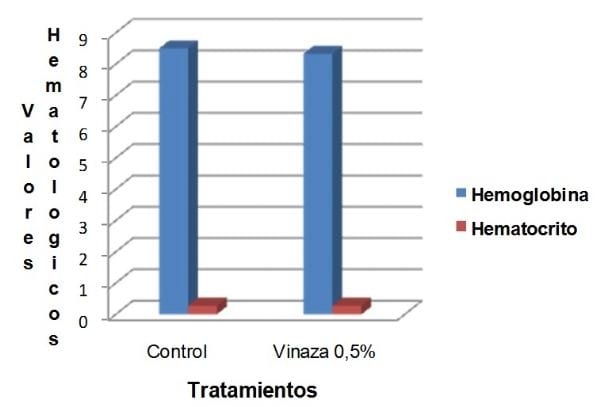
Hematological indicators (Fig. 1) are a tool to determine the state of health of the animals. In this study hematocrit and hemoglobin values were within physiological ranges reported for this species.
These results are consistent with Martínez et al. (2006), who supplied enzymatic hydrolyzed agents to replacement pullets, reporting no significant differences in the to the levels of hemoglobin among the treatments. Browder (1999) and Patchen (1999), however, determined that bioproducts such as α (1.3) glucans and other mannans have the ability to stimulate the activity of the blood cells, as well as to increase their number.
Figure 1. Effect of vinasse on the hematological indicators of broilers.
Conclusions
- The use of vinasse (0.5%) as a supplement in broiler diet does not affect the morphometry of the different segments of the gastrointestinal tract.
- The effect of vinasse did not modify the hematological values in broilers.
- The use of vinasse as a supplement in the levels indicated is feasible in broiler diets.
Bibliography
Browder SP. 1999. Nutrition World, Inc. Websdie 2501. S. Federal Higway. Fort Pierce, Florida 34982.
Brozca F, Grybusky R, Stecka K & Prieska M. 2000. Effect of two probiotics vs antibiotics on chicken broiler body weight carcass yield and carcass quality. Roczniki Naukowe Zootecniki 27:303
Devegowda BIR, Rajendra K, Morton MG. 1997. Inmunosupresión en aves causadas por aflatoxinas y su atenuación mediante S. cerevisiae (YEASACC 1026) y mananooligosacáridos (BIOMOS y Mycosorb). Séptima Ronda Latinoamericana y del Caribe de Alltech hacia el 2000. Soluciones viables para la industria de la Producción Animal.
Duncan, B. 1955. Multiple range and multiple F test. Biometrics, 11:1
García Y, Boucourt R, Acosta A, Albelo N & Nuñez O. 2007. Efecto de una mezcla de Lactobacillus acidophillus y Lactobacillus rhamnosus en algunos indicadores de salud y fisiológicos de pollos de ceba en el trópico. Rev. Cubana Cienc. Agríc. 41(1):71-74.
González C & Vergara F. 2004. Análisis del efecto de la introducción de la harina de cáscara de soya en algunos de los indicadores productivos de la ponedora. Memorias del IV Congreso de Avicultura, Stgo. de Cuba.
Lynch MJ, Raphael SS, Mellar LD, Spare PD, Inwood M. 1969. Medical Laboratory and clinical pathology. Ed. Revolucionaria. La Habana. Cuba. p. 671.
Nieto, A. 1999. Prevención primaria de la alergia alimentaria - prebióticos - tolerancia oral. An Esp Pediatr. 126:3.
Nieves D. 2006. Forrajes promisorios para la alimentación de conejos en Venezuela. Valor nutricional. Disponible en: URL:http://www.sian.info.ve/porcinos/.../viii.../duilio.htm. Consulta: 25 Oct. 2010.
NRC. 1994. National Research Council. Nutrient Requeriments of Poultry. Washington D.C.
Ojeda F & Cáceres O. 2002. Principales avances en la utilización de los subproductos agroindustriales. Rev. Pastos y Forrajes 25:21.
Onifade A. 1997. Growth performance, carcass characteristics, organs measurement and haematology of broiler chikens fed a high fibre diet supplemented with antibiotics or dried yeast. Nahrung 41(6):370-374.
Patchen SP. 1999. Nutrition World, Inc. Websdie 2501. S. Federal Higway. Fort Pierce, Florida 34982.
Sánchez A. 1990. Enfermedades de las aves. Editorial ENPES. La Habana. p. 285
Solano G, Cobos V, Fernández J, Ramírez R, Cabrales D. 2001. Elaboración y evaluación de subproductos industriales para la alimentación animal. Rev. Cubana Cienc. Agric. 33:345.
Urrutia, S. 1997. Desventajas en el inicio de la postura con un bajo peso corporal. Avicultura Profesional. 15(1):6-9.
Valdivié M. 2003. Sustitución total de cereales por azúcar crudo en gallinas ponedoras. Rev. Cubana Cienc. Agríc. 37:24-28.
Valdivié M. 2005. Alimentación de aves y cerdos con mieles y jugo de caña .En Seminario Internacional de Nutrición y Alimentación de Monogástricos y Rumiantes. ESPOCH, Riobamba, Ecuador.8-9de Junio.