Comparing mannan oligosaccharide and antibiotic responses: effects on turkey hen performance
The search for alternatives to the use of antibiotics and antimicrobial growth promoters has been encouraged by consumer fear of antibiotic residue in meat producing animals and the possible increase in bacterial resistance to antibiotics used for human therapies. Much information has been published to investigate whether consumption or association with food animals treated with antimicrobials increases the risk of antibacterial resistance. A publication entitled DANMAP 2000 records “Consumption of antimicrobial agents and occurrence of antimicrobial resistance in bacteria from food animals, foods and humans in Denmark”. Reports such as these and many others address the risk of bacterial resistance to human pathogens that can be increased by use of antimicrobial agents in commercial agriculture.
The main issue is that antibiotics used to treat specific human pathogens are also used on the farm to treat livestock. The potential selected growth of antibiotic-resistant bacteria that could infect sensitive populations has been determined to be a risk. Some human populations are immunologically challenged by cancer, chemotherapy, AIDS or other diseases that affect the immune system. In other cases, age (infants and aged populations) and other circumstances (surgical operations) might increase susceptibility to potential pathogens (Salyers, 2000).
This risk, while not based on extensive data, has been sufficiently influential in the EU to cause regulatory officials to ban particular antimicrobial growth promoters and antibiotics such as tylosin, zinc bacitracin, spiramycin and virginiamycin in 1998 for use in domestic animals (Spring, 1999). In order to maintain efficient production in commercial agriculture, other alternative treatments need to be developed and tested.
Antimicrobials are added to commercial turkey diets in order to improve livability, feed efficiency, carcass quality and growth. This has been accomplished by changing the microbiological flora in the digestive tract as well as the elimination of potential pathogens that would otherwise diminish growth productivity. One additive that has been used in recent years is mannan oligosaccharide (MOS).
A derivative from mannan in yeast cell wall, MOS has been shown to remove pathogenic bacteria (Newman, 1994) and might provide a favorable environment for nutrient utilization (Savage et al., 1997). Two experiments were conducted to determine the comparative effectiveness in turkey hens of mannan oligosaccharides added to commercial diets.
Experiment 1: virginiamycin/bacitracin vs mannan oligosaccharides
An experiment was conducted to compare a basal control diet with no antibiotics, commercial antimicrobial supplemented diet, and a mannan oligosaccharide (MOS)-supplemented diet. Nine hundred and sixty female poults were randomized into six pens (88 ft2) for the first four weeks. All pens were supplied with feed and water ad libitum.
At four weeks of age, all birds were moved into the 24 finisher pens until 12 weeks of age (40 birds/ pen). The dietary treatments consisted of the basal diet (control), the basal diet plus 55 mg/kg bacitracin MD (Alpharma Animal Health) for the first four weeks and then 22 mg/kg virginiamycin (Stafac®, Pfizer Animal Health, Inc., Exton, PA) for the 4 to 12 weeks of age (B/V), and the basal diet plus 1.0 g/kg MOS (Bio-Mos®, Alltech Inc.). All treatment groups were fed a coccidiostat (Coban®) from 8 to 12 weeks. All birds were started and maintained on bell drinkers. The design of the experiment was a three-way ANOVA design with pens serving as the experimental unit.
Experiment 2: mannan oligosaccharides vs Synermax®
The objectives of this study were to evaluate growth efficiency and performance of hen turkeys supplemented with Synermax®, a soy-based enzyme product (Abbott Labs) or MOS (1.0 g/kg) when compared to hens fed a control diet without the supplement to 13 weeks of age (16 lbs). An experiment was conducted with three dietary treatments for Nicholas hen turkeys. Eleven hundred and eighty hens were randomized into three dietary treatments (two pens per treatment) with 180 poults per pen (0.60 ft2/bird) for the first 21 days. At 21 days, birds were put into 12 pens per treatment with 90 poults (minus mortality) per pen (.98 ft2/bird) to be raised to 42 days of age. At 42 days, birds were finally placed into 24 pens per treatment with 45 poults (minus mortality) per pen (1.95 ft2/bird) to be raised to 42 days of age. Feed was changed at 3, 6, 8, and 11 wk of age. Samples of each diet, feed intake, feed conversion and body weight measurements were taken at each feed change.
All birds were started on nipple drinkers, feeder flats, and hanging feeders. Feed and water were provided free choice. Samples of the feed were analyzed at Barrow-Agee Laboratories, Inc. and compared to the calculated values. Day length was set at the following schedule: 0 to 7 days, 23 hrs light:1 hr dark, 7 to 42 days, 20 hrs light:4 hrs dark, and from 42 to 91 days, 16 hrs light:8 hr dark. Analysis of the data for the two studies was completed as a 3-way analysis of variance for a completely randomized design.
Results
EXPERIMENT 1: VIRGINIAMYCIN/BACITRACIN VS MANNAN OLIGOSACCHARIDES
No significance difference in body weights was found for the birds given diets containing bacitracin/ virginiamycin or MOS when compared with the hens fed the control diet (Table 1). However, a significant improvement was found in feed conversion (Table 2) for the birds fed MOS when compared with hens fed either the control or the bacitracin/virginiamycin (1.95) diets. Mortality at two weeks of age (Table 3) was significantly higher for the birds given MOS and the control diet compared to birds started on the antibiotic-containing diet. Birds given MOS had improved feed conversion with similar body weights as hens fed the other diets to 12 weeks of age.
Table 1.Effect of antibiotics and Bio-Mos® on body weight (g) of turkeys (Experiment 1).
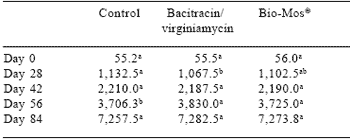
abMeans within row differ (P<0.05).
Table 2.Effect of antibiotics and Bio-Mos® on feed conversion of turkeys.
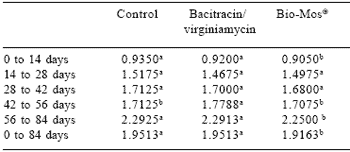
Table 3.Effect of antibiotics and Bio-Mos® on cumulative mortality (%) of turkeys (Experiment 1).
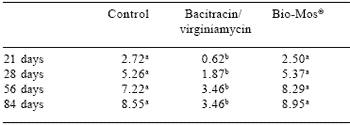
abMeans within rows differ (P<0.05).
EXPERIMENT 2: MANNAN OLIGOSACCHARIDES VS SYNERMAX®
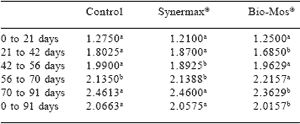
Body weight of the hens on the treated diets was significantly different at market age (Table 4) with hens supplemented with Bio-Mos® having greater body weights than hens supplemented with Synermax®, which in turn, were greater in body weight than hens fed the control diet. The hens supplemented with Bio-Mos® had significantly greater body weight at 21, 42, 56, 70 and 91 days of age. Hens given Bio-Mos® were only heavier than those given Synermax at 42, 56 and 91days of age.
Average daily gains for hens fed Bio-Mos®, Synermax® and the control diets were 0.1752, 0.1700, and 0.1671 lb/day, respectively. Early growth was thought to be inhibited by a feed ingredient quality or feed mixing problem that provided a nutritional challenge to the poults.
Table 4.Effect of Synermax® and Bio-Mos® on body weight (g) of turkeys (Experiment 2).
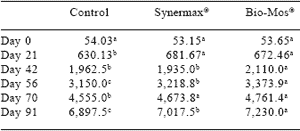
abMeans within a row differ (P<0.05).
Cumulative feed conversion (0 to 91 days) was significantly improved by feeding the Bio-Mos® supplemented diet when compared to the Synermax® or control diets (Table 5). Cumulative feed conversion was not different for those hens fed control or Synermax supplemented diets. The time periods between 21 and 42 days (starter diet) and 70 to 91 days (finisher diet) showed the greatest differences in feed conversion between the diets.
Table 5.Effect of Synermax® and Bio-Mos® on feed conversion of turkeys (Experiment 2).
abMeans within a row differ (P<0.05).
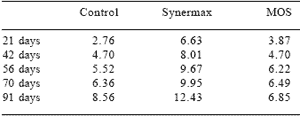
Mortality was about 2% higher than what would be considered normal with an average of 4.42% mortality at 21 days of age (Table 6). Because of lack of beak trimming, cannibalism was a problem and light had to be reduced in intensity. Because of the variability among pens, no difference in mortality between diets could be statistically determined.
However, the hens given Bio-Mos® had the highest livability (93.15 %), the Synermax®-fed hens had the lowest livability (87.57%), while the hens fed the control diet were in between with a livability of 91.44%.
Table 6.Effect of Synermax® and Bio-Mos® on cumulative mortality (%) of turkeys (Experiment 2).
Summary
When data from both studies are considered, Bio- Mos® has a beneficial effect on feed utilization in turkey hens. Hens fed Bio-Mos® were three and five points better in feed conversion when compared to those given non-supplemented diets. When challenged in Experiment 2, a difference in body weight in favor of the Bio-Mos® treatment was also found.
References
Newman, K.E. 1994. Mannan-oligosaccharides: Natural polymers with significant impact on the gastrointestinal microflora and the immune system. In: Biotechnology in the Feed Industry: Proceedings of Alltech’s 12th Annual Symposium (T.P. Lyons and K A. Jacques, eds), Nottingham University Press, Nottingham, UK, pp. 47-54.
Salyers, A. 2000. Why poultry producers should worry about bacterial sex. Poultry USA, February, Watt Publishing, pp. 22-25.
Savage, T.F., E.I. Zakrzewska and J.R. Andreasen. 1997. The effect of feeding mannanoligosaccharide supplemented diets to poults on performance and morphology of the small intestine. Poultry Sci. 76 (Suppl. 1):139.
Spring, P. 1999. The move away from antibiotic growth promoters in Europe. In: Biotechnology in the Feed Industry: Proceedings of Alltech’s 15th Annual Symposium (T.P. Lyons and K.A. Jacques, eds), Nottingham University Press, Nottingham, UK, pp. 173-183.
Author: R. MICHAEL HULET
Department of Poultry Science, Pennsylvania State University, University Park, PA, USA






FIGAP MEXICO 2026 - INTERNATIONAL EXHIBITION

Adisseo – a Bluestar Company




Life Rainbow

LIPTOSA