Check out what is new in Aquaculture
Find the best technical articles, forums, and videos on Aquaculture at Engormix. Enter now and interact with the world's largest agricultural social network.
Efficient grain and forage management has become a critical factor for profitability and sustainability in the agro-industrial and livestock sectors. Climate variability, post harvest losses, and input cost volatility are forcing companies to adopt precision technologies . In this context, smart sensors...
Comments : 0
Recommendations: 0


Dana Nelson (Famsun) shares insights now shaping next-generation extrusion solutions at Samsung. The focus: advanced extrusion technology that enhances cooking energy control, product consistency, hygiene, and operational efficiency, set to be presented at FIGAP 2026, taking place in Guadalajara, Mexico, from October 21–23. ...
Comments : 0
Recommendations: 0
Smart Agriculture and Livestock: A Data-Driven Revolution Artificial Intelligence (AI) is transforming operational decision-making by providing predictive analytics based on vast volumes of data. Technologies such as IoT sensors, drones, satellites, and thermal cameras are already generating...
Comments : 0
Recommendations: 1


Join Patricia Jazo, Director of FIGAP, as she invites the industry to FIGAP 2026, happening October 21–23 at Expo Guadalajara. A global meeting point for equipment, machinery, and now expanded nutrition—bringing the entire production chain together in one place. ...
Comments : 0
Recommendations: 5
Featured users in Aquaculture

Chris Beattie
MSD - Merck Animal Health
Global Head of Aquaculture at Merck Animal Health
United States
United States





ARLINGTON, Va. – The American Feed Industry Association (AFIA) extends its gratitude to the members who volunteer their time and expertise to serve on committees. The AFIA committees play a pivotal role in advancing the association’s mission, objectives and programs, ensuring the continued success of the animal feed and...
Comments : 0
Recommendations: 0

Introduction Aquaculture has become a vital component of global food production, contributing significantly to food security, nutritional requirements, and economic development [4]. In India, aquaculture plays a crucial role in the rural economy, with Indian major carps, particularly Rohu (Labeo rohita) and Catla (Catla catla), being predominant species in freshwater fish culture. Efficient feed management practices are essential for sustainable aquaculture, as feed constitutes...
Comments : 0
Recommendations: 1
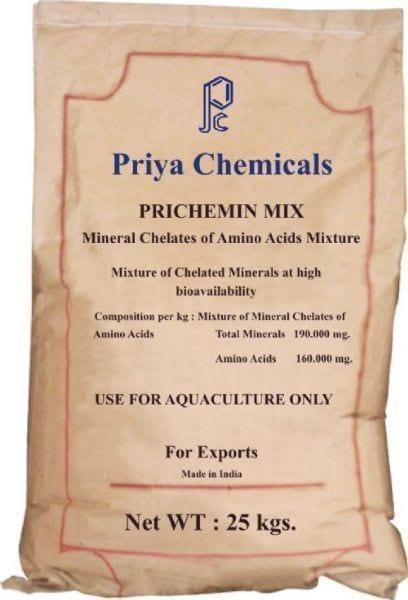

PRICHEMIN MIX
Priya's PRICHEMIN MIX is a mineral supplement for aquaculture. It consists of a mix of mineral chelats from aminoacids
Suggested link
Introduction Fish or any animal needs an adequate balanced diet that contains all the required necessary essential nutrients to have optimal growth. These nutrient requirements vary from species to species, sex, age, the environment where it lives, different stages of larval development, and the health status of the species. A minimum of 35 to 45 nutrients is required for marine fish. To have the best optimal growth and reduce pollution in the environment a thorough knowledge of...
Comments : 0
Recommendations: 0
Introduction Indian giant carps (IMCs), along with fish species such as Catla catla, Labeo rohita and Cirrhinus mrigala, are economically important freshwater fish species widely cultivated in the Indian subcontinent They are highly valued for their meat quality, fast growth rate, and adaptability to various environmental conditions. The cultivation of IMCs plays a crucial role in the aquaculture sector, contributing significantly to food security and livelihoods in the region....
Comments : 0
Recommendations: 1
FIGAP 2026: The Scientific And Technological Exhibition Of The Livestock Industry
Suggested link


.jpg&w=3840&q=75)
Dr. S. Nandakumar, Formulator at Cargill India, specializes in custom shrimp and fish feed formulations. He shares insights on India's rapidly growing aquaculture sector, driven by innovation, government support, and rising consumer demand....
Comments : 2
Recommendations: 0


.jpg&w=3840&q=75)
Dr. Charles Starkey (North American Renderers Association - NARA) talks about the sustainable contribution of amino acids from animal proteins vs. marine proteins for livestock...
Comments : 0
Recommendations: 0
PRICHEMIN MIX
Priya's PRICHEMIN MIX is a mineral supplement for aquaculture. It consists of a mix of mineral chelats from aminoacids
Suggested link


Introduction Creatine (essential for energy metabolism) and glutathione (GSH; an important non-enzymatic antioxidant) are major metabolites of glycine [the simplest amino acid (AA)] in animals (Fig. 1). Specifically, arginine:glycine amidinotransferase (AGAT) and guanidinoacetate N-methyltransferase (GAMT) convert glycine into creatine in the presence of arginine and methionine, whereas γ-glutamylcysteine synthetase and glutathione synthetase catalyze the formation of GSH...
Comments : 1
Recommendations: 0

Short Answer: Rendering is Recycling It’s a process that repurposes co-products(also called by-products) that would otherwise go to waste from the “meat we don’t eat.” By rendering specific materials that many North American consumers would consider inedible, such as certain fats, bones and proteins, renderers provide...
Comments : 0
Recommendations: 1
FIGAP 2026: The Scientific And Technological Exhibition Of The Livestock Industry
Suggested link
Rendering involves repurposing animal co-products that would otherwise be discarded. It converts the parts of a meat animal we choose not to eat into stable, usable materials such as fuel, pet food, and livestock feed, creating a highly sustainable alternative. Below, learn more about products made from rendered materials in detail. You can discover...
Comments : 0
Recommendations: 1

Aquaculture, the cultivation of aquatic organisms, is experiencing a technological evolution with the integration of Artificial Intelligence (AI). This dynamic synergy holds the potential to redefine and optimize various aspects of aquaculture, from resource management to environmental sustainability. One key player in this transformative landscape is ChatGPT, a cutting-edge AI language model. In this article, Bhusan Chettri delves into the multifaceted ways in which AI, and specifically...
Comments : 5
Recommendations: 0
PRICHEMIN MIX
Priya's PRICHEMIN MIX is a mineral supplement for aquaculture. It consists of a mix of mineral chelats from aminoacids
Suggested link


Introduction The feeds for fish can be categorized as floating feeds, slowly sinking feeds, and sinking feeds. Each of these types of feeds are either made by exploring different types and amounts of ingredients, for instance, by controlling starch levels in the feed formulations or by varying the processing parameters, for instance, by modifying the screw profile, changing the screw speed, etc. Floating feeds are mainly made using an extrusion process whereas sinking feeds are...
Comments : 2
Recommendations: 1
The COVID-19 pandemic and its aftermath brought the aquaculture industry no shortage of turbulence, logistic obstacles and market disruptions. Despite these challenges, the aquaculture industry persevered and came out strong thanks to its collective high resilience and adaptability during this period. Our Zinpro® team had the pleasure of hosting a webinar session with Gorjan Nikolik, senior industry analyst from Rabobank, to discuss a detailed industry outlook for the year 2023. He...
Comments : 0
Recommendations: 1
FIGAP 2026: The Scientific And Technological Exhibition Of The Livestock Industry
Suggested link

Introduction Animal production relies on the supply of nutritious feeds supporting high growth, welfare and health of animals and the production of high-quality products in an environmentally sustainable and profitable manner. With feed cost representing 50 to 80% of the total production cost, feed manufacturers have a very important role in the overall economic viability of animal agriculture enterprises. Animal production involves a complex “nutritional supply...
Comments : 3
Recommendations: 2

Introduction Early fish development is the most important thing that should be known before producing any seeds, especially in the new cultured species or strain. Generally, early development is divided into egg, larvae and juvenile, whereas mostly fish embryos develop from transparent eggs [1] . According to Kendall et al. [2], the egg stage is divided into early, middle and late subdivisions, which end with blastopore closure, freeing of the tail bud from the yolk, and...
Comments : 0
Recommendations: 0
PRICHEMIN MIX
Priya's PRICHEMIN MIX is a mineral supplement for aquaculture. It consists of a mix of mineral chelats from aminoacids
Suggested link
.jpg&w=3840&q=75)
Rob Strathman (Famsun) discusses how to achieve safe and efficient production of aquafeed and pet food, during FIGAP 2022 in Guadalajara, Mexico....
Comments : 0
Recommendations: 2
.jpg&w=3840&q=75)
Joe Kearns (JPK Consulting) discusses different factors involved in the production of aquafeed, during FIGAP 2022 in Guadalajara, Mexico....
Comments : 1
Recommendations: 1